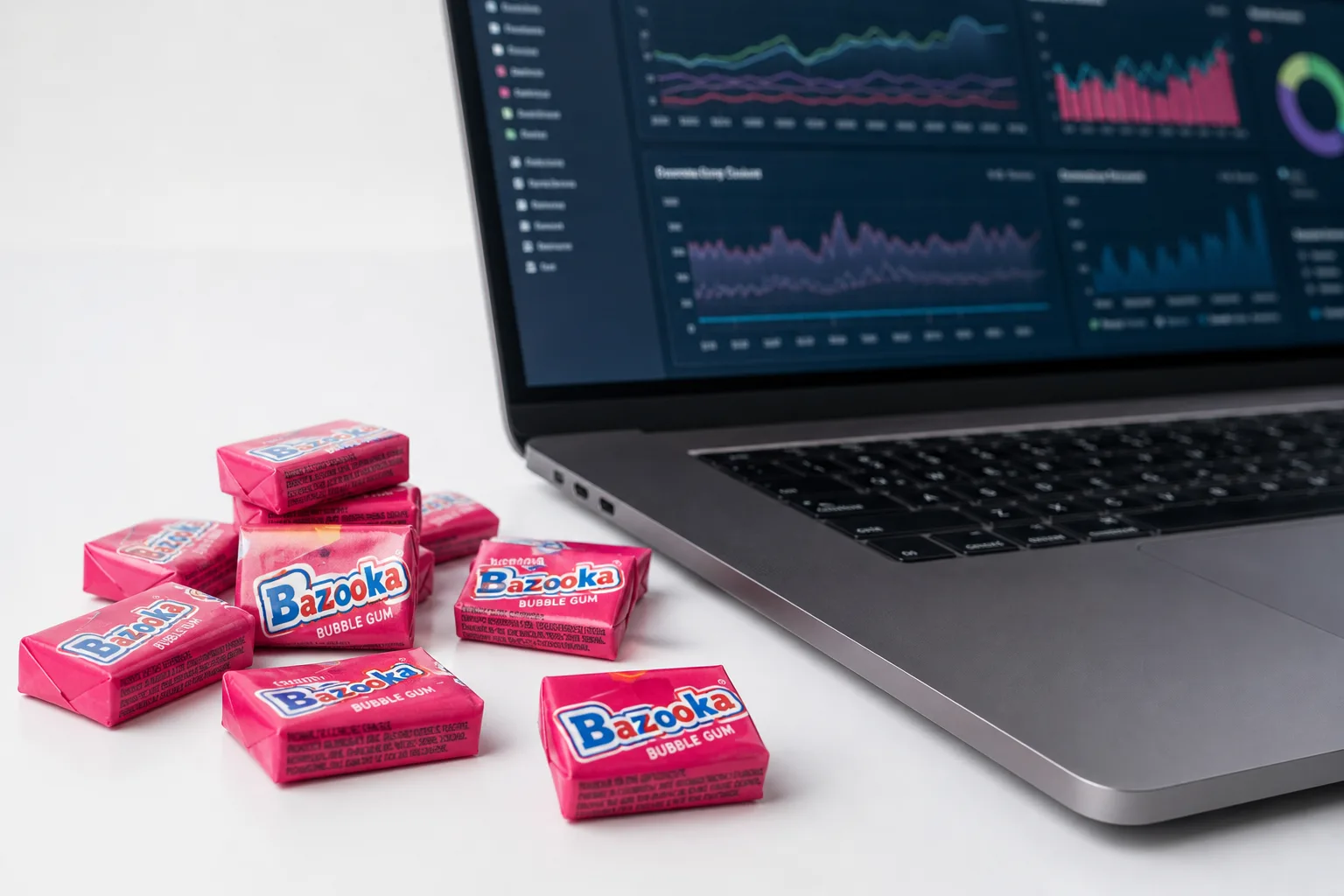
- Bazooka AI strategy is helping the iconic gum brand modernize operations amid a challenging candy market.
- The Bazooka AI strategy spans supply chain, demand forecasting, and consumer marketing — not just one department.
- Gum category sales have been declining for years, putting pressure on legacy brands to find new efficiency gains.
- Bazooka’s CIO is treating AI adoption as a business-wide shift, not a tech team side project.
Table of Contents
An Unlikely AI Story, Hiding in Plain Sight
When you think about companies leading the charge on artificial intelligence, Bazooka probably isn’t the first name that comes to mind. But the Bazooka AI strategy quietly taking shape inside Bazooka Candy Brands — the company behind that iconic pink bubble gum and Ring Pop — might be one of the more interesting enterprise AI stories in the consumer packaged goods space right now. The brand’s CIO is pushing AI deep into the company’s operations, and the timing is no accident.
The candy industry isn’t exactly booming. Gum in particular has been in a slow, steady decline for well over a decade. Statista data on global chewing gum market trends shows the category has been squeezed by shifting consumer habits, reduced impulse purchases (those checkout lane sales that once drove enormous volume), and increased health consciousness. If you’re running a legacy candy brand in that environment, standing still isn’t an option.
So Bazooka is doing what a surprising number of traditional consumer brands are quietly doing: betting on AI to find efficiency, sharpen decision-making, and stay competitive in a world that’s increasingly unkind to legacy confectionery names.
What the Bazooka AI Strategy Actually Looks Like
The Bazooka AI strategy isn’t a single project — it’s a series of interconnected bets across the business. According to reporting from Fortune, the company’s CIO has been threading AI tools through multiple functions: supply chain management, demand forecasting, and consumer-facing marketing are all in scope.
That’s notable because a lot of companies at this stage of AI adoption are still running isolated pilots — a chatbot here, an analytics dashboard there. Bazooka appears to be trying to do something more connected. The ambition is to let data and AI models inform decisions across the business in a more unified way, rather than having each department operate on its own information island.
Demand forecasting is probably the area where the ROI case is most obvious. For a candy company, getting inventory wrong is expensive. Too much product sitting in a warehouse ties up capital. Too little means you miss shelf space at the exact moment a retailer wants it. AI-driven forecasting, trained on historical sales data, seasonality patterns, and broader consumer trends, can meaningfully reduce that guesswork. Companies like Unilever and Procter & Gamble have spent years and billions building out this kind of predictive infrastructure. Bazooka is trying to get there faster, with leaner resources.
On the marketing side, the Bazooka AI strategy seems focused on getting smarter about where and how the brand speaks to consumers. Nostalgia is a real asset for Bazooka — the brand has serious heritage — but nostalgia alone doesn’t sell gum to a 22-year-old who’s never been near a checkout-lane candy rack. AI tools that help the company identify audience segments, personalise messaging, and measure campaign effectiveness more precisely are genuinely useful here.
The Headwinds Are Real
None of this AI investment happens in a vacuum. The candy industry is facing genuine structural pressure, and gum specifically is struggling in ways that go beyond typical cyclical softness.
The post-pandemic collapse of impulse purchases hit gum harder than almost any other confectionery category. When people stopped commuting, stopped passing through airports, and stopped standing in checkout queues, gum sales fell off a cliff. The category has recovered somewhat, but it hasn’t returned to its pre-2010 peak, and there’s a reasonable argument that it never will. Consumers have shifted toward functional wellness products, and traditional sugar gum occupies an awkward position — it’s not healthy enough to ride the wellness wave, and it’s not indulgent enough to compete with premium chocolate.
Wrigley, now part of Mars, and Mondelez with its Trident and Dentyne brands have the scale to weather this. Bazooka doesn’t have that same cushion. Which is exactly why the Bazooka AI strategy matters beyond the company itself — it’s a case study in how mid-sized legacy brands try to punch above their weight using technology when they can’t win on raw scale.
The CIO’s Broader Vision
What’s interesting about the way Bazooka is approaching this is that the CIO is framing the Bazooka AI strategy not as a cost-cutting exercise, but as a capability-building one. That distinction matters. A lot of companies reach for AI first when they want to reduce headcount or trim operational fat — and while efficiency gains are real, that framing tends to produce narrow, defensive deployments.
Building capability means asking different questions: How do we make better decisions faster? How do we understand our consumers in ways we couldn’t before? How do we move from reactive to predictive across our supply chain? Those questions tend to produce broader, more durable AI programmes — even if they’re harder to sell internally in the short term.
For a brand that lives and dies on whether kids and nostalgic adults decide to pick up a pack of gum or a Ring Pop, better decisions faster is actually a pretty meaningful competitive advantage.
What Other CPG Brands Can Learn From This
Bazooka isn’t alone in this journey, but it’s an instructive example because of its scale. Most CPG AI coverage focuses on the giants — the Nestlés, the Krafts, the Coca-Colas of the world — companies with entire data science divisions and multi-million dollar technology budgets. The Bazooka AI strategy shows that meaningful AI adoption is accessible below that tier too, provided the leadership has clarity about what they’re actually trying to solve.
The risks are real as well. AI models are only as good as the data they’re trained on, and smaller brands often have messier, thinner historical data than their larger rivals. Getting the data infrastructure right before throwing models at it is unglamorous work, but it’s the work that determines whether an AI programme actually delivers or just produces confident-sounding nonsense at scale. Ultimately, the Bazooka AI strategy is a reminder that disciplined data foundations matter as much as the models built on top of them.
The broader trend here is unmistakable: AI is moving out of tech companies and deep into traditional industries, and the brands that treat it as a serious operational capability — rather than a press release — are going to build meaningful advantages over the next five years. Bazooka’s bet is that gum and candy can get smarter. Given the alternative, it’s hard to argue with the logic.