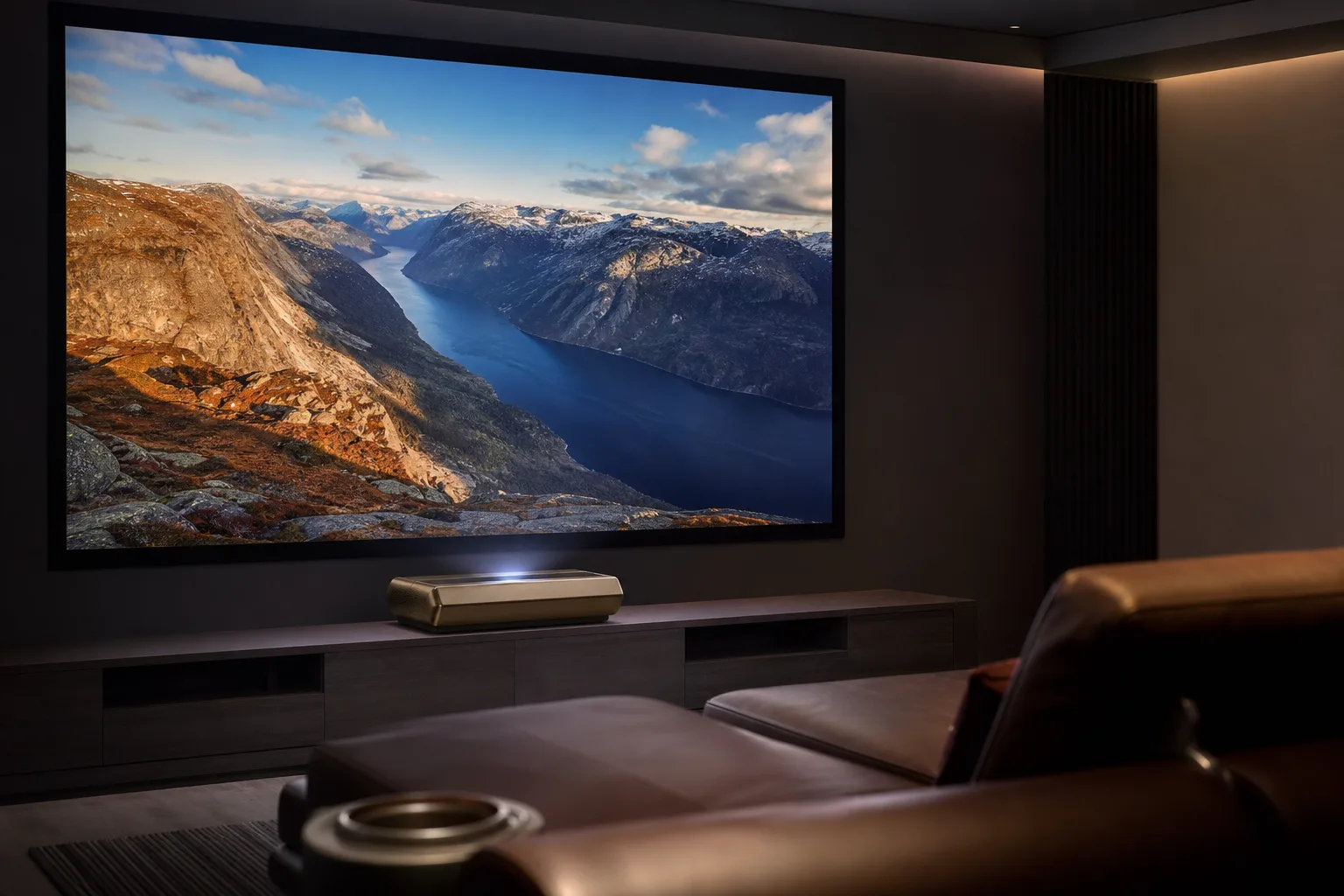
- The Hisense L9Q short-throw projector delivers a rated 5,000 ANSI lumens that holds up in real-world daytime viewing conditions.
- The Hisense L9Q short-throw projector fits a 120-inch screen in tight spaces while sitting just 16 inches from the wall.
- Improved motor focus and a new Digital Laser Engine 2.0 make picture quality a clear step up from its predecessor, the PX4-Pro.
- A subtle ticking noise during 1080p upscaling and Dolby Vision’s natural dimming are the two main trade-offs to know about.
Table of Contents
The Hisense L9Q Short-Throw Projector Makes a Strong First Impression
The Hisense L9Q short-throw projector is the kind of product that makes you wonder why anyone still mounts a flat panel on a wall. After spending extended time with it in a dedicated theater setup, one thing is obvious: Hisense has been doing this long enough that it really shows. The company is one of the most prolific names in the ultra-short-throw space, and the L9Q doesn’t just coast on that reputation — it builds on it meaningfully.
Ultra-short-throw projectors aren’t a novelty anymore. The early UST market was plagued with washed-out colors, fussy calibration, and optics that couldn’t quite match the promise on the box. That era feels well behind us now. Brands like Hisense, Samsung with its The Premiere lineup, and Epson have collectively matured the category to the point where a serious home cinema setup no longer requires a ceiling mount, a blacked-out room, or a dedicated projector screen that costs more than a used car.
Hardware Design: Looks Better Than It Has Any Right To
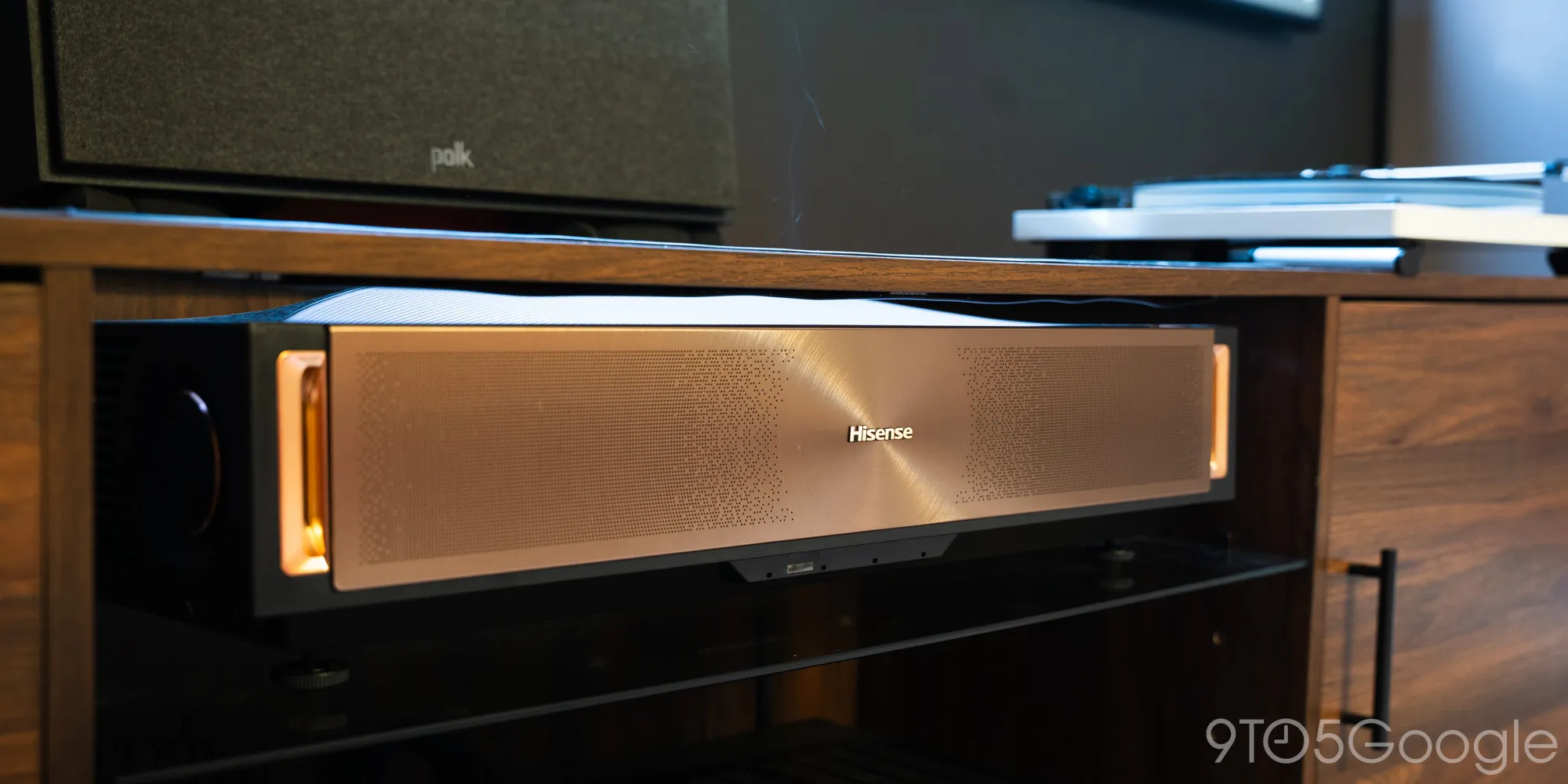
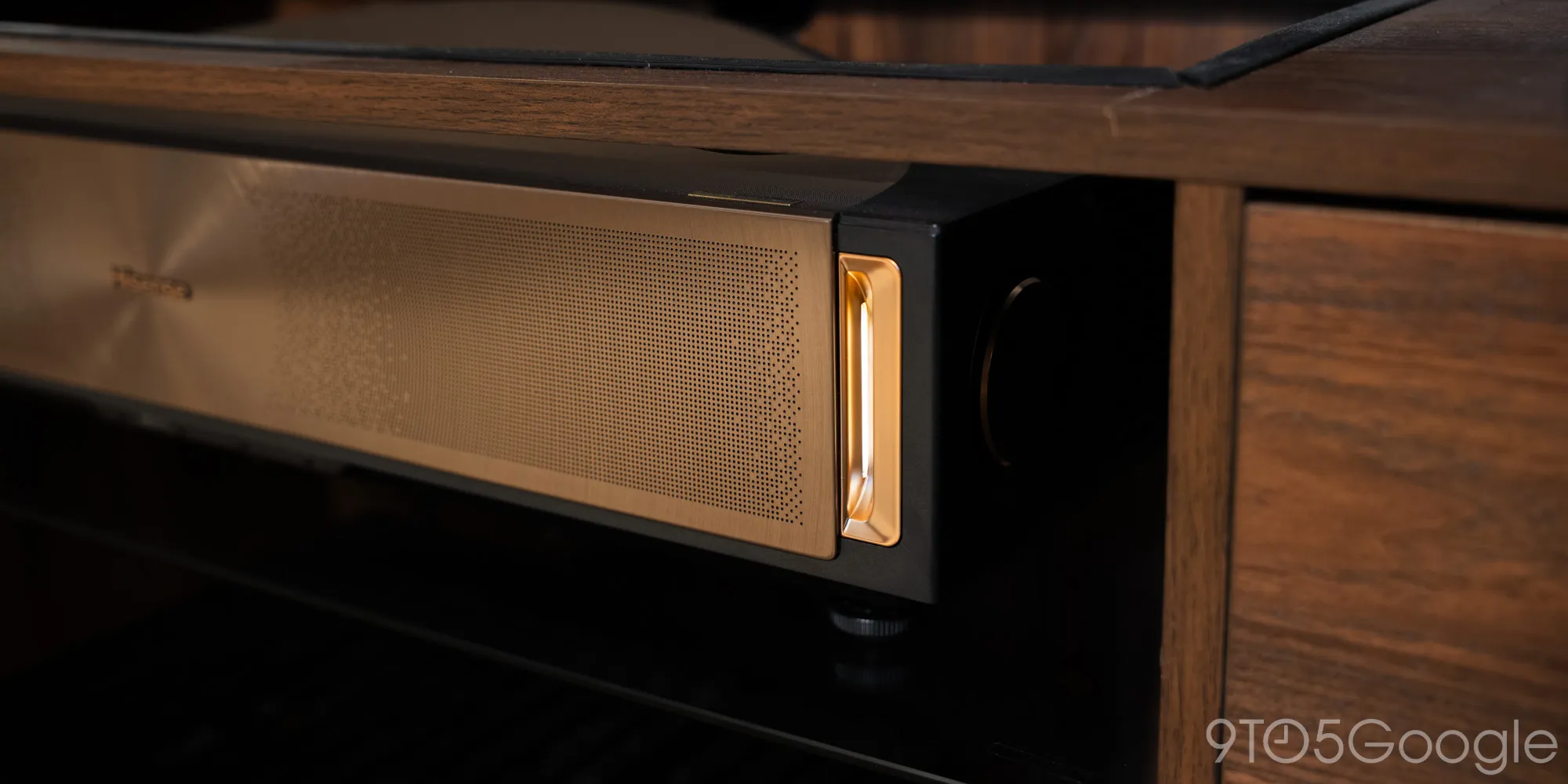
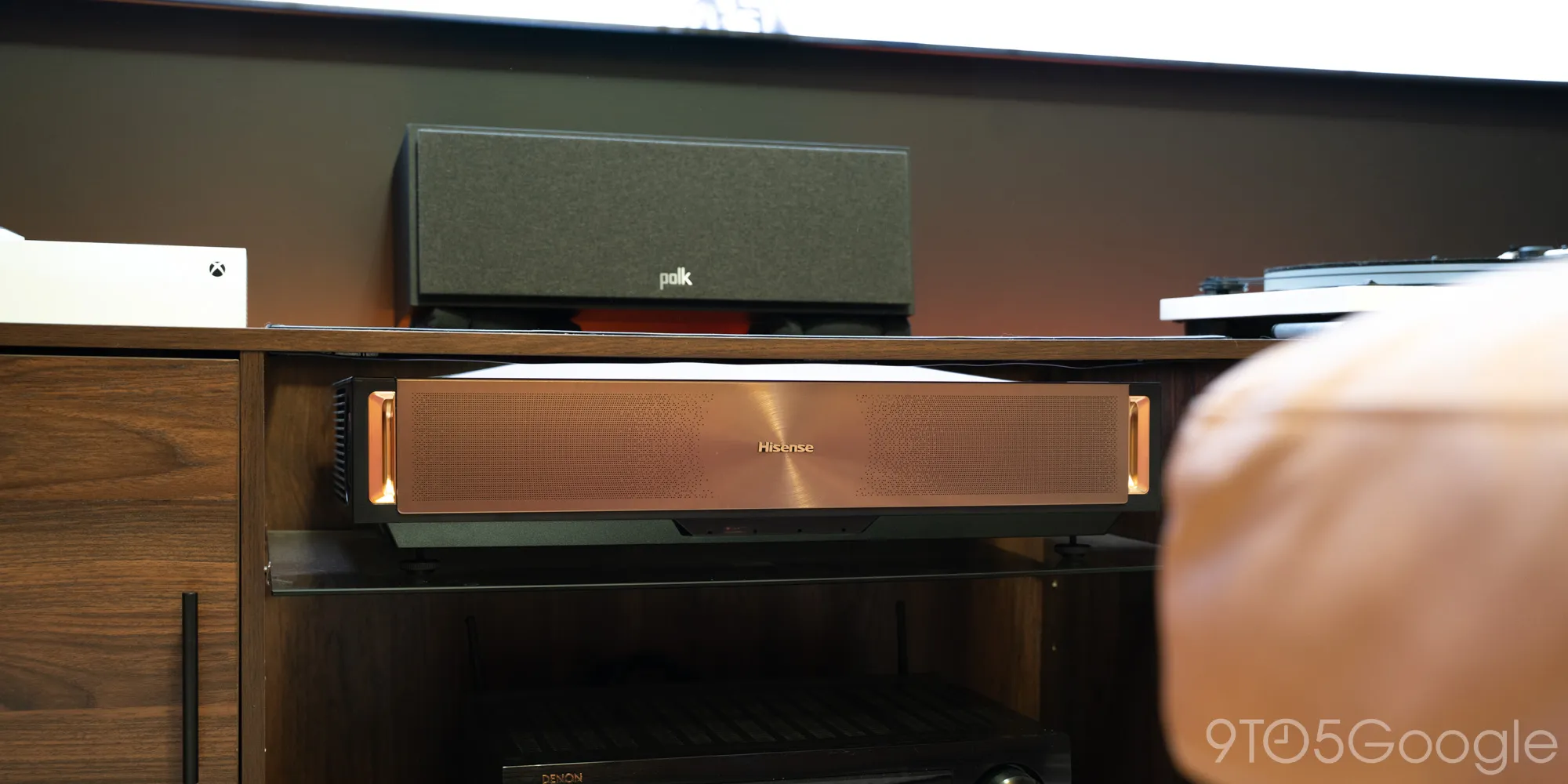
Projectors have historically been utilitarian objects — grey or black boxes you tolerate because the picture they produce is worth it. The Hisense L9Q short-throw projector takes a different approach. Its gold-toned facade with a textured faceplate is genuinely attractive, catching ambient light in a way that feels intentional rather than accidental. Two orange LEDs on either side pulse softly in standby mode. It sounds like a gimmick, but in practice it gives the unit a presence on the media console that’s closer to a piece of audio equipment than a forgotten AV appliance.
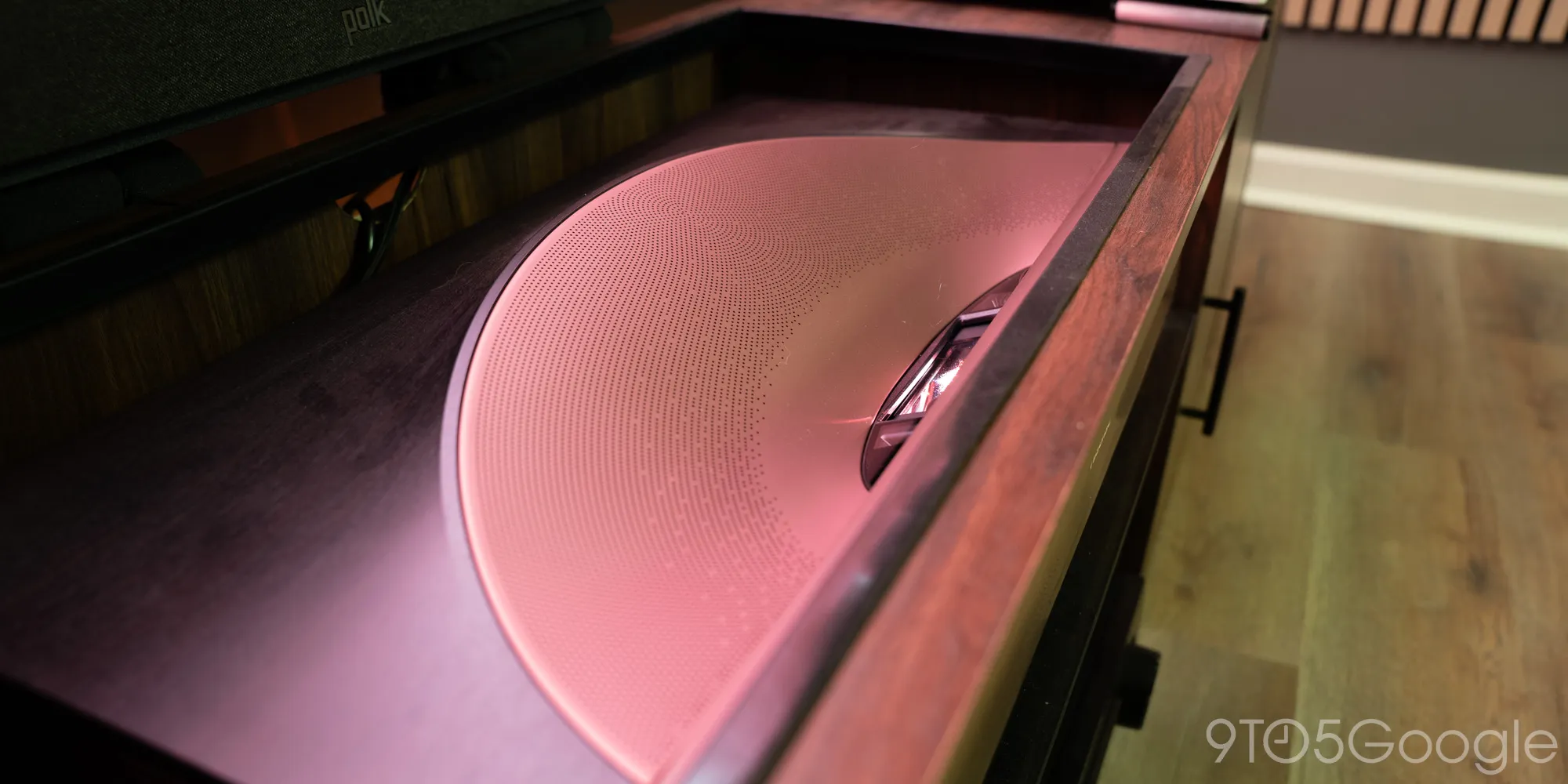
Port selection is solid. The rear panel includes both HDMI 2.1 and HDMI 2.0 with eARC, which covers most configurations. Running a single HDMI out to an AV receiver that handles an Nvidia Shield Pro, an Xbox Series S, and other sources is a completely clean and viable setup — no compromises required. Ventilation fans line the sides and rear. The unit gets warm under sustained use, but never uncomfortable to touch. Given that the internal LPU Digital Laser Engine 2.0 is pushing an RGB triple laser light source covering 110% of the BT.2020 color space, that thermal management is doing real work.
Setup is the one area where patience pays dividends. There are four adjustable feet on the bottom to fine-tune the projection angle. The smart move is to pull the unit out from the wall incrementally until you hit your target screen size, then mark and mount the screen. With the Hisense L9Q short-throw projector positioned about 12 inches off the ground, a 120-inch screen fits cleanly above it with the projector’s lens sitting roughly 16 inches from the wall. That’s a compact footprint for a truly cinematic image size.
Picture Quality: Where Hisense L9Q Short-Throw Projector Really Earns Its Price
The headline spec is 5,000 ANSI lumens, and unlike many manufacturers who treat their lumen ratings as aspirational fiction, Hisense actually delivers here. At brightness level 8 out of 10, the image is comfortable and punchy enough for casual daytime viewing with overhead lights on — something that would have been unthinkable from a projector in this form factor just a few years ago. There’s even room to go brighter if the room demands it, though level 8 is the practical sweet spot.
Dolby Vision performance deserves its own conversation. The format is becoming increasingly common across streaming services, and the Hisense L9Q short-throw projector supports it alongside HDR10+, HDR10, and IMAX Enhanced. The trade-off — and this isn’t unique to Hisense — is that Dolby Vision aggressively controls brightness to manage contrast, which means dark scenes go genuinely dark. In a well-lit room, those scenes can wash out. That’s a Dolby Vision characteristic, not a hardware flaw. On a TV you’d run into the same issue. For controlled viewing environments, Dolby Vision on the L9Q is excellent. For a casual Sunday afternoon with the blinds open, you’ll want to switch to HDR10.
Color accuracy is one of the stronger points of the Hisense L9Q short-throw projector. Out of the box, some adjustment is needed — setting the color space to native and color temperature to Warm2 gets you to a natural, detailed image without heavy-handed calibration. Hisense also offers granular controls per content type, so SDR, HDR, and Dolby Vision content can each be tuned independently. Most users will find a comfortable baseline by setting motion to minimal and active contrast to medium. The result is clean and filmic without feeling artificially sharpened.
Focus, Upscaling, and the Quirks You Should Know About
Compared to the PX4-Pro — Hisense’s previous flagship UST — the Hisense L9Q short-throw projector shows a noticeable improvement in motor focus consistency. Corner sharpness has always been a weak point in this category, and while the very top corners still show a minor softening, the overall image is dramatically more even. For a screen this large, that’s a meaningful upgrade.
The 1080p upscaling story is interesting. Hisense appears to use a pixel-shifting approach under what it calls Ultra Sharp Mode, which smooths jagged edges on standard HD content without introducing blurring. It works well visually. The catch — and forums have picked up on this — is that the upscaling engine produces a faint ticking noise during certain content, most noticeable on streaming at 1080p and largely absent when playing back from Blu-ray. The sound is subtle: something like the fizzle of carbonation against the inside of an aluminum can. From a couch, during a show, it’s easy to miss. But once you know it’s there, you might clock it occasionally.
Fan noise, meanwhile, is far less of an issue than many competing units. The Epson LS800, for reference, is noticeably louder in a quiet room. The L9Q’s fans are audible if you’re listening for them in silence, but they don’t compete with dialogue or a film’s score.
Audio: Better Than Expected, Still Not a Replacement
The built-in speakers on the Hisense L9Q short-throw projector punch well above what you’d expect from a projector in this class. They’re genuinely better than the speakers in most mid-range flat-panel TVs, which sets a surprisingly high bar for standalone use. For a bedroom setup or a space where a full audio system isn’t practical, they’ll do the job. That said, pairing the L9Q with an AV receiver and a proper speaker configuration is where the whole experience snaps into focus. The HDMI eARC port makes that integration straightforward.
Who Should Buy the Hisense L9Q?
The Hisense L9Q short-throw projector is aimed squarely at people who want a cinematic experience without sacrificing a room to it. It’s for the homeowner who has a small-to-medium dedicated space and wants 120 inches of 4K image without ceiling mounts, long-throw optics, or a projector that sounds like a vacuum cleaner. It competes directly with Samsung’s The Premiere 9 and LG’s HU915QE, and it holds its own on brightness, color volume, and overall usability.
The minor gripes — the Dolby Vision daytime limitation, the ultra-sharp mode tick, slight corner softening — are real but none of them are dealbreakers. They’re the kind of trade-offs that exist across the entire UST category right now, and Hisense’s implementation manages them better than most. As the home cinema market continues shifting away from wall-mounted panels toward compact projection systems, the Hisense L9Q short-throw projector is a clear signal of where the quality ceiling currently sits — and it’s higher than it’s ever been.