
The Bitcoin price clawed its way back above $64,000 on June 12, touching an intraday high of $64,301 in a session that — for the first time in five days — actually had institutional money moving in the right direction. It sounds like progress. Whether it actually is depends entirely on what happens before Monday morning.
- Bitcoin price climbed to $64,301 on June 12 as spot ETF inflows returned positive after four straight outflow sessions.
- The Bitcoin price must hold $64,000 through the weekend to confirm a real recovery rather than a short-lived relief bounce.
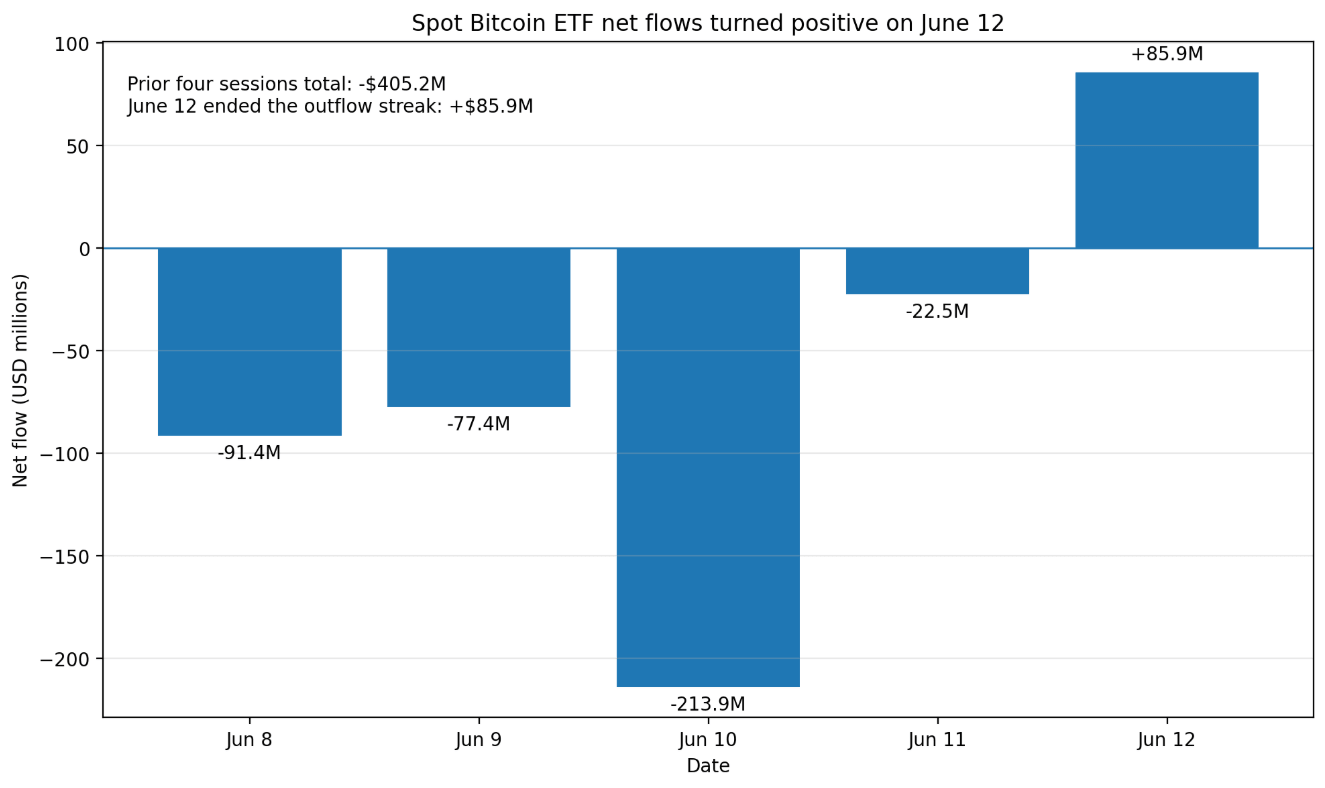
- Spot Bitcoin ETFs recorded $85.9 million in net inflows on June 12, reversing over $405 million in cumulative withdrawals.
- A US-Iran deal signing or Fed hawkishness could each shift the Bitcoin price dramatically when markets reopen Monday.
Table of Contents
A Fragile Recovery Built on Two Very Shaky Pillars
The Bitcoin price rebound on June 12 didn’t happen in a vacuum. Two things broke right simultaneously: spot ETF flows finally turned positive, and oil prices dropped on peace-deal optimism between Washington and Tehran. Either of those factors, on its own, might have been enough for a modest relief bounce. Together, they pushed BTC to its best level in days. The problem is that both are deeply conditional — and the weekend is a long time in crypto.
On the ETF side, Farside Investors data shows $85.9 million in net inflows on June 12. That ends a four-session outflow run that pulled more than $405 million out of the spot ETF complex since early June. In isolation, $85.9 million is a respectable single-day number. In context, it’s barely a down payment on what left. And critically, June 12 is the last institutional flow print before Monday’s open. Whatever happens over the weekend — geopolitical, macroeconomic, or otherwise — the Bitcoin price absorbs it without any fresh demand signal from Wall Street’s ETF desks.
That’s the structural exposure that makes this weekend more tense than most. Equities and commodity futures close. Bitcoin doesn’t. A 24/7 market facing a 48-hour news window with no institutional circuit breaker is a setup that has burned bulls before.
Iran, Oil, and the Peace Trade’s Durability Problem
Brent crude dropped toward $88 per barrel on June 12 — its lowest level in nearly two months — as signals multiplied that a US-Iran framework agreement was imminent. Pakistan’s prime minister stated publicly that a signing was expected within 24 hours. A Western source told reporters that Vice President JD Vance and Iran’s parliament speaker could formally sign an initial deal as early as June 14 in Geneva. That’s a remarkably specific timeline, and markets priced it in fast.
But here’s the part that should give any Bitcoin bull pause: even as that optimism peaked, US forces shot down multiple Iranian one-way attack drones heading toward the Strait of Hormuz. CENTCOM confirmed all drones were intercepted and that commercial traffic through the strait continued flowing. The peace trade’s durability was on full display — a deal that both sides describe as imminent can still generate live military exchanges within hours of the most positive headlines. That’s not a stable foundation for sustained risk appetite.
The oil market’s own fragility compounds this. According to LSEG data, Brent crude open interest has fallen nearly 17% this year as investors exit a market they now consider too volatile and unpredictable to hold meaningful positions in. Thin positioning means oil-driven macro moves land faster and with less cushion than they would in a liquid, well-hedged market. The Bitcoin price, which is trading as a risk asset in this environment, absorbs those moves in real time around the clock while equities sit closed. It’s an asymmetric exposure that rarely ends well for the side holding the bags over a news-heavy weekend.
A clean peace signing on June 14 — with oil dropping further and risk sentiment genuinely improving — sets up the Bitcoin price to test the $65,500–$66,000 zone when markets reopen Monday. That’s the range where the bounce starts to look more structural rather than reactive. Conversely, any breakdown in the deal text, a fresh military exchange near Hormuz, or a statement from President Donald Trump walking back the timeline would likely send oil back above $90 and hit risk assets hard before ETF desks can respond.

Bitcoin Price vs. The Fed: Higher for Longer Is Back on the Table
Even if the weekend delivers a clean peace signing and oil slides further, Bitcoin price still faces the Federal Reserve’s June 16–17 meeting on the other side of Monday. The Fed has kept rates at 3.50%–3.75% since March and is broadly expected to hold again. That part isn’t the risk. The risk is the language around what comes next.
Headline CPI came in at 4.2% year-over-year in May. One-year inflation expectations are sitting at 4.6%. Consumer sentiment improved in June as gasoline prices eased — which is itself partly a function of the same Iran peace optimism that lifted BTC — but the underlying inflation print gives the Fed very little room to soften its tone. Markets are increasingly pricing in the removal of the Fed’s easing bias at this meeting: an explicit signal that the next rate move, if it comes, would be a cut rather than a hike, but that it won’t be coming anytime soon.
For Bitcoin, this matters because the current bounce from sub-$60,000 lows has been partly a macro relief trade. The same falling energy prices and peace optimism that reduced inflation anxiety gave crypto a lift. If the Fed doubles down on higher-for-longer at its June 17 statement and strips out any language hinting at near-term easing, that relief evaporates. The Bitcoin price would then need sustained, conviction-driven ETF inflows — not just a one-day $85.9 million blip — to hold $64,000 and push through the resistance zone above it.

Bull and Bear Cases Heading Into Monday
The bull case is actually pretty clean. A US-Iran deal gets signed this weekend. Oil drops further — say, toward $85 or below. Risk appetite opens Monday morning on a genuine macro positive. ETF desks that were cautious on June 12 put real capital to work. Bitcoin price clears $65,500, the ETF reversal starts to look like the opening of a sustained institutional re-entry, and the $64,000 zone converts from contested resistance into established support. That’s not fantasy — it’s a plausible sequence if the next 48 hours go well.
The bear case is simpler and faster. One bad headline — deal talks breaking down, a fresh exchange near Hormuz, Trump publicly walking back the signing timeline — sends oil back above $90, compresses risk appetite, and returns the Bitcoin price to the $63,000 area before Monday’s ETF session even begins. At $63,000, bulls are defending a level that already failed once this week. A daily close below it would make the entire $64,000 reclaim look like a liquidity grab, and the next reference point becomes the prior panic low at $59,000–$60,000.
What makes this particularly sharp is the asymmetry of timing. Good news has to materialise and hold over two days. Bad news only needs a single headline and thirty minutes to reverse the trade. Bitcoin’s 24/7 market structure, which is often cited as a feature, is very much a vulnerability in this specific setup.

What to Watch Before Markets Open Monday
The June 14 Geneva signing — or the absence of one — is the clearest binary trigger. Watch Brent crude’s reaction as an immediate proxy for risk sentiment before Bitcoin price even moves. If oil drops below $87 on a confirmed deal, that’s a meaningful tailwind. If it spikes back above $90, BTC is likely heading back toward $63,000 before US equity futures open.
Beyond the Iran deal, the structure of Monday’s ETF flows will be telling. The June 12 inflow was the first positive day in five sessions. One day does not a trend make. If ETF desks come into Monday with sustained buying — say, back-to-back sessions of $100 million or more — that changes the calculus and suggests the institutional selling pressure that accumulated through early June is genuinely exhausting itself. Anything less, and the $64,000 hold starts to look more like a ledge than a floor.
The Fed statement on June 17 sits a couple of days out but is already casting a shadow. If the Bitcoin price holds $64,000 through the weekend and clears $65,500 Monday, it still needs to survive a potentially hawkish Fed statement midweek. The bounce from sub-$60,000 has multiple checkpoints to pass before anyone should call it a confirmed recovery. Right now, it’s passed exactly one.
Frequently Asked Questions
Why does the $64,000 level matter so much for Bitcoin price right now?
$64,000 is the contested resistance zone Bitcoin reclaimed on June 12. Holding it through the weekend would signal genuine recovery momentum. A rejection risks sending BTC back toward $63,000, and a daily close below that level would point back to the prior panic low near $59,000–$60,000.
How did spot Bitcoin ETF flows perform on June 12?
Farside Investors data shows spot Bitcoin ETFs recorded $85.9 million in net inflows on June 12, ending four consecutive sessions of outflows that totalled more than $405.2 million in net withdrawals. It was the last institutional demand signal before Monday’s open.
How could the Fed meeting affect Bitcoin price next week?
The Federal Reserve meets June 16–17 and is widely expected to hold rates at 3.50%–3.75%. The real risk is the removal of its easing bias. If the Fed signals higher-for-longer policy more firmly, risk assets including Bitcoin could face renewed selling pressure heading into the new week.
What role is the Iran situation playing in Bitcoin’s current move?
Bitcoin’s bounce to $64,301 coincided with growing optimism around a US-Iran peace framework, which pushed Brent crude toward $88 per barrel — its lowest in nearly two months. Any breakdown in those talks or a military flare-up near the Strait of Hormuz could quickly reverse the risk-on mood driving BTC higher.