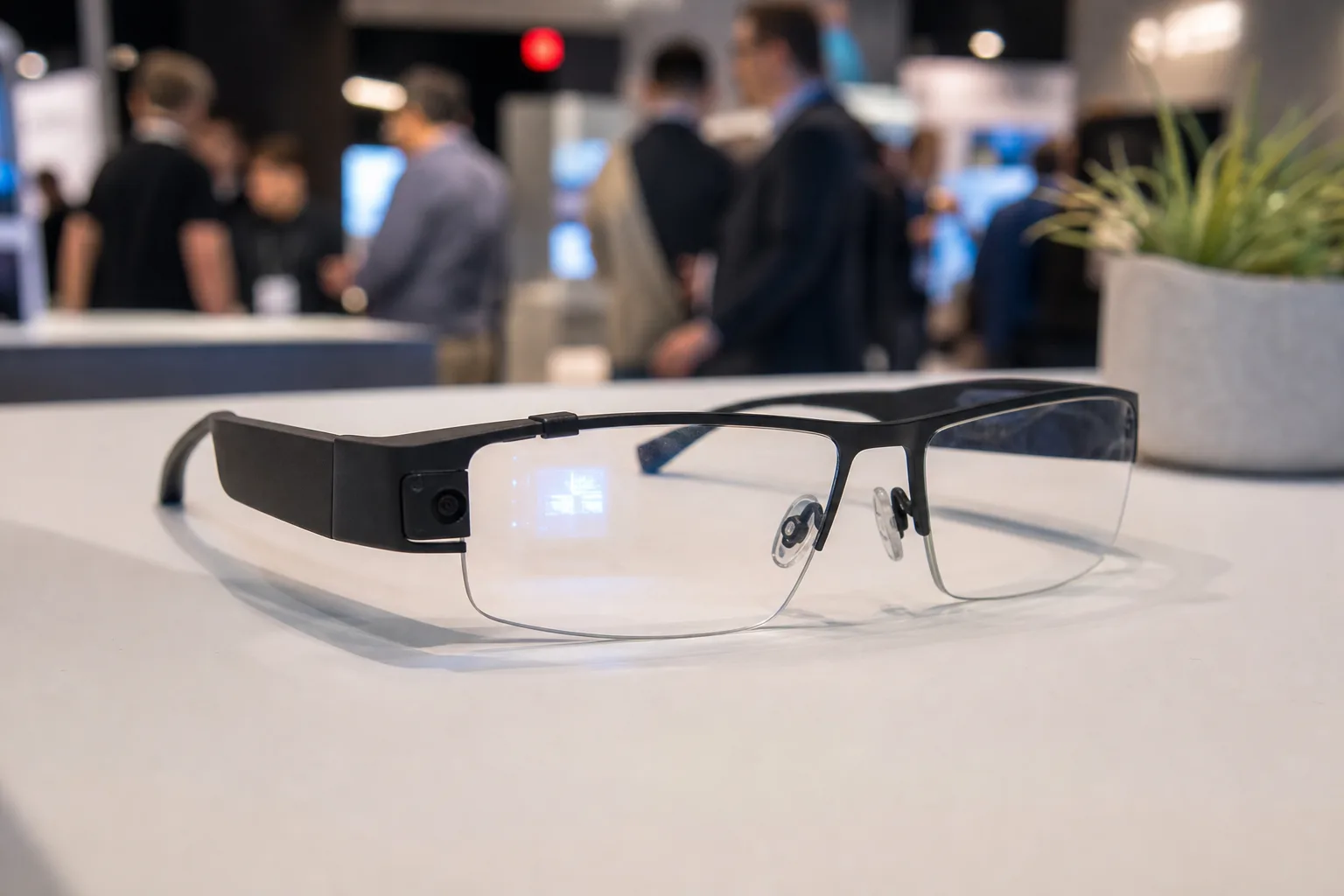
Samsung smart glasses have been the subject of leaks, rumours, and wishful thinking for a while now. But this week, the picture got a little sharper — literally. At the Augmented World Expo (AWE) 2026, Samsung Display took the wraps off a pair of prototype AR glasses built around a 0.62-inch RGB OLEDoS microdisplay, offering the clearest signal yet of where the company’s XR ambitions are heading.
- Samsung smart glasses could use a new 0.62-inch RGB OLEDoS microdisplay unveiled at AWE 2026.
- Samsung Display’s panel hits 40,000 nits, making Samsung smart glasses viable in bright outdoor conditions.
- Samsung Electronics has two separate smart glasses reportedly in development — one display-free, one with microLED lenses.
- Samsung Display hasn’t confirmed which products will use the new panel technology shown at the expo.
Table of Contents
What Samsung Display Actually Showed at AWE 2026
The star of Samsung Display’s AWE presentation was a compact prototype — a pair of AR glasses housing that tiny 0.62-inch RGB OLEDoS panel. Samsung says the display is sharp enough to render real-time translation text, navigation prompts, and weather data in a form factor light enough to wear comfortably. That’s a meaningful benchmark. Anyone who’s tried a first-generation AR headset knows that ‘wearable’ and ‘usable’ aren’t always the same thing.
Alongside the prototype glasses, Samsung Display also demonstrated a larger 1.3-inch RGB OLEDoS panel capable of hitting an eye-watering 40,000 nits of peak brightness. To put that in context, a high-end smartphone display tops out somewhere around 2,000 to 3,000 nits. AR optics lose a significant amount of light passing through the waveguide and lens system, so raw panel brightness is critical — you need headroom to spare if the display is going to stay visible in daylight conditions. Forty thousand nits is serious headroom. This is precisely the kind of display capability that Samsung smart glasses will need to succeed in real-world conditions.
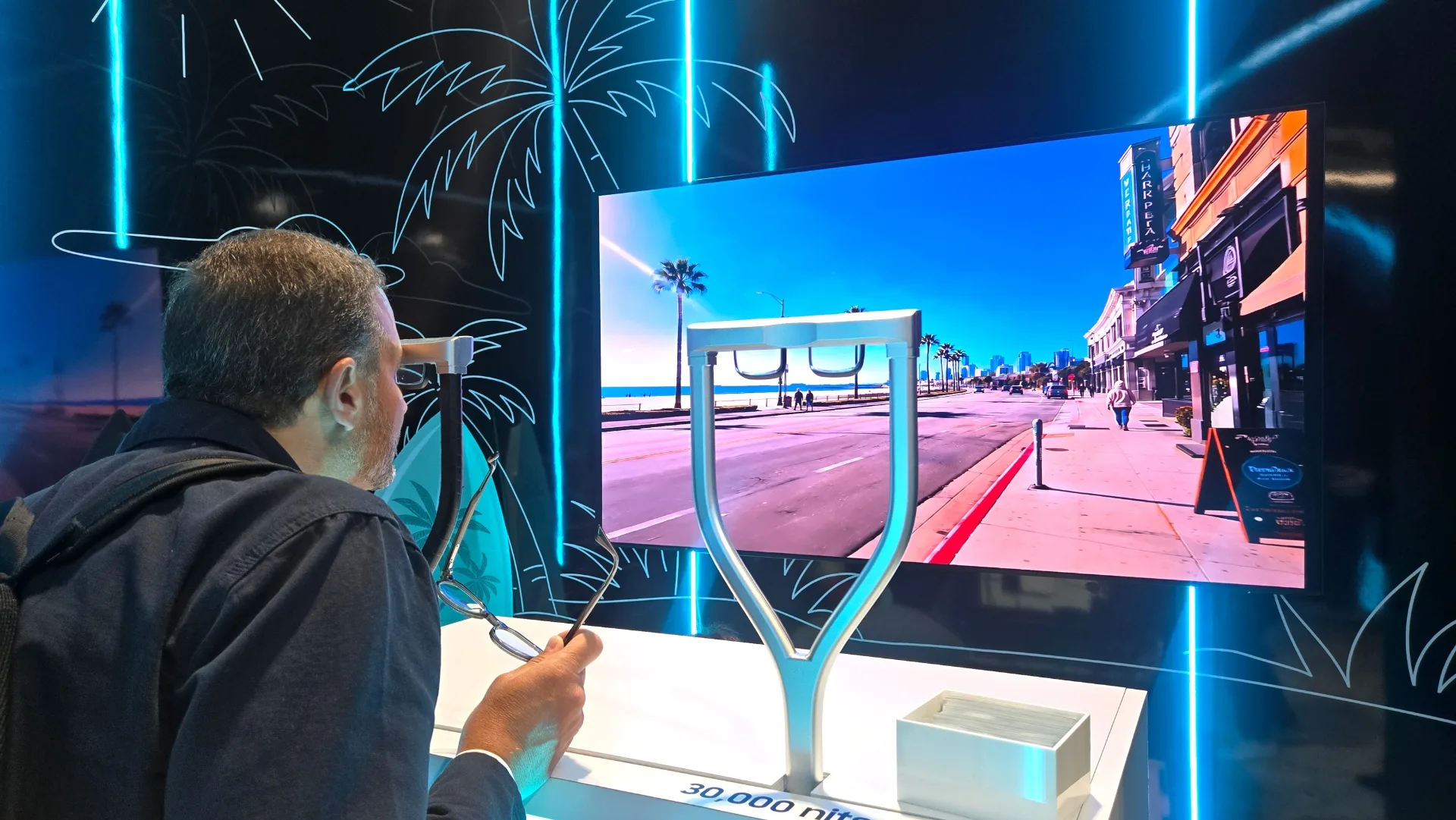
Samsung positions RGB OLEDoS as a strong fit for lightweight XR hardware specifically because of its simpler panel architecture compared to some rival microdisplay approaches. The company claims it delivers what it calls ‘excellent’ brightness, colour reproduction, and power efficiency — three factors that form the basic triangle of any wearable display design. You usually get to pick two. Getting all three at this scale would be genuinely impressive, if Samsung’s claims hold up under independent scrutiny.
Why Samsung Smart Glasses Need This Kind of Display
The challenge every AR glasses maker faces is straightforward to describe and brutally hard to solve: pack a display bright enough to compete with ambient light, sharp enough to read small text, and power-efficient enough to last a few hours — all into a package that weighs roughly what a pair of sunglasses weighs. Most current solutions involve trade-offs that make the product feel like a prototype rather than a finished consumer device. For Samsung smart glasses, clearing this bar is the difference between a niche gadget and a product people actually wear daily.
OLEDoS — OLED panels fabricated directly on silicon wafers rather than glass substrates — has emerged as one of the more promising paths forward precisely because it allows for very high pixel density in a very small physical footprint. Samsung Display isn’t alone in pursuing this; Sony has shipped OLEDoS panels for professional use in camera viewfinders, and companies like Kopin have been building microdisplays for military and industrial applications for years. But consumer-grade AR at this brightness and efficiency level is still very much an open frontier.
The RGB approach Samsung is using is also worth flagging. Many competing microdisplay designs use a white OLED with a colour filter on top — simpler to manufacture but less efficient, since you’re essentially throwing away light at the filter stage. An RGB OLEDoS uses separate red, green, and blue subpixels, which is more complex to produce but delivers better colour accuracy and doesn’t waste as much of the light you’re generating. For an AR application where every nit counts, that’s a meaningful structural advantage — and one that makes the technology a particularly compelling candidate for Samsung smart glasses going forward.

Samsung’s Two-Track Smart Glasses Strategy
Here’s where things get interesting — and a little complicated. Samsung Electronics (the consumer products division, distinct from Samsung Display) reportedly has not one but two separate Samsung smart glasses products in various stages of development, and they’re aimed at very different use cases.
The first, rumoured to simply be called ‘Glasses,’ is expected to launch on Android XR at some point this year. Based on leaked images, it adopts the Ray-Ban Meta Wayfarer-style design that Meta has clearly established as the default template for fashion-forward smart glasses. The focus here appears to be cameras, AI processing, and voice interaction — think a Samsung-flavoured answer to the Ray-Ban Meta, rather than a full AR overlay experience. There’s reportedly no built-in display in this version. Samsung smart glasses in this category would compete directly with Meta’s existing lineup on style and AI capability rather than optical performance.
The second product, codenamed ‘Haean,’ is a different proposition entirely. This one is said to include microLED displays built directly into the lenses — the kind of experience where digital information actually appears to float in your field of view. That’s the genuinely hard problem in consumer AR, and it’s the category that companies like Apple, with its Vision Pro, and Meta, with its long-running AR research programme, are all trying to crack from different angles.
The twist: current rumours suggest Haean will use microLED technology, not the RGB OLEDoS that Samsung Display just showed at AWE. Samsung Display has explicitly not drawn any line between its AWE demonstration and either of these consumer products. It’s entirely possible the displays shown this week are destined for a third-party device — Samsung Display supplies panels to other brands, and there’s no rule that says every piece of display technology it develops ends up in a Samsung Electronics product.
Reading Between the Lines on Samsung’s XR Roadmap
Even setting aside the specific product questions, the AWE demonstration tells us something important about where Samsung Display sees the market heading. The company isn’t building these panels speculatively — microdisplay development at this level of brightness and efficiency requires significant investment, and you don’t make that investment unless you see a real addressable market forming. Samsung smart glasses, in one form or another, appear to be a core part of that calculation.
The broader XR wearables industry is at an inflection point right now. Meta’s Ray-Ban smart glasses have proven that consumers will actually buy and wear AI-enabled glasses at scale, even without a display. Apple’s Vision Pro has demonstrated that people will pay premium prices for truly immersive mixed reality — but at $3,499 and nearly a kilogram on your face, it’s not a mass market product. The gap between those two extremes — glasses you’d actually wear every day that also show you something useful — is where the real prize sits, and it’s the gap that display technology like Samsung’s RGB OLEDoS is specifically designed to help close. Samsung smart glasses, whichever form they ultimately take, are positioned squarely in that gap.
Whether that technology ends up in a Samsung-branded device, a device from a brand you’ve never heard of, or something from one of the established players sourcing panels externally, the direction of travel is clear. The display problem in AR is being actively solved, piece by piece, panel by panel. Samsung just showed one of the more credible pieces yet.
Frequently Asked Questions
What display technology is Samsung using for smart glasses?
Samsung Display is showing off RGB OLEDoS panels — including a 0.62-inch prototype suited for AR glasses and a larger 1.3-inch panel reaching 40,000 nits. However, current rumours suggest the ‘Haean’ smart glasses will use microLED rather than OLEDoS displays.
When will Samsung release its first smart glasses?
Samsung is expected to launch its first Android XR-powered smart glasses sometime this year. That device is rumoured to focus on AI, cameras, and voice interaction rather than a built-in display.
What is RGB OLEDoS and why does it matter for AR wearables?
RGB OLEDoS stands for Organic Light-Emitting Diode on Silicon. Samsung says it uses a simpler panel structure than competing microdisplay tech, making it lighter and more efficient — two qualities that matter enormously when you’re wearing a device on your face.
What is Samsung’s ‘Haean’ smart glasses project?
Haean is a reportedly separate Samsung smart glasses project, distinct from the rumoured ‘Glasses’ device. Unlike the camera-and-AI-focused ‘Glasses,’ Haean is expected to feature microLED displays built directly into the lenses.