

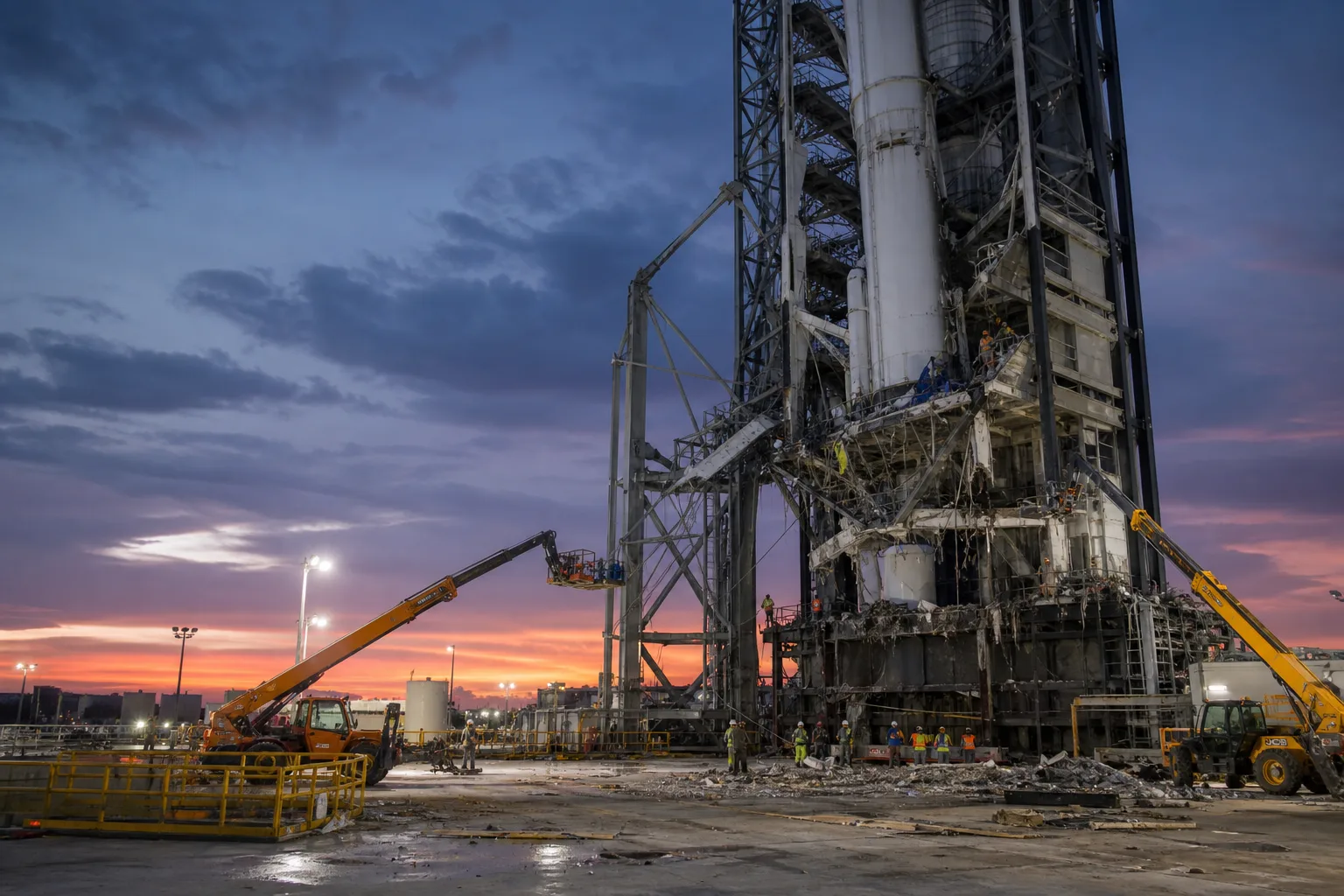
Blue Origin has a mess on its hands — literally. The New Glenn rocket exploded during a fueling test at Launch Complex-36 on May 28, sending a fireball rolling across Cape Canaveral bright enough to light up the sky for observers more than 100 miles away. It was the kind of setback that derails programs for years. But Blue Origin is betting it won’t take that long.
- Blue Origin’s New Glenn rocket exploded during a fueling test at LC-36, sending a fireball visible over 100 miles away.
- The New Glenn rocket debris was cleared from Launch Complex-36 in just nine days, faster than many comparable incidents.
- CEO Dave Limp confirmed reconstruction has begun, with a firm target to fly again before the end of 2026.
- A delayed New Glenn rocket could jeopardize Blue Origin’s role in NASA’s Artemis 3 lunar mission, targeting late 2027.
Table of Contents
Nine Days to Clear the Wreckage
On June 25, CEO Dave Limp posted a timelapse video to X showing the scale of the cleanup operation underway at LC-36. The footage compressed weeks of round-the-clock work into a few minutes — crews picking through twisted metal, clearing scorched debris, and beginning to rebuild what the explosion destroyed. Limp’s caption didn’t bury the lead: ‘Huge shoutout to the team who have been working 7×24. We have started reconstruction and still plan to fly again this year.’
What’s genuinely striking is the speed. According to Limp, all wreckage from the New Glenn rocket and the surrounding infrastructure was recovered and cleared in just nine days. That’s a fast turnaround for a launch site that experienced what appeared, from the outside at least, to be catastrophic damage. For comparison, when SpaceX’s Falcon 9 exploded on the pad at LC-40 in September 2016, similar incidents like that one have taken up to twice as long to recover from relative to Blue Origin’s nine-day debris clearance. Blue Origin is aiming to have the New Glenn rocket back in business at LC-36 within months, not years.
That said, clearing debris and actually flying a rocket are very different milestones. The cleanup is a necessary first step, but what lies ahead — structural repairs to the pad, systems checks, a new rocket vehicle — is a far heavier lift. The fact that reconstruction has already started is meaningful, but the timeline between ‘we’ve started rebuilding’ and ‘we’re ready to launch’ will be the real test for the New Glenn rocket program.
What’s at Stake for Blue Origin
This isn’t just a matter of corporate pride or investor relations. Blue Origin has a contract with NASA to provide the Blue Moon human landing system — one of the crewed lunar landers for the agency’s Artemis program. And Blue Moon is designed to ride to orbit on the New Glenn rocket. That dependency creates a hard constraint: if the New Glenn rocket can’t fly, Blue Moon can’t get off the ground, and NASA’s Artemis 3 mission — currently targeting late 2027 — faces serious complications.
Artemis 3 is the mission that’s supposed to demonstrate docking maneuvers and spacecraft interoperability ahead of future missions to land astronauts on the lunar surface. The plan involves astronauts launching aboard an Orion capsule, meeting both a Blue Moon lander and a SpaceX Starship variant in low Earth orbit, and completing docking demonstrations that prove out the interoperability of these systems before a crewed lunar landing. It’s an intricate choreography involving multiple vehicles from competing companies, and if any one piece slips, the whole timeline shifts.
SpaceX’s Starship is also part of this picture. NASA originally tapped Starship as the lunar lander for Artemis 4 and 5, but development delays prompted the agency to revisit which vehicles would actually fly the crewed landing missions. That opened a door for Blue Moon — and put both companies in a position where missing the Artemis 3 window isn’t just a schedule embarrassment. It potentially means losing out on the first crewed lunar landing contract entirely.
The New Glenn Rocket’s Troubled Road
The May explosion is the latest chapter in a development story that’s been longer and harder than Blue Origin initially projected. The New Glenn rocket, named after Mercury astronaut John Glenn, is the company’s first orbital-class vehicle — a heavy-lift rocket designed to compete directly with SpaceX’s Falcon 9 and Falcon Heavy. It completed its maiden flight successfully in January 2025, which was a significant moment for a company that spent years in the shadow of SpaceX’s rapid cadence.
But a single successful launch doesn’t mean a vehicle is operationally ready, and the fueling test explosion in May demonstrated just how much can still go wrong. Blue Origin hasn’t publicly detailed the root cause, which is standard practice during an ongoing investigation. What the company has communicated is confidence — possibly the only commodity it can offer right now while engineers dig into what went wrong.

Limp’s decision to post publicly, with video evidence of progress, is a deliberate PR move. Transparency about the cleanup — showing rather than just telling — is a way of keeping stakeholders, particularly NASA, reassured that the New Glenn rocket program is moving forward. Whether that’s enough to maintain confidence at the agency level remains to be seen, but it’s the right instinct.
Can Blue Origin Actually Hit Its 2026 Target?
The honest answer is: it’s a stretch, but not impossible. Nine days to clear debris is genuinely impressive operational execution. And Blue Origin isn’t a scrappy startup anymore — it has the financial backing of Jeff Bezos and a large engineering workforce that, apparently, is willing to work around the clock to hit a deadline.
But the physics of rocket pad reconstruction doesn’t bend to ambition. Fueling systems, structural elements, and safety certifications all take time to validate properly. If you rush any of it, you risk another accident — which would be far more damaging than missing a self-imposed 2026 launch window. The FAA’s return-to-flight process adds another layer of oversight that Blue Origin can’t shortcut, regardless of internal timelines.
There’s also the matter of the vehicle itself. Depending on how the fueling test explosion damaged the New Glenn rocket, Blue Origin may be working with a partially or fully destroyed rocket. Building or refurbishing a launch vehicle is not a weeks-long process. The company has not publicly confirmed the state of the New Glenn rocket, which is a notable gap in the information it’s shared so far.
What Blue Origin’s 2026 ambitions really signal is that the company understands how high the stakes are. With NASA watching closely, with Artemis timelines already under pressure from multiple directions, and with SpaceX continuing to operate at a cadence that makes everyone else look slow, there’s no room to treat this as a quiet setback to manage over 18 months. The pressure to move fast is real — and it cuts both ways. Move too slow, and Artemis slips further. Move too fast, and LC-36 could light up the Florida sky again.

