

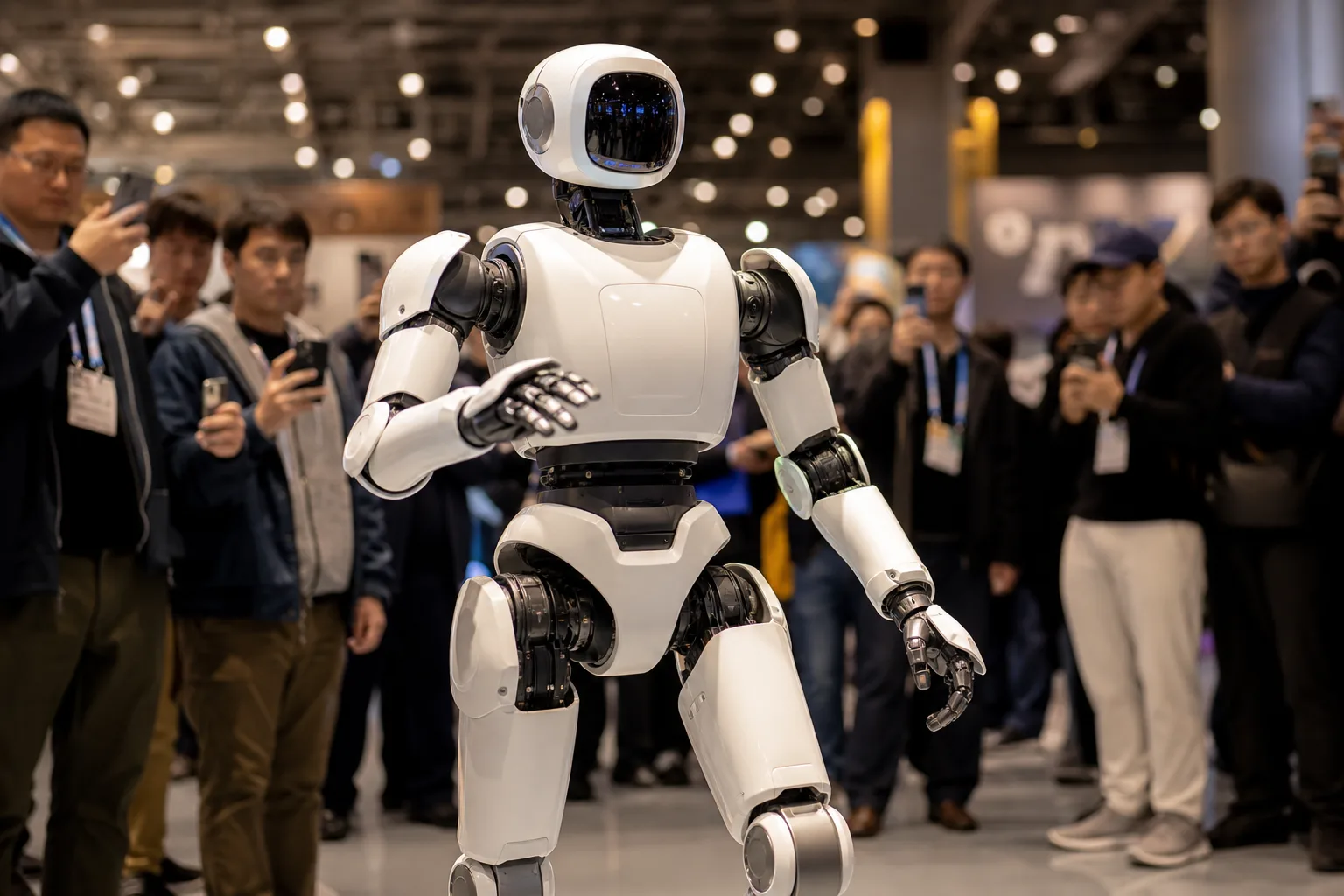
China humanoid robots have spent the past two years accumulating an impressive highlight reel. Sleek bipedal machines dancing in choreographed formations, pouring drinks at auto shows, walking factory floors — the footage has been shared millions of times and has, at least superficially, made China look like it’s pulling ahead in one of tech’s most watched races. But a quieter story has been unfolding in parallel. A rental market, where businesses and event organisers hire these robots for appearances, is offering a far less flattering view of where the technology actually stands.
- China humanoid robots have become a global spectacle, but a growing rental market is revealing significant capability gaps.
- Companies renting out China humanoid robots for events report frequent failures, limited autonomy, and heavy reliance on remote operators.
- Despite the hype, most humanoid robots on the market today can only perform narrow, pre-scripted tasks reliably.
- China’s robotics push is state-backed and fast-moving, but commercial viability remains a serious open question.
Table of Contents
The Rental Boom and What It’s Exposing
Over the past year, a cottage industry has emerged in China around renting humanoid robots for trade expos, product launches, and corporate events. It sounds futuristic on paper. In practice, operators and renters are discovering that the gap between a polished promotional video and a robot that can reliably function in an uncontrolled environment is enormous.
Rental companies are reporting a recurring set of problems. Robots stumble on uneven flooring. They struggle with anything outside their narrow pre-programmed task list. And perhaps most tellingly, most units in the field require a human operator — sometimes multiple — monitoring and occasionally guiding them remotely in real time. That’s not autonomy. That’s a very expensive puppet show.
None of this is a secret to anyone actually working in robotics. The disconnect is between what’s being communicated to the public and investors, and what’s happening on the ground. China humanoid robots have been showcased in settings carefully designed to make them look capable. The rental market doesn’t offer that luxury — it puts these machines in front of real crowds, in real venues, with real consequences when something goes wrong.
A State-Backed Industry Running Very Fast
To understand why the hype has run so far ahead of the reality, you have to understand the structure of China’s robotics industry. This isn’t a purely market-driven phenomenon. Beijing has explicitly identified humanoid robotics as a strategic national priority, with government-backed funding, subsidies, and industrial policy all pointing in the same direction. The result has been an explosion of companies — reportedly a large number of Chinese firms are now working on humanoid robot platforms — many of them racing to show progress to secure the next round of state or venture funding.
That incentive structure produces a lot of impressive-looking demos. It doesn’t necessarily produce robots that work. When your funding pitch depends on a slick video of your machine walking confidently across a stage, you optimise for that. You don’t optimise for what happens when someone asks the robot to navigate a cluttered kitchen or respond to an unexpected question from a visitor at a trade show.
This isn’t a problem unique to China, to be fair. Boston Dynamics spent years producing jaw-dropping videos of Atlas backflipping and dancing before the company acknowledged the genuine difficulty of making that hardware commercially useful. The difference is scale and speed. China humanoid robots have emerged from a sector that was already prone to overpromising and been injected with national-level ambition and capital, compressing timelines in ways that amplify both progress and hype simultaneously.
What China Humanoid Robots Can — and Can’t — Actually Do
It’s worth being specific here, because the capabilities conversation tends to get flattened into ‘robots are coming’ versus ‘robots are a scam,’ neither of which is accurate.
China humanoid robots, particularly those from companies like Unitree, UBTECH, and Fourier Intelligence, have made genuine hardware progress. Unitree’s H1 and the newer G1 models are mechanically impressive — relatively affordable, reasonably agile, and capable of locomotion that would have been remarkable five years ago. UBTECH’s Walker X has been deployed in real manufacturing environments, primarily for inspection and simple logistics tasks.
Where the technology consistently falls short is on the software and autonomy side. Dexterous manipulation — getting a robot to reliably pick up and handle arbitrary objects — remains deeply unsolved. Real-world navigation without pre-mapped environments is still unreliable. And natural, adaptive interaction with humans? That’s a problem that won’t be cracked by throwing more hardware at it.
The rental market failures map almost perfectly onto these known limitations. When a robot is asked to do something outside its scripted routine — even something trivially simple for a human, like picking up a dropped object or adjusting to a slightly different table height — things fall apart fast.
The Wider Industry Is Watching Closely
China’s push has unquestionably accelerated the global conversation around humanoid robots. American companies haven’t been idle. Figure AI, Agility Robotics, Apptronik, and Tesla’s Optimus project are all in active development, each with their own set of genuine capabilities and honest limitations. The Robot Report has reportedly tracked significant growth in serious humanoid development programs globally, with most of the commercial deployment focus landing on warehousing and light manufacturing rather than the general-purpose domestic assistant that dominates the public imagination.
What’s interesting about the rental market story is that it functions as a real-world stress test that controlled demos never will. Third-party rental operators have no incentive to cover for a robot’s failures — they just want to deliver a product their clients will pay for again. Their ground-level experience is arguably more data-rich than anything coming out of a controlled lab environment.
And that data is, right now, not particularly flattering. Clients who’ve rented China humanoid robots for events have increasingly reported the need for human handlers stationed near the machines at all times, robots that need to be restarted multiple times during an event, and significant constraints on what the machine can be asked to do in public without risk of embarrassment. The pattern is consistent enough across rental operators that it can no longer be dismissed as isolated incidents — it reflects the genuine state of China humanoid robots as a product category today.
Hype Cycles and Long Games
None of this means China humanoid robots are a dead end. The trajectory of progress in robotics, like most deep tech, doesn’t move in a straight line — it moves in spurts, often triggered by breakthroughs in adjacent fields like computer vision, large language models, and materials science. The integration of LLM-based reasoning into robot control systems, something several Chinese and American firms are actively working on, could shift the capability curve faster than most analysts currently expect.
But the rental market is doing something valuable right now. It’s inserting a dose of reality into a narrative that had become dangerously detached from it. The question was never whether humanoid robots would eventually be useful — most serious researchers believe they will be. The question is timeline, and the gap between a scripted trade show performance and a genuinely autonomous, commercially deployable robot is still measured in years, probably many of them.
For investors, policymakers, and anyone placing bets on the humanoid robotics sector, the rental market’s candid feedback loop is worth more than a thousand carefully staged demo videos. China humanoid robots that survive this kind of unglamorous, real-world scrutiny will be the ones that matter — whenever they eventually arrive.
Frequently Asked Questions
What are China humanoid robots actually being used for right now?
China humanoid robots are primarily being deployed at trade shows, corporate events, and promotional demos. Rental companies supply them for short-term appearances, but sustained real-world use — in warehouses, factories, or homes — remains largely out of reach due to reliability and autonomy constraints.
Why do humanoid robots struggle in unscripted real-world environments?
Most humanoid robots today rely on pre-programmed routines and remote human operators to handle unexpected situations. Without those guardrails, unpredictable terrain, human interaction, and variable lighting or obstacles can cause them to fail quickly.
Is China ahead of the US in humanoid robot development?
China has launched an aggressive, state-backed push and has more humanoid robot companies than any other country. But US firms like Boston Dynamics and Figure AI are competitive on hardware and software quality. Quantity and quality are two different races.
How much does it cost to rent a humanoid robot in China?
Rental pricing varies by provider and duration, but reports suggest costs can run into thousands of dollars per day for high-profile demos. The pricing reflects both hardware costs and the skilled operators typically required to supervise each unit.

