

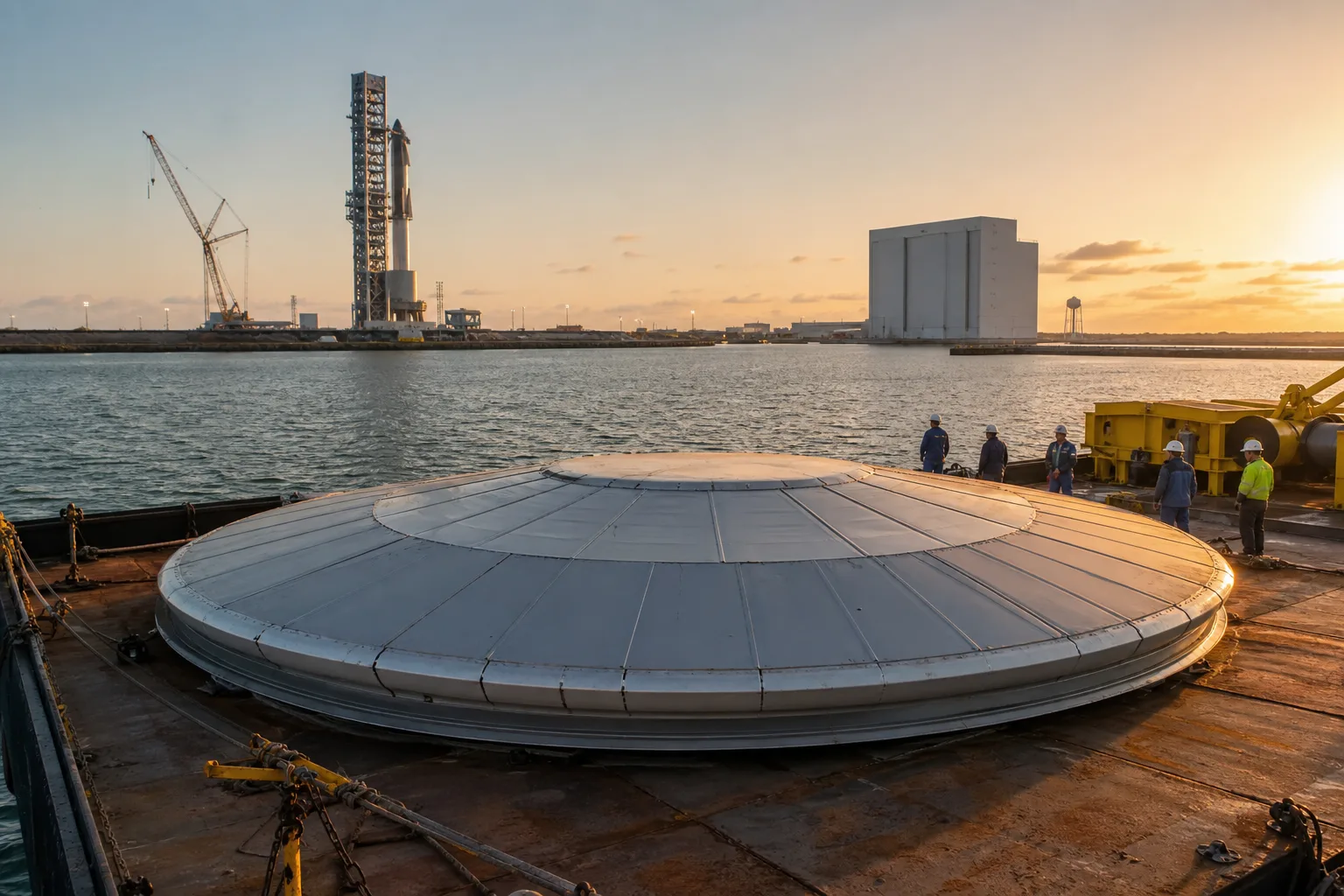
It looks like something straight out of a 1950s B-movie — a gleaming, disc-shaped object sitting on a barge in the Atlantic Ocean. But this particular ‘flying saucer’ isn’t here to probe humanity’s secrets. It’s a critical piece of hardware for the Artemis 3 moon mission, and its arrival at NASA’s Kennedy Space Center marks one of the more visually striking milestones in the agency’s march back to the lunar surface.
- The Artemis 3 moon mission’s SLS core stage weather cover has arrived at Kennedy Space Center aboard the Pegasus barge.
- NASA’s Artemis 3 moon mission is targeting a mid-2027 launch, with this hardware delivery marking a key preparation milestone.
- The disc-shaped cover protects the SLS core stage — the tallest rocket stage NASA has ever built — from Florida’s volatile coastal weather.
- The SLS core stage holds hundreds of thousands of gallons of propellant and supports the Orion crew capsule above it.
Table of Contents
What Exactly Just Arrived at Kennedy Space Center?
The object in question is the weather cover for the core stage of NASA’s Space Launch System (SLS) rocket. It arrived aboard the Pegasus barge — a 310-foot (94.4-meter) cargo vessel purpose-built to haul the SLS core stage along the U.S. waterway network. The core stage itself is far too large and too heavy for road transport, which makes the Pegasus indispensable. Think of it as NASA’s version of an oversized-load truck, just floating.
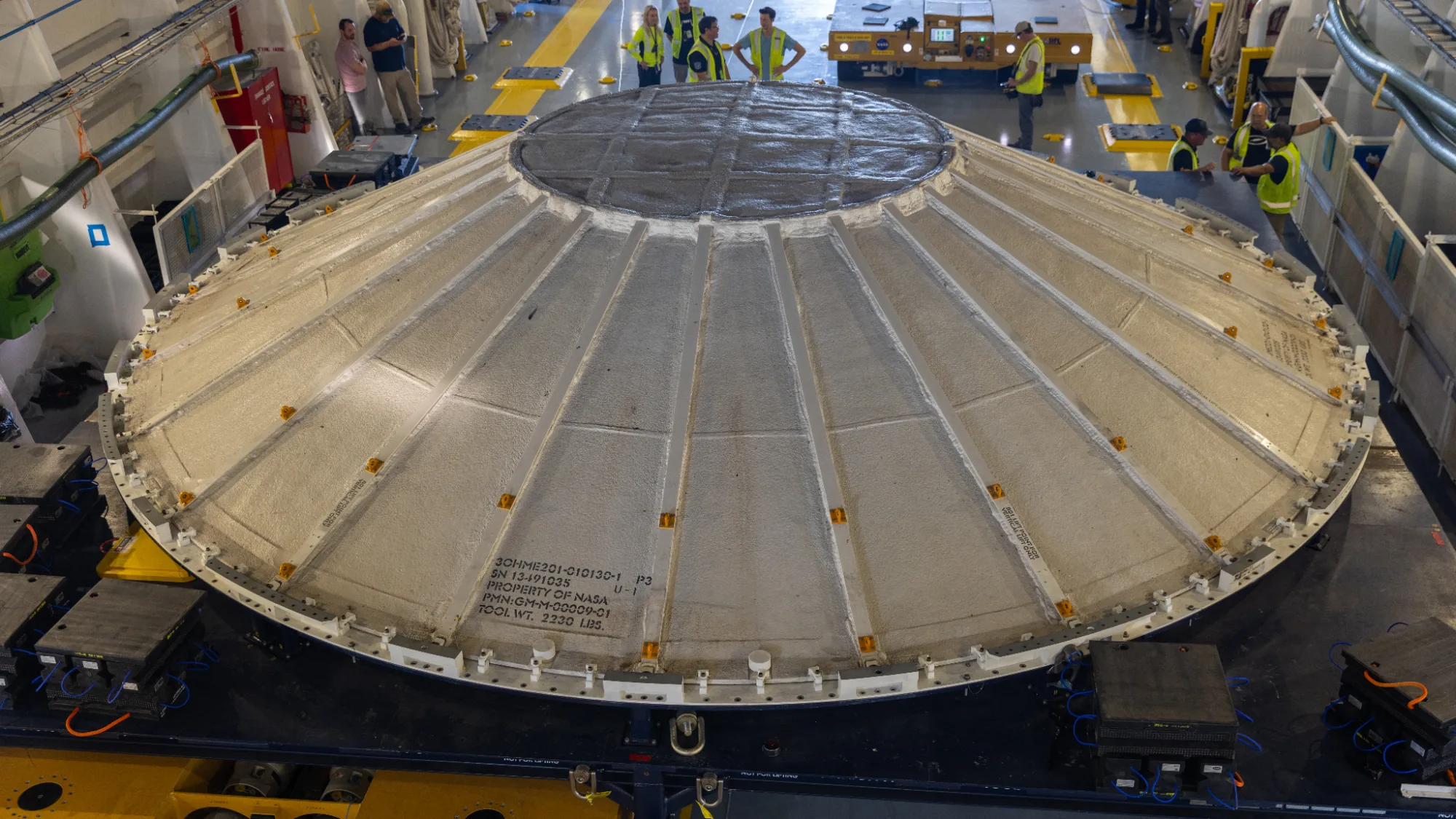
Once the core stage is stacked vertically on the launch pad at Kennedy Space Center, this saucer-shaped cover gets fitted over the top of it. Its job is deceptively simple but genuinely important: protect the rocket’s upper sections, thermal insulation, and sensitive systems from Florida’s famously unpredictable Space Coast weather. Anyone who’s spent time near Cape Canaveral knows the drill — sudden storms, salt air, high humidity, and lightning that seems magnetically drawn to anything tall and metallic. For the Artemis 3 moon mission, keeping that hardware in pristine condition during pad processing is a non-negotiable requirement.
The Artemis 3 Moon Mission: Where Things Stand
The Artemis 3 moon mission is currently targeting a mid-2027 launch window. That timeline has already slipped from earlier projections — Artemis has, frankly, never been a program known for hitting its original schedule — but the arrival of flight hardware is a concrete signal that things are progressing. Hardware delivery isn’t a press release; it’s a physical commitment.
This particular mission is structured as a crewed flight to low Earth orbit, functioning as a key end-to-end systems test before NASA sends astronauts to the lunar surface. That might sound anticlimactic given the program’s name, but it reflects the agency’s cautious, step-by-step approach. Artemis 1 was uncrewed. Artemis 2 is a crewed mission that preceded Artemis 3. The Artemis 3 moon mission will go further — and eventually, a follow-on mission will put boots on the lunar surface for the first time since Apollo 17 in December 1972.
The stakes are high enough that no single component gets treated as trivial. That includes the weather cover.
Why the Core Stage Needs Protecting
The SLS core stage isn’t just big — it’s the biggest rocket stage NASA has ever built. It carries hundreds of thousands of gallons of liquid hydrogen and liquid oxygen propellant, and it bears the structural load of everything stacked above it: the Interim Cryogenic Propulsion Stage, the Orion crew capsule, and the Launch Abort System. That’s an enormous column of hardware that depends entirely on the core stage performing flawlessly at ignition.
Cryogenic propellant systems are particularly sensitive. The thermal protection on the core stage keeps the super-cold propellants at the right temperatures and prevents ice buildup that could damage engines or obstruct sensors. Expose that insulation to weeks of Florida humidity, salt spray, and storm-force winds while sitting on the pad, and you introduce exactly the kind of unpredictable variables that mission engineers spend careers trying to eliminate. The weather cover is, in that sense, mission insurance — and for the Artemis 3 moon mission, that insurance matters enormously.

When Science Fiction Meets Engineering Reality
It’s genuinely hard to look at this thing and not grin. The design — a wide, flattened disc with a slightly domed centre — could have been lifted directly from the prop department of a 1950s Hollywood studio. Flying saucer imagery has been a fixture of science fiction since at least the late 1940s, popularised by Cold War-era UFO sightings and cemented by films like ‘The Day the Earth Stood Still’ and ‘Earth vs. the Flying Saucers.’ Decades of that visual language are baked into our cultural memory.
Whether NASA’s engineers were consciously nodding to that aesthetic or simply arrived at the most aerodynamically and structurally sensible shape for the job is an open question. Probably the latter — form follows function in rocketry more ruthlessly than in almost any other field. But the result is one of those happy collisions where the most practical engineering solution ends up looking like pure science fiction.
It’s a useful reminder that real space exploration, at its best, is already stranger and more visually arresting than most of what Hollywood invents. A 310-foot barge carrying a disc-shaped rocket cover across the Atlantic doesn’t need special effects.
What Comes Next for the Artemis 3 Moon Mission
With the weather cover and the Pegasus barge now at Kennedy Space Center, the next major steps involve the arrival and processing of the SLS core stage itself, followed by the complex vertical integration process inside the Vehicle Assembly Building — one of the largest structures by volume on Earth. The core stage gets stacked with the solid rocket boosters, then the upper stage and Orion capsule are added on top. It’s a process that takes months and involves thousands of technicians.
For the Artemis 3 moon mission specifically, NASA is also working through ongoing challenges with the Orion heat shield — the Artemis 2 crew capsule’s ablative shield showed unexpected erosion patterns during the uncrewed Artemis 1 flight, and the agency has been refining the design and testing process ever since. That’s a separate but equally consequential thread running parallel to all the rocket hardware milestones.
The broader picture here is a program operating under significant pressure. NASA’s Artemis program faces scrutiny over cost — the SLS rocket’s high per-launch price tag is a figure that critics, including SpaceX, have used to argue for commercial alternatives — as well as pressure from international competition, particularly China’s stated ambitions to land on the Moon before the end of the decade. Every hardware delivery, every pad test, every processing milestone is a small but real answer to those pressures.
A flying saucer on a barge might look like a publicity stunt. It isn’t. It’s evidence that the machinery of deep-space human exploration — slow, expensive, and technically unforgiving — is still turning, and that the Artemis 3 moon mission is one step closer to becoming reality.

