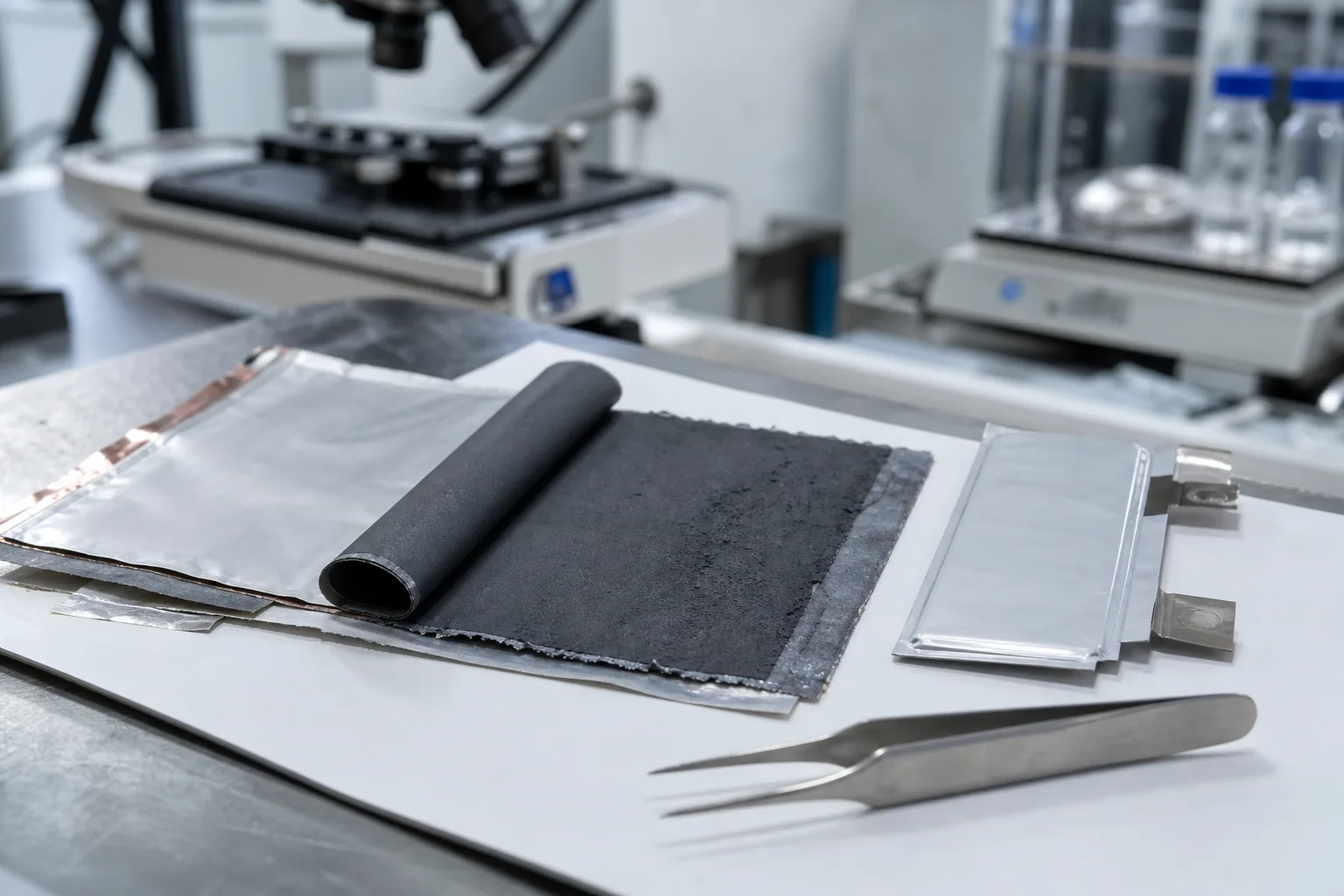
- Solidion Technology has secured 7 new patents covering composite anode materials designed for extreme-environment battery applications.
- The composite anode materials are specifically engineered for humanoid robots, space-based AI data centers, and the emerging lunar economy.
- The patents expand Solidion’s IP portfolio at a moment when next-generation battery tech is becoming a serious competitive differentiator.
- Silicon-enhanced anode chemistry sits at the heart of the patents, promising higher energy density than conventional graphite-based cells.
Table of Contents
Solidion Technology Bets on Composite Anode Materials for Tomorrow’s Wildest Use Cases
Composite anode materials don’t usually make headlines outside specialist electrochemistry circles — but Solidion Technology is trying to change that. The Dallas-based battery materials company has just been granted seven new patents covering proprietary composite anode formulations, and the target applications read less like a product roadmap and more like a science fiction pitch deck: humanoid robots, space-stationed AI data centers, and a nascent lunar economy. Far from being vague marketing territory, though, each of those verticals represents a genuinely distinct and demanding set of electrochemical challenges — and Solidion is planting its IP flag firmly in all three.
The patents cover variations of silicon-enhanced anode chemistry, building on the well-documented limitations of conventional graphite anodes. Standard graphite maxes out at a theoretical capacity of around 372 mAh/g. Silicon, by contrast, can theoretically store roughly ten times that energy — but it expands dramatically during charging, which causes cracking, capacity fade, and early cell death. The entire field of composite anode research exists to solve exactly that problem: binding silicon particles with graphene, carbon nanotubes, or other structural matrices that accommodate the expansion without destroying the electrode. Solidion’s patents claim specific formulations and methods within that space.
Why Humanoid Robots Are a Serious Battery Problem
The robotics angle isn’t as far-fetched as it sounds. Companies like Figure AI, Agility Robotics, and Tesla — with its Optimus platform — are in an arms race to build bipedal machines capable of warehouse and manufacturing work. Every one of those robots carries a fundamental physics problem: the battery has to be light enough not to ruin the weight distribution, energy-dense enough to run a full shift, and durable enough to survive thousands of charge cycles across a working lifetime of years.
Current lithium-ion cells, even good ones, are marginal for this. A humanoid robot drawing 500W to 1kW continuously during active tasks will drain a conventional pack in hours. Composite anode materials that genuinely push energy density closer to silicon’s theoretical ceiling — even if they only capture a fraction of it reliably — could meaningfully extend operational windows and shrink pack sizes. That’s not a trivial commercial edge; it could determine which robot platforms are actually economically viable at scale.
Solidion’s timing is deliberate. The humanoid robot market is projected to grow from a niche research category into a multi-billion-dollar industry within this decade, with Goldman Sachs estimating the sector could reach $150 billion by 2035. Getting your battery chemistry designed into early platform generations — and holding the patents to protect it — is exactly the kind of long-game IP strategy that pays off when a market tips from experimental to commercial.
Space AI Data Centers: The Most Extreme Battery Environment Imaginable
If humanoid robots are a demanding use case, space-based AI data centers are an order of magnitude harder. The concept of orbital or lunar data centers has gained real traction recently, partly because low Earth orbit offers natural cooling advantages for compute-dense servers, and partly because latency requirements for certain AI inference tasks may eventually favour edge compute closer to space-based sensors and satellites.
But powering those facilities is a nightmare. In low Earth orbit, a satellite cycles between sunlight and eclipse roughly every 90 minutes — meaning the battery system charges and discharges 16 times per day. That’s roughly 5,800 full cycles per year, compared to the 500–1,000 cycles a typical consumer EV battery is warrantied for. Add in the radiation environment, the absence of atmospheric pressure, and temperature extremes that can swing 300 degrees Celsius between shadow and sunlight, and you begin to understand why off-the-shelf lithium-ion cells simply aren’t adequate.
Composite anode materials designed for this environment need to maintain structural integrity under radiation bombardment, sustain cycle life an order of magnitude beyond terrestrial norms, and do so without the kind of thermal management infrastructure — liquid cooling loops, active heating — that adds mass and complexity to spacecraft. Solidion’s patent claims in this area suggest formulations that address at least some of these constraints, though the real-world performance data won’t be public until these cells are actually tested in relevant environments.
The Lunar Economy Is Closer Than It Looks
The third pillar of Solidion’s patent strategy — the lunar economy — might sound the most speculative, but it’s attracting serious capital. NASA’s Artemis programme, commercial lander contracts with companies like Intuitive Machines and Astrobotic, and the broader push toward permanent lunar presence have turned ‘lunar infrastructure’ from a phrase associated with Apollo nostalgia into an active procurement category.
Lunar nights last approximately 14 Earth days and plunge surface temperatures to around -173°C. Any battery system expected to keep a rover, habitat, or communications relay alive through a lunar night has to operate at temperatures that freeze most conventional electrolytes solid. Silicon-composite anodes paired with the right electrolyte chemistry can extend the low-temperature operating range significantly — and that’s before considering the absence of a magnetic field to shield electronics from cosmic radiation.
Solidion isn’t the only company thinking about this. Specialty battery developers have been circling the space-and-defense energy storage market for years, and NASA has its own materials research programmes focused on next-generation cells. But patent portfolios matter enormously in this sector — both for direct licensing revenue and for defensive protection once contracts start flowing. Seven new grants in one tranche is a meaningful expansion of Solidion’s IP position.
Where Composite Anode Materials Fit in the Broader Battery Race
It’s worth stepping back to consider what this means in the context of the wider battery industry. The dominant commercial narrative right now is about EV batteries — cost reduction, range improvement, faster charging, cobalt-free cathodes. That’s a multi-hundred-billion-dollar market and it commands most of the investment and media attention.
But there’s a parallel track of development aimed at applications where energy density and environmental resilience matter far more than cost-per-kilowatt-hour. Defense, aerospace, robotics, and remote industrial applications all fall into this category. Companies operating in this space can command premium pricing and, critically, can build durable IP moats that EV-focused players aren’t particularly interested in contesting.
Solidion’s seven patents on composite anode materials are a clear signal that the company is positioning itself squarely in that premium, high-specification tier. The question now is execution: translating patent claims into materials that can be manufactured consistently, integrated into cells reliably, and validated in the genuinely brutal environments these applications demand. The IP is the starting gun, not the finish line — but it’s a credible starting gun, and the race it’s entering is only going to get more competitive as robots walk factory floors and humanity begins to think seriously about what it actually takes to live and work on the Moon.
Frequently Asked Questions
What makes composite anode materials better for humanoid robots?
Composite anode materials are designed to offer improved performance over standard battery chemistries. For humanoid robots, advances in anode materials can translate to benefits such as longer operational runtimes and lighter battery packs, both of which are critical constraints in bipedal machine design.
Why do space-based AI data centers need specialised battery technology?
Space environments expose batteries to extreme conditions that degrade conventional cells. Composite anode materials engineered for these conditions can help maintain stable electrochemical performance where standard battery technologies would fall short.
How does Solidion Technology’s composite anode materials work compare to competitors?
Solidion Technology has been granted new patents on composite anode materials, suggesting a distinct formulation approach. The source does not provide a direct comparison with specific competing companies or their technologies.
What is the lunar economy and why does it need new battery tech?
The lunar economy refers to commercial and governmental activity on and around the Moon, including operations that require reliable power sources. The demanding conditions of the lunar environment make conventional battery chemistries challenging to use without significant materials innovation, which is part of what Solidion’s composite anode work targets.