
- Google Dreambeans is a new Labs experiment that generates personalized daily stories using data from your connected Google apps.
- Google Dreambeans runs on Nano Banana 2 and Personal Intelligence, pulling context from Gmail, Calendar, Photos, and Search history.
- The app is currently exclusive to Google AI Ultra subscribers in the US, ages 18 and up, on Android and iOS.
- Each story includes actionable suggestions at the bottom, letting you explore topics or complete related tasks instantly.
Table of Contents
What Is Google Dreambeans?
Google Dreambeans is the latest experiment to roll out of Google Labs, and it’s one of the more interesting ideas the company has floated in a while. The core concept is straightforward: instead of handing you an infinite scroll of algorithmic content designed to keep you glued to a screen, Dreambeans generates a small, finite set of personalized stories each day — stories built specifically around what’s happening in your life, right now.
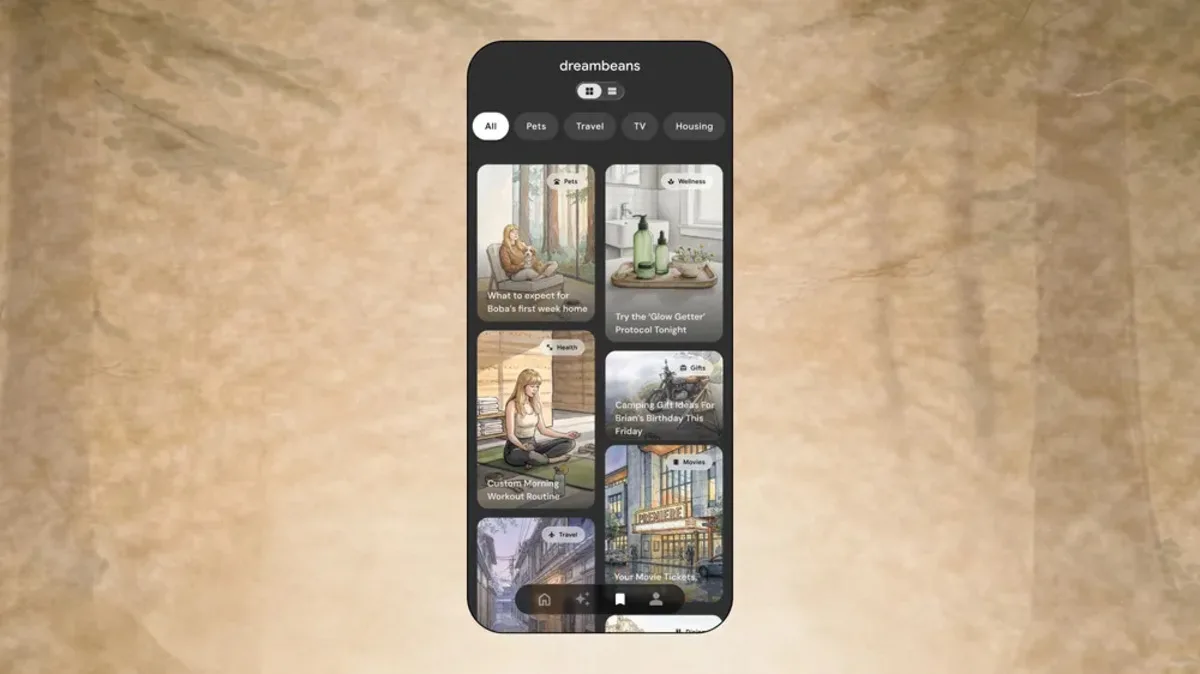
Think of it as AI-generated context, not AI-generated content for its own sake. If you’ve got a new puppy arriving this afternoon, Dreambeans might surface a brief story on how to set up your home for the transition. If you have a work trip on your calendar next week, it might pull together something useful about your destination. The stories are short by design. That’s the point. Google is explicitly pitching this as an antidote to doomscrolling — a way to give you something meaningful to read without engineering compulsive behavior around it.
How Google Dreambeans Actually Works
Under the hood, Google Dreambeans relies on two AI technologies: Nano Banana 2 and Personal Intelligence. Nano Banana 2 handles the actual story generation — it’s one of the smaller, more efficient models in Google’s AI lineup, optimized for on-device or lightweight inference tasks. Personal Intelligence is the layer that does the connecting: it reaches into your Google ecosystem — Gmail, Google Calendar, Photos, YouTube watch history, and Search history — and assembles a picture of what’s relevant to you at any given moment.
Google is clear that you’re in control of what gets connected. The app requires permission to link to at least one Google service to function, but users can choose which apps feed into it and how many. That’s a meaningful distinction. The difference between “we’ll use everything unless you opt out” and “tell us what you want to share” matters enormously when we’re talking about reading your emails and calendar entries to generate content. Whether users will actually engage with those permission screens thoughtfully is another question — but at least the architecture is pointing in the right direction.
Once a story is generated, it doesn’t just sit there as static text. At the bottom of each piece, Dreambeans surfaces a set of suggested actions or follow-up prompts tied to the story’s topic. Using the puppy example Google offered, you might see options like “create a list of essentials for my puppy” or “direct me to the nearest dog park.” It’s designed to be a starting point, not an endpoint — which makes it feel more like a smart assistant feature than a traditional content feed.
Users can also save stories they want to revisit, building up a personal library over time. That’s a small but smart touch. It means the app has some stickiness without needing to manufacture urgency or anxiety to keep you coming back.
Who Can Use Google Dreambeans Right Now
Google Dreambeans is launching today for Google AI Ultra subscribers in the United States, restricted to users aged 18 and over. It’s available on both Android and iOS. Everyone else can join a waitlist — though you’ll need a Google account to do so.

The AI Ultra tier is Google’s premium subscription layer, sitting above the standard Google One AI Premium plan. At $249.99 per month, it’s not cheap, and launching Dreambeans exclusively behind that paywall sends a signal: this is a feature Google considers high-value, or at minimum, one it wants associated with its most engaged, paying users during the experimental phase. Labs experiments often start narrow before broadening access, so the waitlist is likely genuine rather than cosmetic.
The age restriction makes sense given that the app is ingesting personal data across multiple services to generate content. Keeping it to adults during an experimental rollout is a reasonable precaution, especially given the regulatory scrutiny around AI systems that process personal information. The EU’s AI Act, the FTC’s ongoing interest in AI data practices, and consumer privacy frameworks in the US all create a landscape where Google has every incentive to be careful about how widely it deploys something like this before it’s properly stress-tested.
The Bigger Picture: AI That Knows You vs. AI That Watches You
What makes Google Dreambeans interesting — and worth watching — isn’t the stories themselves. It’s what the product represents as a strategic direction for Google’s AI ambitions. Google has spent years accumulating one of the most detailed personal data ecosystems on the planet. Your search history, your emails, your calendar, your photos, your YouTube habits. The company has always used that data to serve ads and tune recommendations, but Dreambeans is something different: it’s Google taking that data and surfacing it back to you, directly, in a form that’s meant to be genuinely useful rather than commercially optimized.
That’s a subtle but important shift. Advertising-driven personalization serves Google’s interests first. A daily story about your puppy or your upcoming trip serves yours — at least in theory. The cynical read is that Dreambeans is a way to make you more comfortable with Google knowing everything about you, because look, it’s being helpful with that knowledge. The optimistic read is that this is what AI assistants were always supposed to do, and we’re finally getting close enough to the technology to make it feel natural rather than creepy.
The finite-stories model is worth calling out specifically. Apple’s Screen Time, various digital wellness apps, and a wave of “slow tech” products have all tried to chip away at compulsive scrolling with mixed results. Most of them work by restriction — limits, timers, blockers. Dreambeans takes a different approach: instead of removing the impulse to consume content, it tries to replace it with something more intentional. Whether that works in practice depends entirely on whether the stories it generates are actually good enough to feel satisfying. A poorly timed, off-target story is worse than no story at all.

What to Watch For as Dreambeans Matures
Google Labs experiments have a variable track record. Some graduate to full products — think features that eventually made it into Google Assistant or Workspace. Others quietly disappear. Dreambeans has the ingredients to go somewhere: it’s built on real infrastructure, it solves a genuine problem people have with content consumption, and it’s differentiated enough from anything Apple, Microsoft, or OpenAI are currently offering to carve out its own space.
The questions that will determine its trajectory are mostly about execution. How accurate is Personal Intelligence at reading what’s actually relevant to your life versus what it thinks is relevant based on your data? How good is the writing quality of the generated stories — are they genuinely readable, or do they feel like AI-generated summaries dressed up in narrative clothing? And critically, how does Google handle the privacy architecture as it scales beyond AI Ultra subscribers to a broader audience?
If Google gets those things right, Dreambeans could become a genuine showcase for what personal AI is capable of — not just a chatbot you talk at, but a system that understands your context and surfaces something useful before you even think to ask. That’s the version of AI assistance that’s been promised for years. Google, of all companies, has the data to actually deliver it. Now it just has to earn the trust to use it.