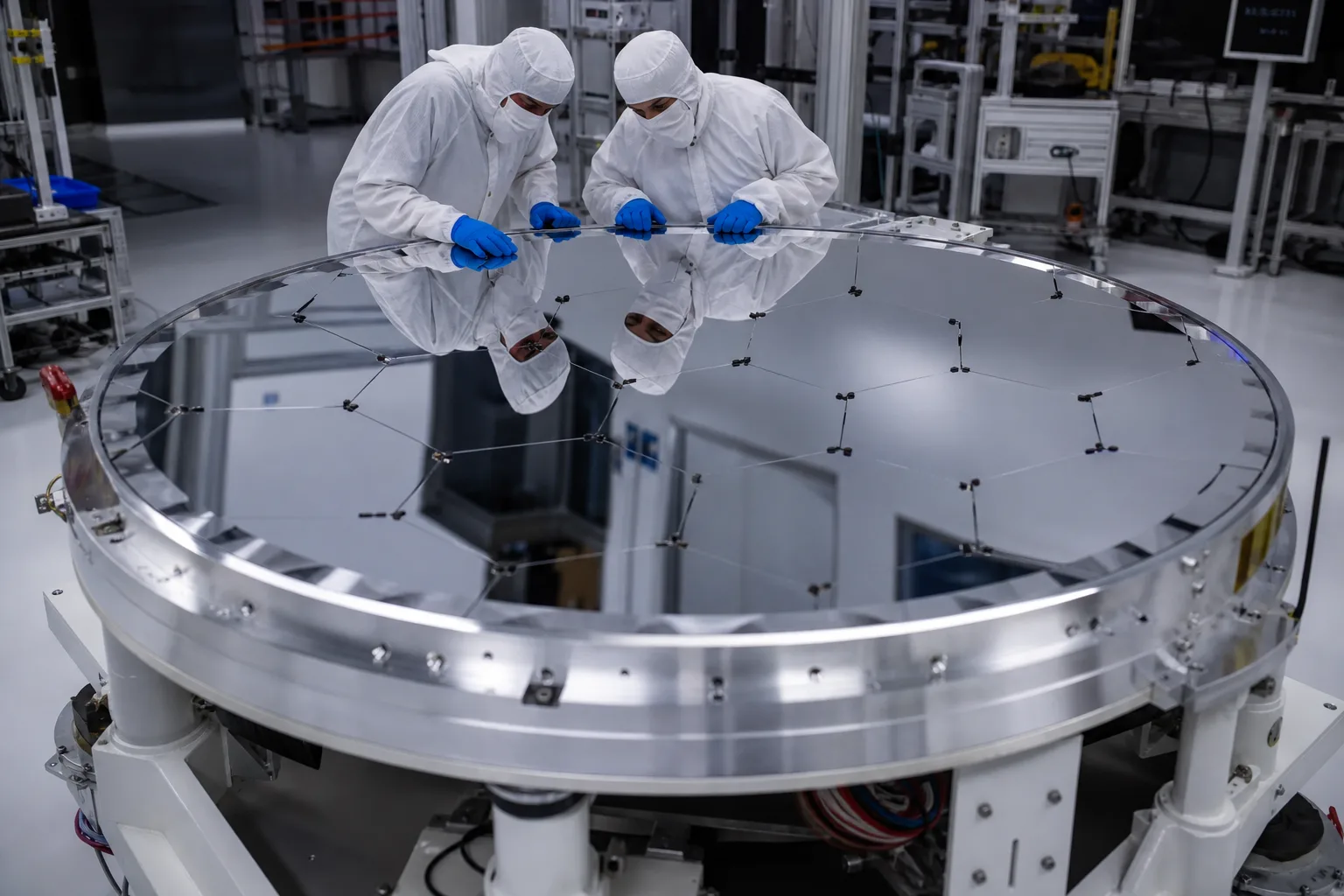
- The Roman Space Telescope passed its final mirror inspection on May 20, confirming everything is flight-ready before shipment to Florida.
- NASA’s Roman Space Telescope could launch as early as August 30 from Kennedy Space Center, ahead of the previously cited early September window.
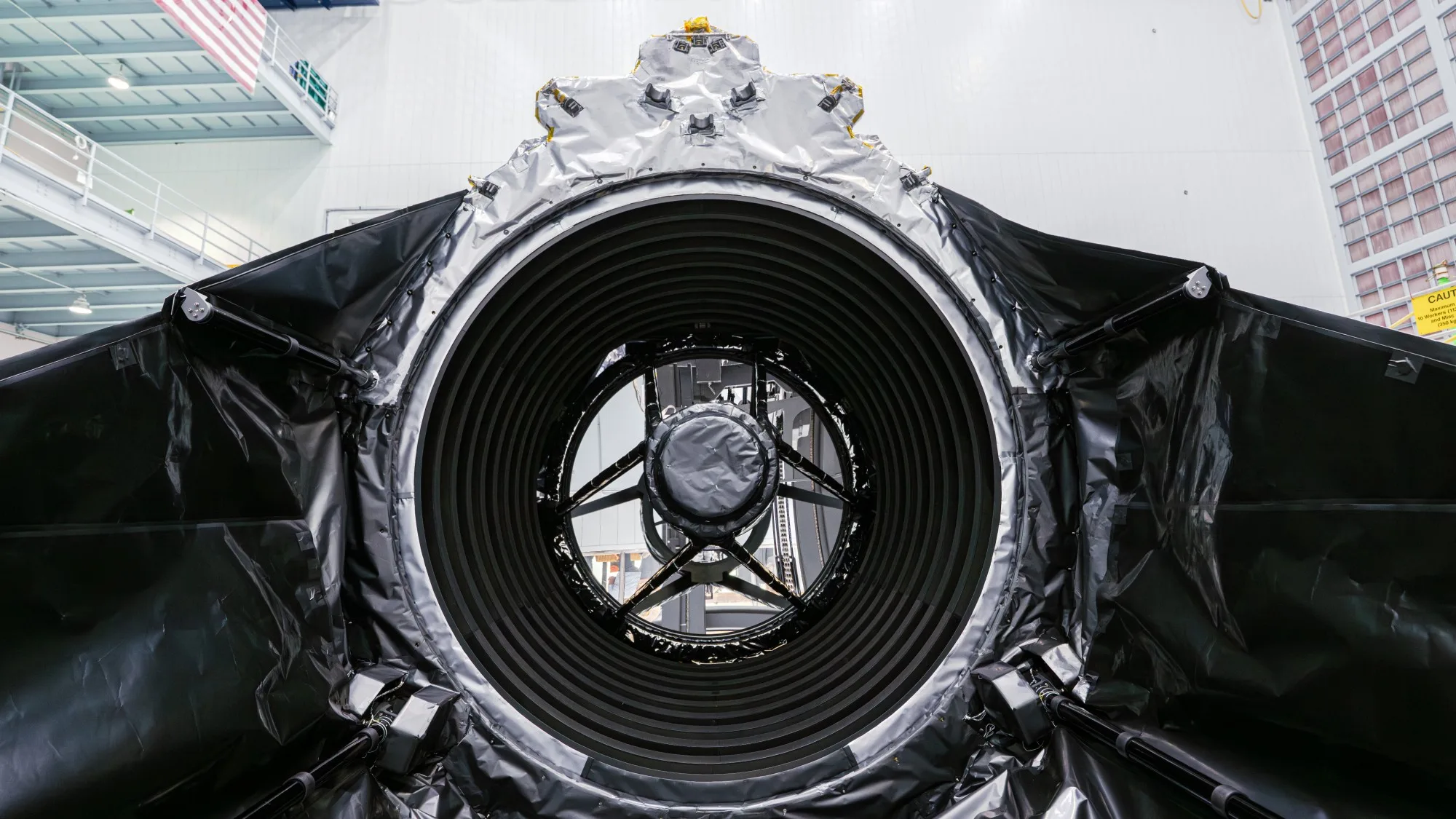
- Engineers used a high-resolution camera with a powerful zoom lens to trace the full optical path from mirror to science instrument.
- The 2.4-metre primary mirror must maintain ultraprecise alignment to enable Roman’s sweeping survey of dark energy, exoplanets, and deep-field galaxies.
Table of Contents
Roman Space Telescope Clears Its Final Hurdle Before Launch
NASA’s Roman Space Telescope is officially done being poked, prodded, and scrutinised by the engineers who built it. On May 20, the team at NASA’s Goddard Space Flight Center in Maryland completed what amounts to a formal farewell inspection — the last time human eyes will look directly at the telescope’s 7.9-foot (2.4-metre) primary mirror before it becomes, as one project manager put it, the eyes of humanity pointed at the cosmos. With that final check now signed off, the telescope is being prepared for shipment to NASA’s Kennedy Space Center in Florida, where it’s targeting a launch window that opens as early as August 30.
That’s a tighter timeline than the early September date that had been publicly circulated. SpaceNews’ Jeff Foust flagged the August 30 possibility, suggesting the programme is running ahead of schedule — a rare and welcome position for a flagship space observatory to be in, given the field’s long history of delays and budget overruns. The Roman Space Telescope was formally declared complete back in April, making this final inspection less a quality-control gate and more a ceremonial send-off for the instrument’s ground-based life.
What the Final Mirror Inspection Actually Involved
This wasn’t a simple visual once-over. The engineering team ran through a structured sequence of checks designed to catch anything that might have shifted, settled, or otherwise gone wrong during the telescope’s shake testing — the vibration trials that simulate the violence of a rocket launch. Think of it as confirming that nothing rattled loose before the real rattling begins.
First, engineers tilted the telescope onto its side and deployed the deployable aperture cover — the large sunshade designed to keep stray light away from the mirror while the instrument is in orbit. That hood will be stowed for the journey to Florida and for the launch itself, but unfurling it gave the team a clean, unobstructed view of the mirror surface, allowing them to confirm no debris had settled on it during testing. Even a microscopic particle in the wrong place can scatter light and degrade measurements, so this kind of visual sweep isn’t optional.
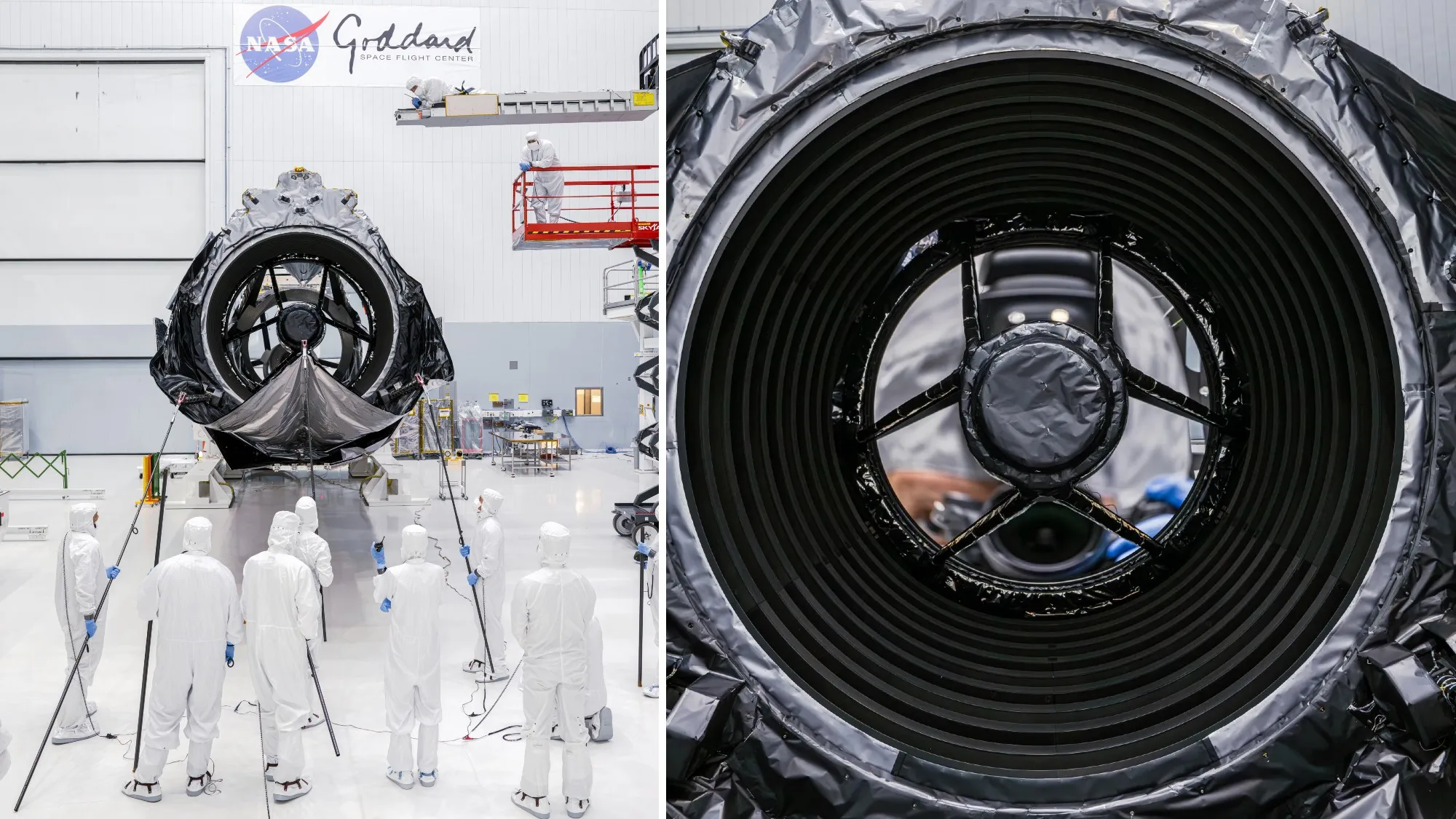
Then came the optical alignment check. Engineers followed the exact path that incoming light will travel — from the primary mirror down to the telescope’s Wide Field Instrument, Roman’s main science camera. To do this precisely without touching anything, the team developed a bespoke inspection method. As Bente Eegholm, the optics lead for Roman’s Optical Telescope Assembly at Goddard, explained:
“We developed a method of using a high-resolution camera equipped with a very powerful zoom lens to do a multi-purpose inspection.”
The verdict? Clean. “The mirror passed with flying colors, keeping the mission on track for an early September launch,” Eegholm said. That statement was made before the August 30 date surfaced publicly, but the sentiment stands either way — the Roman Space Telescope is ready to fly.
Why the Mirror Matters So Much
It’s easy to underestimate what a space telescope mirror actually has to do. Roman’s 2.4-metre primary mirror is the same aperture diameter as the Hubble Space Telescope, but where Hubble was built for deep, narrow observations, Roman is engineered for breadth. Its Wide Field Instrument will capture a field of view roughly 100 times larger than Hubble’s infrared camera — meaning it can survey vast swaths of sky in a single exposure rather than stitching together thousands of individual pointings over years.
That ambition demands extraordinary precision. Eegholm put it plainly: “In order to gather very sensitive measurements of objects strewn throughout space, all of Roman’s components have to be ultraprecise. The primary mirror certainly delivers on that precision.” Any deviation in the mirror’s shape or alignment — we’re talking tolerances measured in nanometres — would propagate through the entire optical system and compromise the science. Roman is designed to map the large-scale structure of the universe, probe the nature of dark energy, hunt for exoplanets through gravitational microlensing, and conduct infrared surveys that will keep astronomers occupied for decades. The mirror is the foundation every one of those programmes rests on.
For context, the Nancy Grace Roman Space Telescope has been in development since the early 2010s, when it was still known informally as WFIRST. It’s named after Nancy Grace Roman, NASA’s first Chief of Astronomy and the figure most credited with making the Hubble Space Telescope happen. The programme has survived multiple budget reviews, a pandemic, and the ever-present threat of cancellation that shadows any long-lead NASA project. Getting to a clean final inspection, on time, feels like a genuinely significant moment.
The Road to Kennedy Space Center
With the inspection complete, the next major logistics challenge is getting the Roman Space Telescope from Goddard in Maryland down to Florida without incident. Space hardware transport is its own specialised discipline — temperature-controlled, vibration-dampened, with convoy-level security and monitoring. The telescope will be packed into its shipping container with the aperture cover stowed, the same configuration it’ll be in for launch.
J. Scott Smith, the Roman Space Telescope Manager at Goddard, captured the weight of the moment in a statement that’s worth sitting with: “The Roman engineering team laid eyes on the telescope for the final time before it, in turn, becomes the eyes of humanity, revealing the wonders of the cosmos. It is a profoundly humbling moment to witness the culmination of hard work from so many dedicated individuals, teams and partner organizations.”
That’s not marketing language. Building a space telescope at this scale — coordinating optics, detectors, thermal management, structural engineering, software, and ground systems across multiple contractors and government centres over more than a decade — is a genuinely staggering organisational feat. The James Webb Space Telescope’s tortured development history, which stretched nearly 25 years from concept to first light, is a constant reminder of how badly these programmes can go. Roman, by comparison, looks like it’s threading the needle.
What Comes Next After Launch
An August or early September launch puts the Roman Space Telescope on a trajectory to its operational orbit at the Sun-Earth L2 Lagrange point — the same gravitational sweet spot where the James Webb Space Telescope currently operates, about 1.5 million kilometres from Earth in the anti-sun direction. Unlike Webb, Roman won’t require an extensive unfolding sequence after launch. Its mirror is a single piece, already tested and aligned, which should make commissioning considerably less nail-biting than Webb’s famously tense deployment in January 2022.
Once Roman reaches L2 and completes its commissioning phase — typically six months to a year for an instrument of this complexity — it will begin its primary survey programmes. Astronomers have been waiting years for Roman’s wide-field infrared capability, and the data pipelines are already being designed to handle the sheer volume of observations the telescope will produce. The Roman Space Telescope is expected to generate more data per year than any previous NASA astrophysics mission, which is either thrilling or terrifying depending on your relationship with data management.
The broader implication here is that NASA is moving into a genuinely exciting chapter for observational astronomy. Webb is delivering on its scientific promise at the far end of cosmic time. Roman will complement it by mapping the middle chapters — the large-scale structure that emerged billions of years after the Big Bang, the distribution of dark matter, the frequency of Earth-like worlds. Together, they represent an observational capability the astronomical community has never had before. If Roman’s launch goes cleanly and its first year of operations matches the ambition of its design, the next decade of cosmology could look very different from the last.