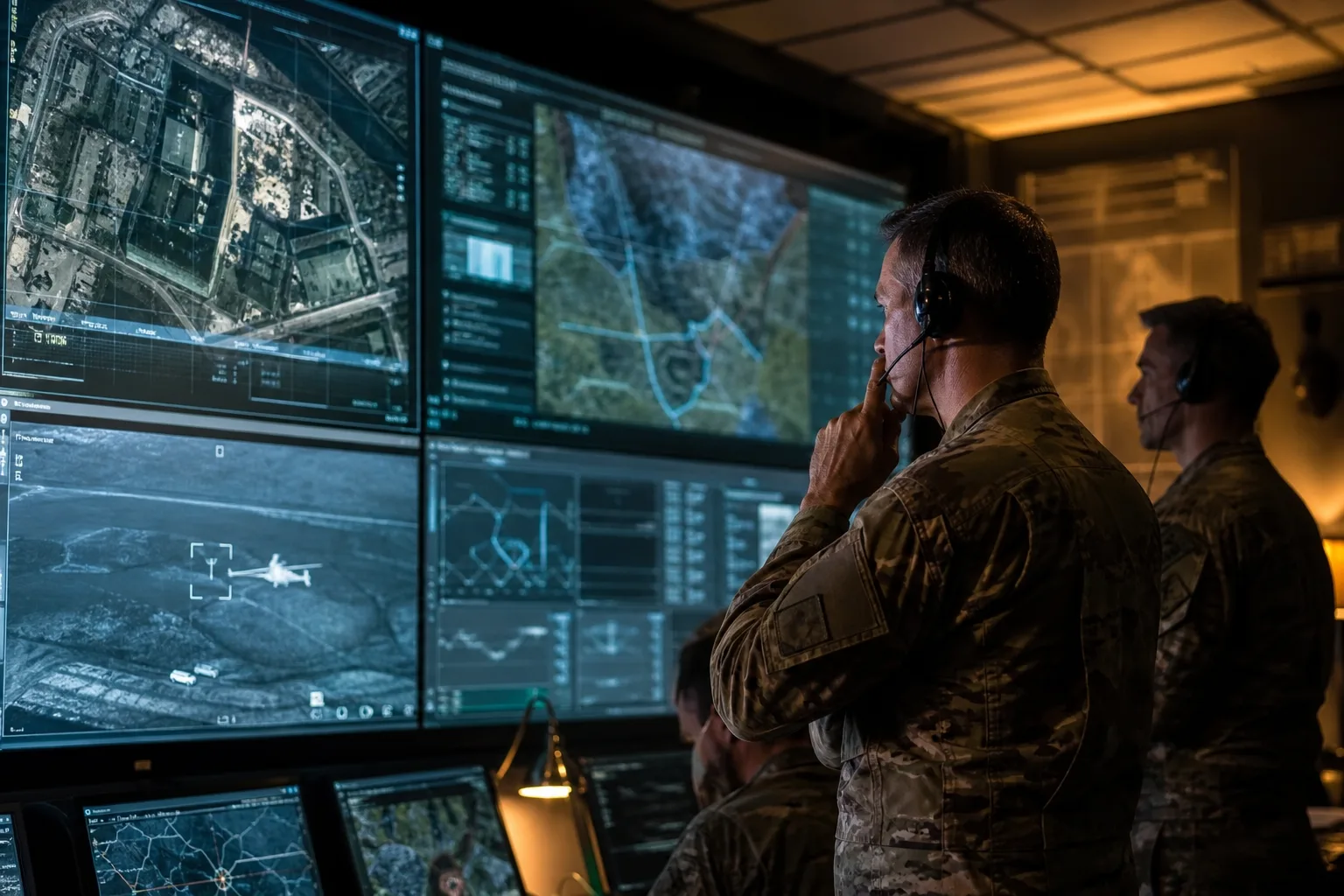
- AI in warfare has moved from science fiction to operational reality, reshaping how militaries plan and execute conflict.
- AI in warfare raises urgent questions about accountability — if an algorithm pulls the trigger, who is legally responsible?
- Autonomous weapons systems are being deployed faster than any international regulatory framework can realistically respond.
- The US, China, and Russia are all investing heavily in military AI, making a global governance consensus increasingly unlikely.
Table of Contents
AI in Warfare Is No Longer a Future Problem
AI in warfare isn’t a thought experiment anymore. It’s happening now — on the battlefield, in command centres, and in the targeting systems of drones flying over active conflict zones. The debate has shifted decisively. We’re no longer asking whether artificial intelligence will change how wars are fought. We’re asking who gets to decide how, when, and against whom it’s used — and right now, the honest answer is: nobody’s fully in charge.
From Ukraine to Gaza to the South China Sea, militaries are integrating AI-driven tools at a pace that’s outrunning the lawyers, ethicists, and diplomats tasked with drawing up the rules. Target recognition software, autonomous patrol drones, AI-assisted logistics, predictive battlefield analysis — these aren’t prototypes sitting in a lab at DARPA. They’re operational. And that changes everything about how we need to think about accountability, international law, and the future of armed conflict.
What AI Is Actually Doing on the Battlefield
It’s worth being specific here, because the conversation often gets lost in abstraction. AI in warfare currently shows up in a few distinct ways. There are decision-support systems — tools that process vast amounts of intelligence data and surface recommendations to human commanders. There are semi-autonomous weapons, like loitering munitions, that can identify and engage targets within defined parameters. And increasingly, there are fully autonomous systems capable of acting without a human in the loop at the moment of a lethal decision.
The Israeli military’s use of an AI system called Lavender — reported in detail by +972 Magazine earlier in 2024 — drew intense scrutiny. The system reportedly generated lists of suspected Hamas militants as potential strike targets, with human oversight described by some operators as cursory at best. Israel disputed some of the characterisations, but the broader point landed hard: an algorithm was materially influencing decisions about who lives and who dies in an active war zone. This is precisely why AI in warfare demands clearer rules of engagement than currently exist.
The US military, through its Department of Defense Directive 3000.09, has maintained a policy requiring meaningful human control over autonomous weapon systems. But critics argue the definition of “meaningful” is doing a lot of heavy lifting. When a system processes targeting data in milliseconds and a human has seconds to confirm or override, is that really human control — or just a rubber stamp?
The Control Problem Nobody Has Solved
This is the crux of it. AI in warfare raises a genuinely hard philosophical and legal problem: if a machine makes a decision that kills civilians, who’s responsible? The programmer? The commanding officer? The state? International humanitarian law — the Geneva Conventions and their protocols — was built around human agency. It assumes someone made a choice, and that someone can be held accountable for it.
Autonomous systems break that chain of accountability in ways existing legal frameworks aren’t equipped to handle. A drone that selects and engages a target based on pattern-of-life analysis trained on potentially flawed data doesn’t fit neatly into war crimes jurisprudence. And states deploying these systems know that.
Human Rights Watch and other organisations have been pushing for a formal international treaty banning fully autonomous lethal weapons — what campaigners call “killer robots” — for over a decade. The Campaign to Stop Killer Robots has support from dozens of countries. But the nations with the most advanced military AI programmes — the United States, China, Russia, the United Kingdom — have consistently resisted binding commitments. Their position, broadly, is that existing international law is sufficient and that banning autonomous systems would amount to unilateral disarmament in a world where adversaries won’t follow suit.
That logic is self-reinforcing, and it’s exactly how arms races perpetuate themselves.
The Geopolitics of Military AI
China’s ambitions here are unambiguous. The People’s Liberation Army has made AI integration a central pillar of its modernisation strategy, with Beijing explicitly targeting “intelligentized warfare” — a doctrine that envisions AI coordinating military operations across domains at speeds no human command structure can match. President Xi Jinping has described AI supremacy as critical to China’s national security, and defence spending reflects that.
Russia, despite economic constraints imposed by sanctions following its invasion of Ukraine, has continued developing autonomous and semi-autonomous systems. The war in Ukraine has itself become a live testing ground for AI in warfare on both sides — drone swarms, electronic warfare guided by machine learning, AI-enhanced artillery targeting.
The US, for its part, has poured billions into the Pentagon’s AI ambitions. The Replicator initiative, announced by Deputy Defense Secretary Kathleen Hicks in 2023, aims to field thousands of autonomous systems — primarily drones — within 18 to 24 months, explicitly framed as a counter to China’s numerical military advantage. The message was clear: autonomy at scale is now a strategic necessity, not a nice-to-have.
When the three dominant military powers are all accelerating in the same direction, the prospects for meaningful multilateral restraint look thin.
Can Governance Keep Up?
There have been attempts. The United Nations Convention on Certain Conventional Weapons has been the primary forum for discussions on autonomous weapons since 2014, but progress has been glacial. Talks in Geneva have repeatedly failed to produce binding outcomes, stalling at voluntary guidelines and declarations of principle that carry no enforcement mechanism.
In 2023, the US co-sponsored a Political Declaration on Responsible Military Use of Artificial Intelligence and Autonomy — a non-binding statement signed by over 50 countries committing to responsible AI use in military contexts. It was a diplomatic step, but non-binding declarations are precisely the kind of commitment that looks meaningful until it isn’t. States sign them, then do what their strategic interests demand.
Some experts argue the better approach is to focus on specific applications rather than trying to ban a technology category. Prohibit the use of AI in warfare in certain decision types — strikes in densely populated civilian areas, for instance — rather than autonomous systems wholesale. That’s a pragmatist position, and it acknowledges the reality that AI in warfare can’t be uninvented.
Others, particularly from the humanitarian law community, argue that any framework that permits lethal autonomous decision-making without genuine human control is fundamentally incompatible with the laws of war. You can’t have proportionality and distinction — the core principles of international humanitarian law — without a human capable of exercising contextual moral judgement.
The Stakes Are Higher Than Most People Realise
It’s easy to frame AI in warfare as a problem for generals and diplomats. It isn’t. The decisions being made right now — about which systems get deployed, under what rules of engagement, with what oversight — will shape the character of armed conflict for decades. And those decisions are being made inside defence ministries and technology companies largely out of public view.
The technology companies are a part of this story that often gets underplayed. Google’s Project Maven controversy in 2018 — when thousands of employees protested the company’s contract to help the Pentagon analyse drone footage using AI — showed that the line between Silicon Valley and the defence establishment is blurrier than most people assumed. Microsoft has significant military contracts. Palantir’s entire business model is built around government and defence data analysis. Anduril, founded by Palmer Luckey, is explicitly building autonomous weapons systems as its core product.
The commercial AI sector and the military AI sector aren’t separate industries. They’re increasingly the same industry, drawing from the same talent pools, the same foundational models, and the same compute infrastructure. That integration makes governance harder, not easier — because any restriction on military AI use immediately runs into questions about dual-use technology that has both civilian and weapons applications.
Where this ends up is genuinely uncertain. But the window for establishing meaningful norms around AI in warfare — before autonomous systems become so embedded in military doctrine that unwinding them is unthinkable — is narrowing fast. The technology isn’t waiting for the policy to catch up. It never does.