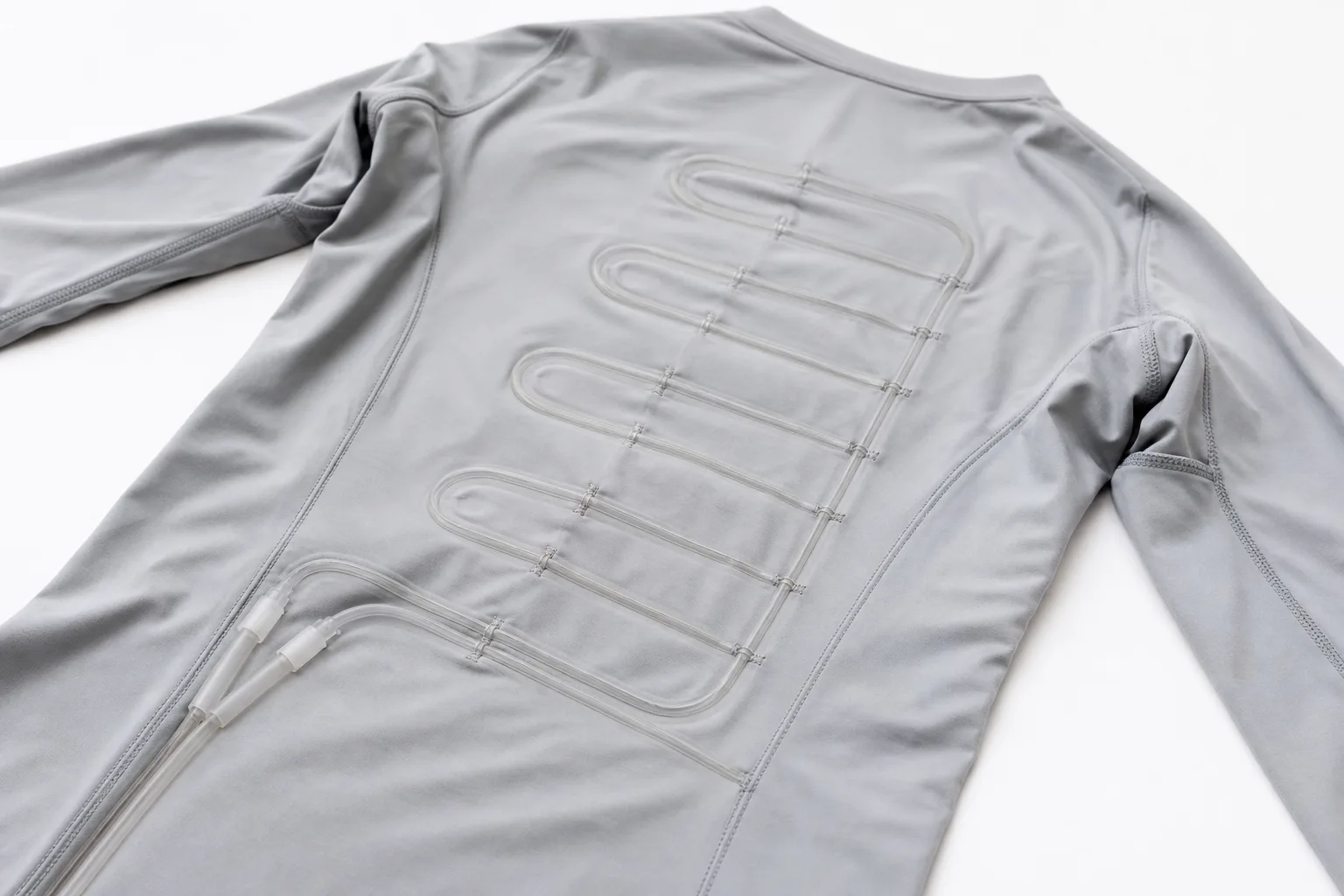
- The new NASA spacesuit base layer is a liquid-cooled garment co-designed by Axiom Space and Prada for Artemis IV.
- This NASA spacesuit base layer circulates cold water through embedded tubes to pull heat away from astronauts’ bodies.
- A built-in backup cooling system means a single failure won’t leave crew vulnerable — a major upgrade over older designs.
- The garment also manages oxygen supply to the helmet and routes exhaled CO2 to a scrubber for safe recirculation.
Table of Contents
The NASA Spacesuit Base Layer Nobody Knew They Were Waiting For
When Axiom Space and Prada first announced they were teaming up to build a spacesuit for NASA’s Artemis programme, the fashion angle grabbed all the headlines. Now the partnership has pulled back another layer — literally. The two companies have unveiled the Liquid Cooling and Ventilation Garment, or LCVG, which serves as the NASA spacesuit base layer that astronauts will wear directly against their skin when they step onto the lunar surface during Artemis IV, currently slated for 2028. It’s the undergarment that makes everything else work, and it’s a more sophisticated piece of engineering than its unglamorous nickname — ‘high-tech long johns’ — suggests.
The LCVG sits beneath the Axiom Extravehicular Mobility Unit (AxEMU), Axiom Space’s next-generation suit designed to replace NASA’s ageing Extravehicular Mobility Units that have been in service since the early Space Shuttle era. Getting the outer shell right matters enormously, but the NASA spacesuit base layer is what actually keeps a human alive and functional during the brutal temperature swings of a lunar EVA — swings that can range from around 120°C in direct sunlight to -130°C in shadow. No pressure.
Cold Water, Hot Problem: How the Cooling System Works
The core function of the NASA spacesuit base layer is thermal regulation. Human bodies generate significant heat during physical exertion, and inside a sealed pressure suit there’s nowhere for that heat to go — unless you build the escape route in from the start. The LCVG handles this by circulating cold water through a network of thin tubes woven directly into the fabric. As the water flows across the astronaut’s skin, it absorbs body heat and carries it away to a downstream sublimator in the outer suit, which vents it into the vacuum of space.
It’s a system that’s been used in spacesuits for decades — NASA’s original Apollo-era suits used a similar principle — but Axiom Space’s version comes with a critical upgrade that older designs lacked: a redundant backup cooling circuit. If the primary system fails during a moonwalk, the secondary kicks in. That kind of built-in redundancy sounds obvious in retrospect, but it wasn’t always standard practice. Given that an astronaut could be several hundred metres from the lunar lander when something goes wrong, having a fallback isn’t just a nice-to-have — it’s the difference between a recoverable situation and a catastrophe.
Breathing Easy: The Ventilation Half of the Equation
Cooling is only one part of what the NASA spacesuit base layer manages. The LCVG also integrates the suit’s ventilation system, which has two equally important jobs. First, it supplies a continuous flow of fresh oxygen to the AxEMU helmet — the air the astronaut actually breathes during an EVA. Second, it captures exhaled air, which is rich in carbon dioxide, and routes it to a CO2 scrubber before recirculating the cleaned air back into the suit loop.
That CO2 management is non-negotiable. Carbon dioxide builds up quickly in an enclosed environment, and even moderate CO2 concentrations cause impaired judgement, headaches, and eventually loss of consciousness. The scrubber system ensures the suit’s internal atmosphere stays breathable for the duration of the EVA — which, for Artemis IV, could stretch to several hours at a stretch. Packing all of that — thermal regulation, oxygen delivery, and CO2 scrubbing — into a single NASA spacesuit base layer that has to be comfortable enough to work in for hours is a genuinely difficult design challenge.
What Prada Actually Brings to the Table
It’s tempting to read the Prada involvement as a marketing exercise — a luxury brand lending its name to a NASA mission for the prestige. But that reading undersells what high-end fashion houses have actually developed over decades of working with demanding technical textiles. Prada’s R&D division has deep experience with precision fabric construction, seam sealing, and materials that need to perform consistently under stress. Those capabilities translate directly to a NASA spacesuit base layer that has to maintain consistent tube geometry, prevent leaks at hundreds of micro-junctions, and conform closely to a human body in motion — all while surviving the launch and landing loads of a crewed spacecraft.
The Axiom Space and Prada collaboration on the AxEMU outer suit was already announced, and the LCVG reveal adds another dimension to what is becoming a genuinely substantive technical partnership rather than a branding exercise. Axiom Space brings the aerospace systems integration; Prada brings the materials science and construction precision. Whether that combination produces the best possible garment is something we won’t know until astronauts are actually walking on the Moon — but the logic of the pairing holds up.
NASA’s History of Fashion-Tech Crossovers
This isn’t the first time NASA has looked outside the traditional aerospace supply chain for spacesuit innovation. The agency previously funded the BioSuit concept developed by MIT professor Dava Newman, with design input from architect Guillermo Trotti. Unlike conventional gas-pressurised suits, the BioSuit concept explored mechanical counter-pressure — using tightly fitted elastic layers to apply pressure directly to the skin rather than enclosing the astronaut in an inflated shell. It never made it to flight hardware, but it demonstrated that the intersection of fashion, architecture, and aerospace engineering is a legitimate design space, not just a novelty.
The broader pattern here matters. Traditional aerospace contractors built suits that worked — the Apollo suits got twelve people to the Moon — but they were notoriously uncomfortable, difficult to move in, and punishing during extended use. The new generation of commercial spacesuit development, driven by companies like Axiom Space and Collins Aerospace (which is building suits for Boeing’s Starliner missions), is placing far more emphasis on wearability, fit, and the human experience of being inside a suit for hours. Bringing in design expertise from outside aerospace is one way to accelerate that shift, and the LCVG is a strong example of how a well-engineered NASA spacesuit base layer benefits from that outside perspective.
What’s at Stake for Artemis IV
Artemis IV is currently targeting a 2028 launch and will be the first Artemis mission to actually land astronauts on the lunar surface — Artemis III, planned earlier, carries that distinction if it stays on schedule, but IV is the mission confirmed to use the AxEMU and, by extension, the LCVG. The stakes for every component are high. NASA hasn’t put boots on the Moon since Apollo 17 in December 1972, and the pressure — political, scientific, and symbolic — to get it right is intense.
The NASA spacesuit base layer might not be the most photogenic part of that mission when the cameras are rolling, but it’s arguably the most consequential piece of personal equipment the crew will have. Everything else — the AxEMU’s outer layers, the life support backpack, the helmet visor — depends on the NASA spacesuit base layer doing its job quietly and continuously. If the LCVG keeps the crew comfortable and safe through hours of surface operations, nobody will talk about it. If it doesn’t, it’ll be all anyone talks about. That’s the nature of critical infrastructure, whether it’s in orbit or in your building’s basement.
With 2028 still a few years out, Axiom Space and Prada have time to iterate on the design — and given how much depends on getting thermal management right, you’d expect them to take full advantage of it.
Frequently Asked Questions
What does the NASA spacesuit base layer actually do?
The NASA spacesuit base layer — formally the Liquid Cooling and Ventilation Garment (LCVG) — keeps astronauts thermally comfortable by circulating cold water through tubes embedded in the suit. It also supplies fresh oxygen to the helmet and diverts exhaled CO2 to a scrubber for recirculation.
Why is Prada involved in designing a NASA spacesuit?
Prada brings advanced materials expertise and precision manufacturing to the Axiom Space collaboration. High-performance textiles, sealing techniques, and human-fit engineering overlap significantly between luxury fashion and spacesuit construction — it’s less surprising than it sounds once you look at the technical demands involved.
When will the Axiom Space AxEMU spacesuit be used on the Moon?
The AxEMU and its LCVG base layer are planned for the Artemis IV mission, which is currently targeting a crewed lunar surface return in 2028.
How is the new LCVG different from older cooling garments?
The key upgrade is redundancy. The new LCVG includes a backup cooling system that activates if the primary circuit fails — something older suits lacked. Combined with an integrated ventilation system, it’s a more self-sufficient thermal management solution than previous generations.