The 2026 FIFA World Cup is finally here, and alongside the usual noise from pundits, group chats, and that one coworker who won’t stop talking about xG, we now have a new class of forecaster: large language models. Seven of the world’s most capable AI systems were handed the full 48-team draw and asked to do what analysts, bookmakers, and fans have been doing for months — make AI World Cup predictions and actually show their reasoning. The results were more interesting than a simple leaderboard.
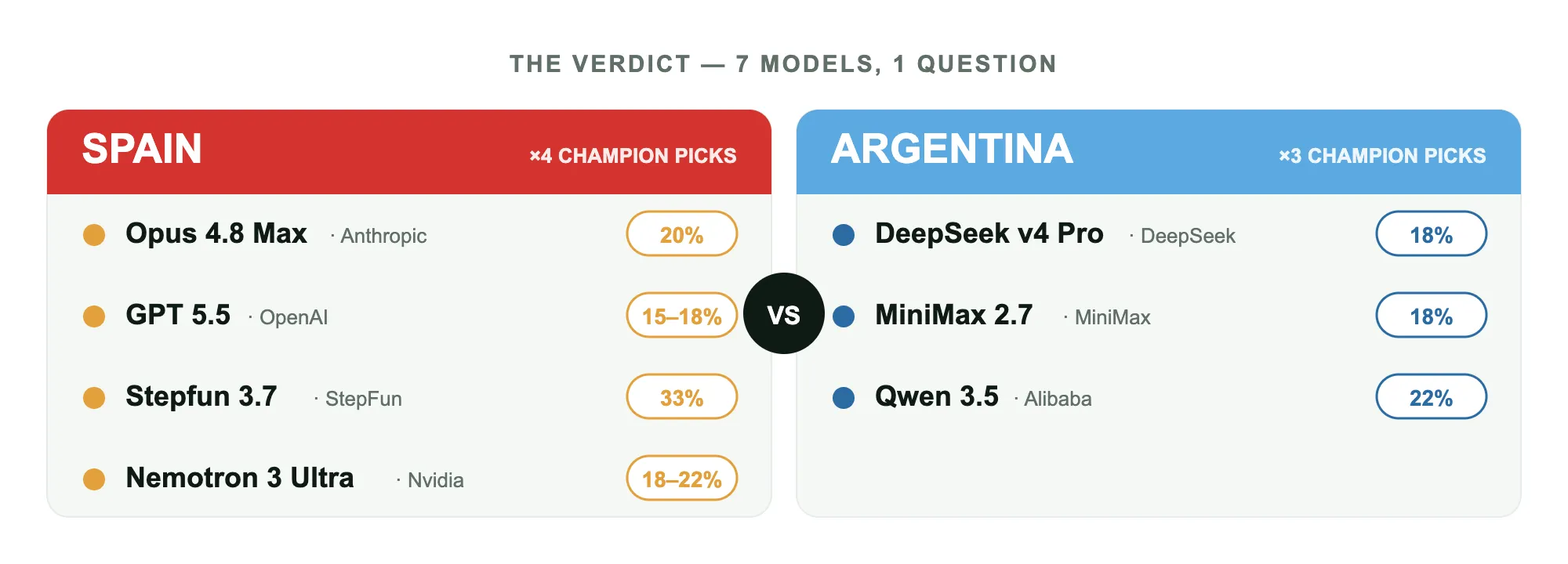
- AI World Cup predictions from 7 frontier models split 4-3 in favor of Spain over defending champions Argentina.
- Every AI World Cup predictions model placed Spain, Argentina, and France in its top tier, regardless of methodology.
- Spain leads prediction markets too, priced at 19% on Myriad — with Argentina surprisingly low at just 10%.
- Each model used a different approach, from Monte Carlo simulations to 5,000-word qualitative breakdowns, yet converged on the same two contenders.
Table of Contents
How the AI World Cup Predictions Experiment Worked
The setup was methodical. Seven frontier AI models — Claude Opus 4.8 Max, GPT-5.5, DeepSeek v4 Pro, Qwen, Stepfun, and two others — were each configured as agents with access to publicly available statistics sources. Same draw, same brief, total freedom on approach. Some went full quant. Some wrote essays. One basically composed a tournament operating manual. The only rule was to forecast the champion and show the work. These AI World Cup predictions were generated independently, with no model able to see what the others had concluded.
The split came out 4-3 in favor of Spain over Argentina. No model put a dark horse on top. Every single one placed Spain, Argentina, and France in its top tier. Which tells you something: whatever method you use — Poisson distributions or gut instinct honed on football data — the consensus at the frontier of AI reasoning looks a lot like the consensus among human analysts. That’s either reassuring or unsettling, depending on how much you were hoping the machines would surprise us. The AI World Cup predictions exercise, taken as a whole, produced a remarkably stable picture at the top.
Prediction markets broadly agree. On Myriad, Spain sits at 19% and France at 17%, while Argentina — three-time World Cup winners and reigning champions — is priced at just 10% as of early June. That gap between the AI World Cup predictions and the markets on Argentina is one of the most interesting signals in this whole exercise.
Claude Opus 4.8 Max: The Physicist’s Approach
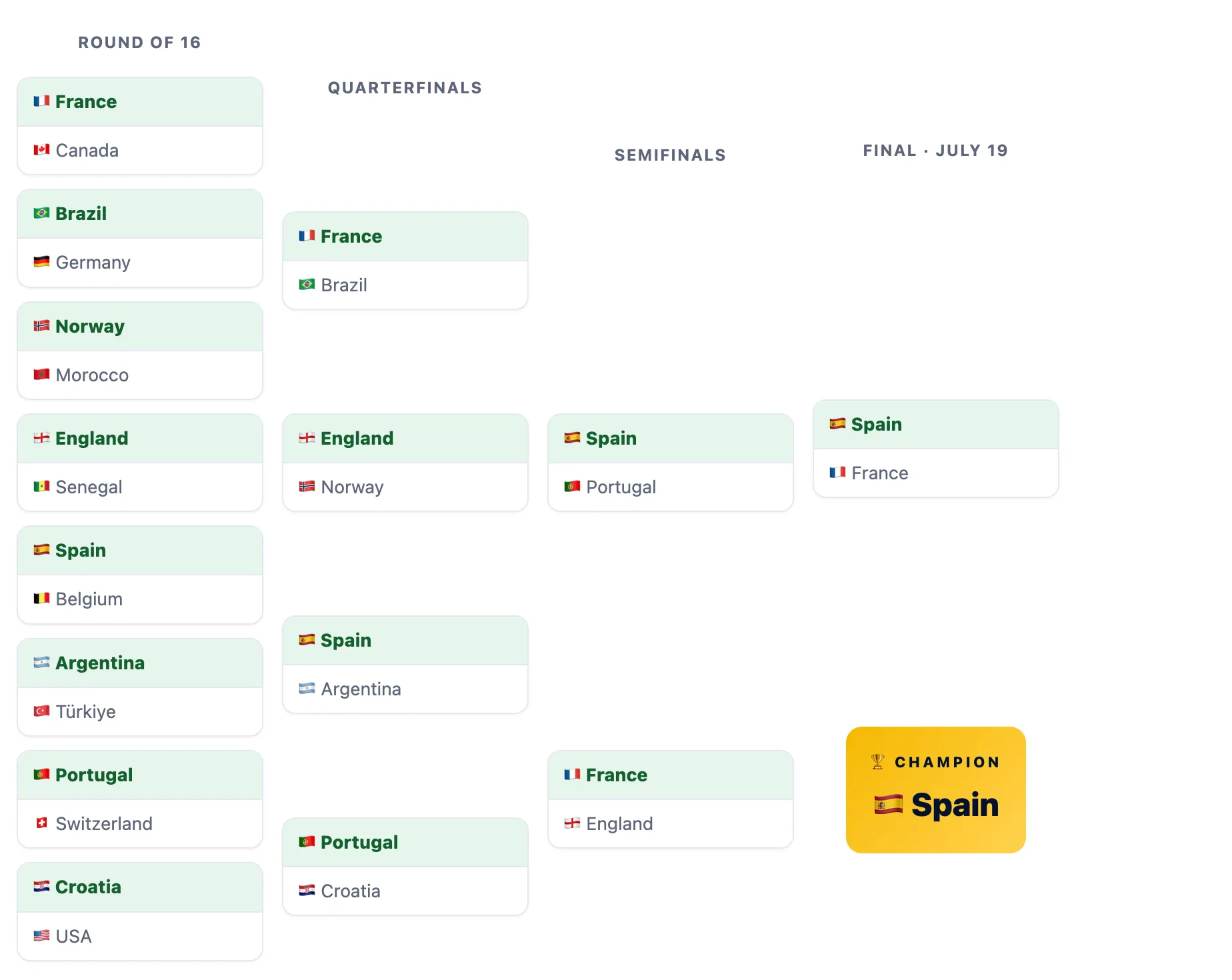
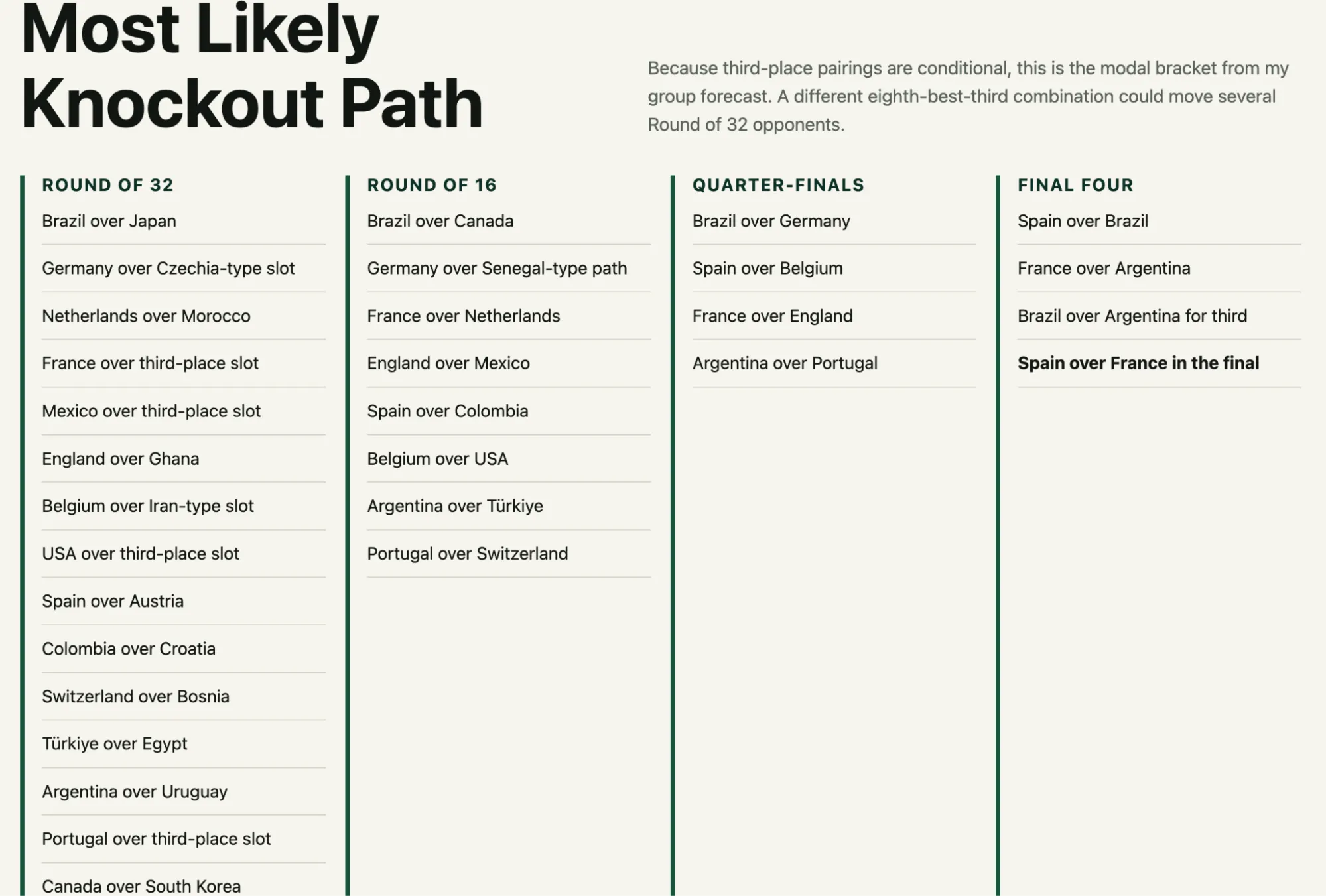
Anthropic’s flagship model treated the tournament like a fluid dynamics problem. It built a Dixon-Coles Poisson model — the same framework that underpins serious bookmaker pricing — layered Elo ratings on top, and ran the bracket through thousands of Monte Carlo simulations. Spain emerged at 20%, with a projected final against France, and Portugal and England knocked out in the semis. Among all the AI World Cup predictions generated in this experiment, Opus produced some of the most granular probabilistic outputs.
What made Opus stand out wasn’t the methodology — it was the variables it chose to price in. It was the only model to treat the physical conditions of a North American summer tournament as a genuine analytical input. Five matches fall in heat severe enough to measurably affect performance, it argued. Visiting teams climbing to 2,200 meters at the Azteca — home to some of the Group Stage matches — tend to fade badly in the final 20 minutes. Opus treated altitude and heat as a quiet but compounding tax on squads without depth.
Its harshest call was Brazil. With Rodrygo’s knee out, Estêvão injured, and Neymar — 34 and returning for one final tournament — back in the squad, Opus cut the five-time champions to just 8%. That’s roughly half what Argentina-leaning models assigned them. And its marquee prediction was a quarterfinal billed as ‘the real final’: Spain over Argentina, Messi pinned back and unable to impose himself. Mbappé got the Golden Boot nod. Opus barely deliberated on that one.
GPT-5.5: The Careful Scout
OpenAI’s model took the opposite philosophical stance. Rather than building a simulation it might trust too much, GPT-5.5 built a scorecard — five weighted categories, with squad quality accounting for 35%, followed by tactical control, finishing, availability, and draw luck. It was deliberately blunt about the weights to avoid the illusion that football is more predictable than it actually is. As AI World Cup predictions go, GPT-5.5’s approach was among the most epistemically honest in the field.
Spain came out on top at 15–18% — and that range is deliberate. GPT-5.5 wouldn’t pretend to more decimal places of precision than the sport warrants. It projected a Spain 2-1 France final, decided by a single moment or extra time. Then it did something none of the others did: it cross-checked itself. It benchmarked against Opta’s 25,000-simulation supercomputer, which landed Spain at 16.1% — almost identical. That’s not a coincidence; it’s a sign that the underlying statistical picture is fairly stable across methodologies.
The scouting instinct came through in what it flagged beyond the numbers. A training-ground incident where a stray Gavi challenge left Rodri on the floor. The careful management of Lamine Yamal and Nico Williams returning from muscle trouble. None of it changed the pick. All of it lowered the confidence. That’s actually good forecasting — acknowledging what you don’t know rather than papering over it with a tighter probability estimate. England, it noted bluntly, is loaded and genuinely dangerous, and will almost certainly be stopped by France before the semifinals.
DeepSeek v4 Pro: The Maximalist Case for Argentina
If GPT-5.5 was a scout’s notebook, DeepSeek v4 Pro was a parliamentary inquiry. It answered a standard forecasting brief with a 5,000-word document — the full Round of 32, annotated squad assessments for all 48 teams, travel distance breakdowns including the 4,500 kilometers separating Vancouver and Miami venues. The others wrote previews. DeepSeek wrote the manual. Its AI World Cup predictions were the most exhaustive single output in the entire experiment.
All that analysis pointed to Argentina at 18% — the highest confidence assigned to any team by any model in the field. The case was classical: reigning champions with a settled spine, a gentle group-stage draw, and a coach who has spent three years learning exactly how to manage a 39-year-old Messi across a seven-match tournament. DeepSeek wasn’t swayed by the sentiment around a ‘Messi farewell tour.’ It saw tournament pedigree and structural advantage.
The model’s single biggest bet, though, was on one calf muscle. DeepSeek argued the entire France picture — and by extension the title — hinged on whether goalkeeper Mike Maignan recovered from a March injury. If Maignan plays, France are co-favorites; if not, the gap widens, it concluded. That’s a defensible framing. It’s also a reminder of how quickly AI sports analysis can become outdated: if DeepSeek was reading old injury reports, its entire France calculation may be built on stale data. It predicted the final would take place in Miami — it won’t. MetLife Stadium in New Jersey hosts the final, a factual error that somewhat undermines the 5,000-word authority.
What the Split Actually Tells Us
The 4-3 vote for Spain over Argentina is less meaningful than the unanimity underneath it. Every model put those two plus France in the top tier. The disagreement was about which numbers to trust — Elo-based simulations versus qualitative squad assessment versus weighted scorecards — not about which teams are genuinely dangerous. Across all seven sets of AI World Cup predictions, the top-tier consensus held firm regardless of method.
The more interesting signal is the divergence between the AI World Cup predictions and the prediction markets on Argentina. Among the more bullish models, DeepSeek assigned Argentina 18% and Qwen 22%, while others varied in their assessments. Myriad has them at 10%. That gap suggests either the markets are pricing in something the models aren’t seeing — recent form, injury whispers, the intangible drag of a squad built around a 39-year-old — or the models are over-indexing on Argentina’s tournament pedigree and Messi’s historical record.
There’s a broader point here worth sitting with. These AI World Cup predictions models are genuinely good at processing structured data — Elo ratings, fixture schedules, squad depth charts, historical tournament outcomes. They’re less equipped for the things that actually decide knockout football: a goalkeeper having the match of his life, a 25-yard screamer in the 88th minute, a video review that takes four minutes and sends a captain off. The Dixon-Coles model doesn’t have a parameter for that.
That doesn’t make the exercise pointless — far from it. The convergence on Spain across wildly different methodologies is meaningful signal. So is the consistent placement of France. But the honest read on AI World Cup predictions is that they’re best understood as a sophisticated prior, not a forecast. They tell you where the balance of probability sits before a ball is kicked. The tournament is where probability goes to get complicated. As Spain, Argentina, and Mbappé’s France are about to find out.
Frequently Asked Questions
Which team do most AI World Cup predictions favor for 2026?
Four of the seven AI models tested picked Spain as the 2026 World Cup champion, with odds ranging from 15% to 20%. Three models backed Argentina. Every single model placed Spain, Argentina, and France in its top tier, suggesting broad consensus on those three teams.
How accurate are AI predictions for major sports tournaments?
AI models use statistical methods like Elo ratings, Dixon-Coles Poisson models, and Monte Carlo simulations that bookmakers also rely on. They can process squad data efficiently but struggle with unpredictable factors like injuries, referee decisions, and tournament momentum — so treat them as informed guides, not certainties.
What methodology did the AI models use to forecast the World Cup?
Methods varied widely. One model used a Dixon-Coles Poisson model with Monte Carlo bracket simulations. Another built a five-category weighted scorecard. DeepSeek v4 Pro wrote a 5,000-word qualitative analysis covering all 48 squads. Some factored in altitude, heat, and travel distance.
Does AI account for player injuries in World Cup predictions?
Some models did. One model cut Brazil’s odds to 8% after factoring in injuries to Rodrygo and Estêvão, plus Neymar’s age. Another flagged a training scare involving Rodri and monitored Yamal and Nico Williams’ fitness. DeepSeek’s entire France analysis hinged on goalkeeper Mike Maignan’s calf injury.