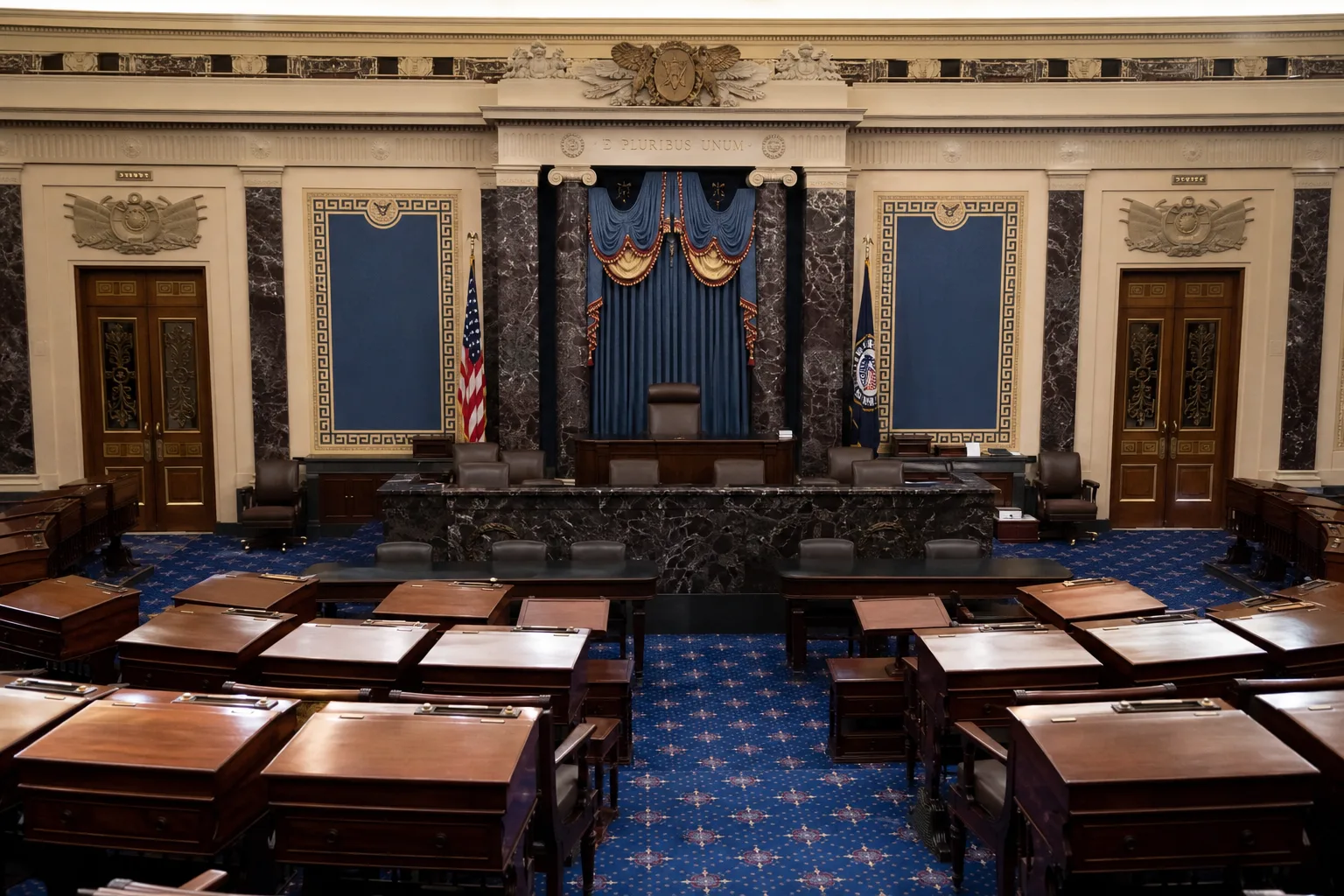
- The JAWBONE Act targets government censorship by letting Americans sue federal agencies — even for unsuccessful pressure campaigns.
- Senators Cruz and Wyden disagree sharply on who is most guilty of government censorship, despite co-sponsoring the same bill.
- Under current law, victims can only seek injunctions — the new bill would add monetary damages as a remedy.
- The bill would require agencies to hand over communications with private companies, boosting transparency around speech coercion.
Table of Contents
A Rare Bipartisan Stand Against Government Censorship
There aren’t many issues in Washington right now where Ted Cruz and Ron Wyden end up in the same corner. But government censorship — specifically, the practice of federal officials quietly leaning on private companies to remove or suppress speech — turns out to be one of them. The two senators have jointly introduced the Justice Against Weaponized Bureaucratic Overreach to Networked Expression Act, which they’re calling, with obvious relish, the JAWBONE Act.
The name isn’t just a clever acronym. It references ‘jawboning,’ a term that describes the informal but often effective practice of government officials pressuring platforms, broadcasters, or app stores to change what they host — without ever passing a law or issuing a formal order. It’s coercion with plausible deniability, and it’s been a genuine legal puzzle for years. Courts have wrestled with exactly how much unofficial government pressure becomes a constitutional violation, and victims have historically had very few tools to fight back against government censorship.
That’s the gap this bill is trying to close. According to Cruz and Wyden’s announcement, ‘Americans face significant hurdles in proving these violations’ under existing law — and the JAWBONE Act is designed to lower those hurdles significantly.
What the Bill Actually Does
The mechanics here matter. Right now, if you believe a government agency pressured a company to censor your speech, your best legal option is to seek an injunction — a court order telling the agency to stop doing it. That’s a weak remedy against government censorship. By the time a court grants it, the damage is already done, the speech is already gone, and the government actor faces no real consequence.
The JAWBONE Act would change that in three meaningful ways. First, it creates a direct cause of action against government agencies and individual employees who attempt to coerce private companies into suppressing speech. Crucially, the attempt doesn’t have to succeed — even an unsuccessful pressure campaign would be actionable. Second, it opens the door to monetary damages, giving plaintiffs a real financial remedy rather than just a symbolic court order. Third, it would force government agencies to disclose their communications with companies implicated in complaints, creating a paper trail that currently doesn’t have to exist.
That transparency provision alone could be significant. One of the core frustrations for researchers and civil liberties advocates probing cases like the government’s communications with social media platforms over content moderation has been the difficulty of obtaining internal correspondence. This bill would effectively mandate disclosure in the context of active complaints.
Where Cruz and Wyden Sharply Disagree
The bipartisan handshake only goes so far. Both senators used the bill’s announcement to take pointed shots at the other side of the aisle — which, in a way, actually illustrates why the legislation could matter.
Cruz trained his fire on the Biden administration, accusing it of weaponizing the Cybersecurity and Infrastructure Security Agency to pressure Big Tech into removing content from people who ‘spoke out against vaccine mandates and election fraud.’ That’s a reference to revelations from the so-called ‘Twitter Files’ and subsequent congressional testimony, which showed CISA staff flagging content to social media platforms for moderation review — a practice that critics argued crossed from information-sharing into government censorship of a particularly opaque kind.
Wyden, meanwhile, pointed in the opposite direction. In his statement, he argued the most obvious recent example of jawboning is ‘Trump threatening cable companies because he doesn’t like their late-night shows’ — a swipe at the former and current president’s habit of publicly demanding that networks pull programming he finds unflattering. A spokesperson for Wyden also told Ars Technica that the bill would cover the Trump administration’s alleged pressure on Apple and Google to remove ICEBlock from their app stores. ICEBlock was an app that let users pin the locations of ICE agents on a map. Its creator is currently suing the federal government over what the lawsuit describes as ‘unlawful threats’ that led directly to the app’s removal — another example of government censorship through informal coercion rather than formal legal process.
The fact that both senators can point to their own party’s enemy as the primary offender isn’t a contradiction — it’s actually the point. Jawboning isn’t a partisan tactic. It’s a structural temptation for whoever happens to hold executive power. Any administration with a phone and a grudge can pick it up.
The Broader Legal Context
This bill doesn’t exist in a vacuum. The Supreme Court weighed in on the boundaries of government censorship pressure in Murthy v. Missouri, decided in 2024, where the court ultimately ruled that the plaintiffs lacked standing to challenge the Biden administration’s communications with social media companies — not because the conduct was necessarily lawful, but because they couldn’t show a sufficient causal link between government contacts and specific content removals. The majority opinion left the door open for future cases with stronger standing, and the JAWBONE Act is essentially a legislative attempt to build that door wider.
By explicitly creating a cause of action — including against unsuccessful attempts — the bill sidesteps some of the standing problems that sank Murthy. You wouldn’t need to prove that a government email directly caused your post to be deleted. You’d just need to show the pressure happened.
Whether that standard is too broad is a legitimate question. Critics could argue it would expose government officials to harassment lawsuits any time they communicate with a platform about anything. Defenders would say the current situation is worse — a complete absence of accountability for conduct that can genuinely constitute government censorship and chill speech at scale.
What Happens Next
Bipartisan bills with catchy names don’t automatically become law, and this one faces the usual gauntlet. Congress has a long history of introducing legislation around free speech and platform governance — from the ongoing push to reform or repeal Section 230 to various attempts at federal privacy legislation — and most of those bills have stalled. The political incentives to actually pass something are complicated when both parties want to reserve the right to do a bit of jawboning themselves.
Still, the coalition here is real. Cruz brings the conservative base’s anger over perceived anti-conservative bias in content moderation. Wyden brings the civil libertarian left’s alarm over executive overreach. If those two camps can stay focused on the bill’s core mechanism rather than their preferred villains, there may be more appetite for this one than for the usual partisan grandstanding dressed up as legislation.
The JAWBONE Act also arrives at a moment when the relationship between government and platform speech is more contested than it’s been in decades. AI-generated content, election misinformation, and national security-driven pressure on app stores have all pushed the question of where government influence ends and government censorship begins into genuinely unresolved territory. A law that at least draws a clearer line — and puts consequences behind it — might be overdue.
Frequently Asked Questions
What does the JAWBONE Act do to fight government censorship?
The JAWBONE Act creates a legal cause of action against any government agency or employee that pressures private companies to censor speech — even if those attempts fail. It allows plaintiffs to seek monetary damages, not just injunctions, and requires agencies to disclose relevant communications with companies.
What is ‘jawboning’ in the context of free speech?
Jawboning refers to government officials using informal pressure — threats, calls, or persuasion — to get private companies to change their content moderation policies or remove speech, without passing any formal law. It sits in a legal grey zone that the JAWBONE Act aims to address.
Is the JAWBONE Act already law?
No. As of its introduction, the JAWBONE Act is a Senate bill. It still needs to pass both chambers of Congress and receive presidential approval before it becomes law.
What real-world cases does the JAWBONE Act apply to?
Supporters point to several examples: the Biden administration’s alleged pressure on Big Tech over vaccine and election content, Trump threatening cable networks over programming, and the Trump administration pushing app stores to remove ICEBlock, an app that tracked ICE agents’ locations.