They’re the size of Jupiter, but weigh almost nothing by comparison. NASA’s TESS mission has just confirmed two super-puff planets so extraordinarily light that scientists reached for a decidedly unscientific analogy to describe them: cotton candy. These aren’t theoretical oddities — they’re real, confirmed worlds orbiting a star 1,113 light years from Earth, and they’re already causing headaches for the models we use to explain how giant planets form.
- NASA’s TESS mission discovered two super-puff planets so light their density rivals cotton candy, unlike anything seen before.
- The two super-puff planets, TOI-791 b and c, orbit a Sun-like star 1,113 light years away with unusually long orbital periods.
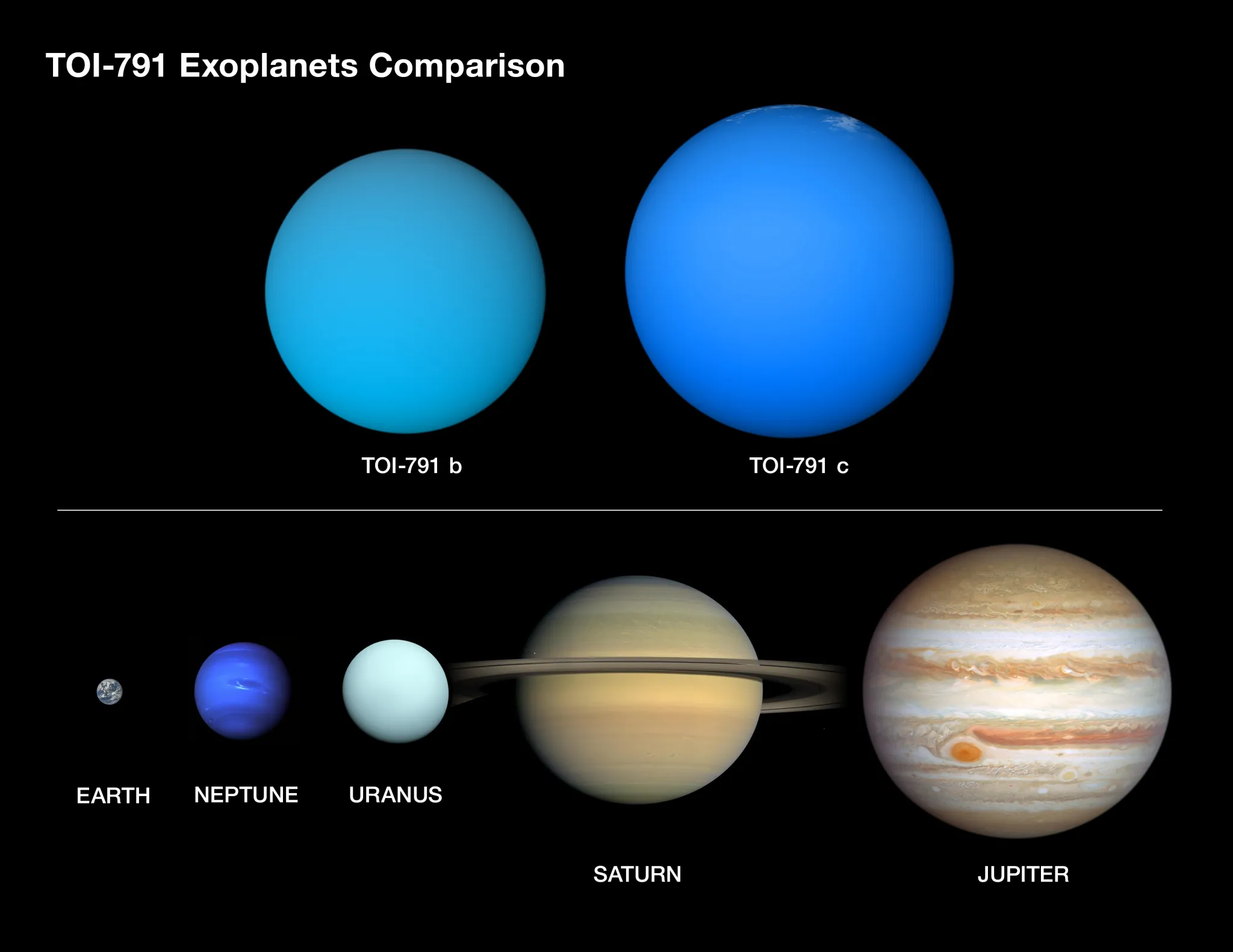
- TOI-791 b is Jupiter-sized but holds just 3% of Jupiter’s mass — a disparity that challenges standard models of giant planet formation.
- Scientists plan to study the planets’ atmospheres and orbital histories to understand how such extreme low-density worlds can exist.
Table of Contents
Meet TOI-791 b and TOI-791 c, the Lightest Worlds We Know
The two newly confirmed super-puff planets go by the designations TOI-791 b and TOI-791 c, named after their host star TOI-791, a Sun-like star sitting more than a thousand light years away in our galaxy. TOI-791 b is nearly identical in physical size to Jupiter — but carries just 3.0% of Jupiter’s mass. TOI-791 c is actually larger than Jupiter, yet manages only 5.9% of Jupiter’s mass. To put that in perspective, if Jupiter were a bowling ball, TOI-791 b would be closer to a balloon.
That makes both worlds the lowest-density planets ever confirmed, according to researchers involved in the Monthly Notices of the Royal Astronomical Society study that published these findings. The study was led by George Dansfield of Oxford University’s Department of Physics, in collaboration with teams from Université Côte d’Azur and the University of Birmingham.
‘Only a handful of these super-puffy planets are known, and it is even rarer to find two in the same system,’ said Dansfield. ‘Their extremely low densities make them fascinating targets for understanding how planetary systems form and evolve.’ That’s a polite way of saying these planets probably shouldn’t exist — at least not according to the theories we currently rely on.
How TESS Tracked Down These Super-Puff Planets
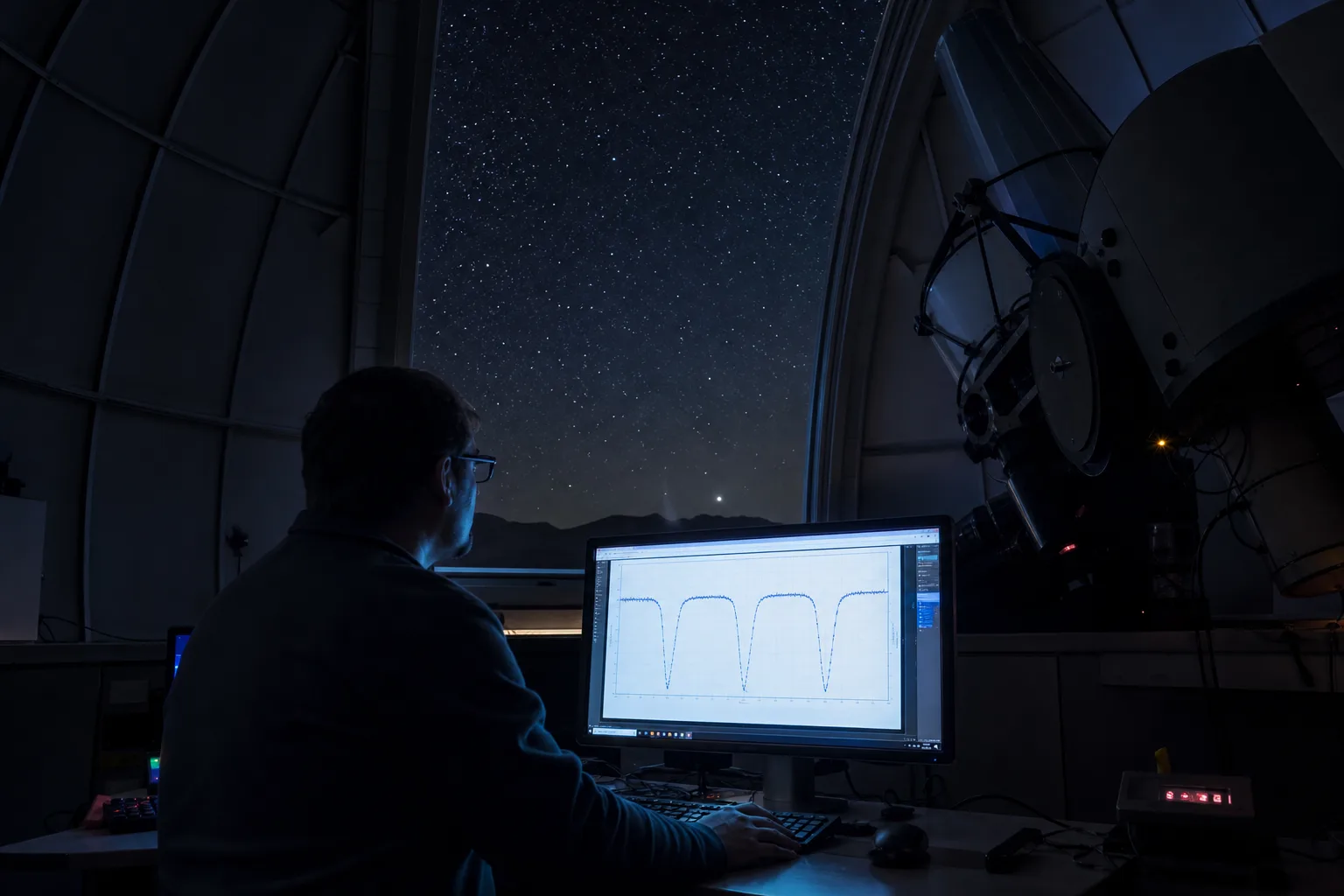
TESS — the Transiting Exoplanet Survey Satellite — has been one of NASA’s most quietly productive missions since its 2018 launch. Its method is elegant in its simplicity: stare at stars and wait for their brightness to dip. When a planet crosses in front of its host star, it blocks a tiny fraction of that starlight, creating a repeating pattern that reveals the planet’s presence, size, and orbital period.
Finding super-puff planets like these two required patience. TOI-791 b takes 139 days to complete one orbit around its star. TOI-791 c takes even longer — 232 days. These are unusually long orbital periods for confirmed exoplanets, because detecting and verifying a planet’s transit requires watching it complete multiple orbits. That demands sustained observation windows that most telescopes simply can’t commit to.
TESS, operating from high Earth orbit, managed to accumulate 1,122 days of data on the TOI-791 system across seven years of operation. That’s an extraordinary dataset, and it’s what made this discovery possible. Jon Jenkins, science lead for the Science Processing Operations Center at NASA’s Ames Research Center in California’s Silicon Valley, explained the significance: ‘The main reason these planets are interesting to study is that we didn’t expect to see them at all. They represent a puzzle for us to solve about how giant planets like Jupiter and the super-puffs form.’
A Gravitational Dance That Revealed Their Masses
Detecting a planet via transit tells you its size and orbital period. But mass — one of the most fundamental properties of any world — is trickier to pin down. For TOI-791 b and c, the research team got lucky: the two planets are locked in a gravitational resonance, meaning they periodically pull on each other as they orbit their star.
That mutual gravitational influence causes subtle shifts in the exact timing of each planet’s transit across TOI-791. By carefully measuring those timing variations — a technique known as transit timing variation, or TTV — scientists were able to calculate both planets’ masses with enough confidence to confirm their status as super-puff planets. It’s one of the few methods available when you’re dealing with long-orbit planets that are hard to study with radial velocity measurements, which typically require a planet to be yanking on its star with a detectable gravitational force.
The fact that two super-puff planets sit in the same system, tugging on each other in a measurable way, is a stroke of scientific fortune. It’s the kind of configuration that lets researchers extract far more data than they’d normally get from a single isolated world at this distance.
Why Super-Puff Planets Challenge Everything We Think We Know
Standard models of giant planet formation — the core accretion model being the dominant one — generally predict that gas giants build up a solid or semi-solid core, then accrete enormous amounts of gas until they reach Jupiter-like masses. Super-puff planets blow a hole in that picture. How do you end up with a Jupiter-sized object that has barely any mass to speak of?
Several competing explanations have been proposed. One idea is that super-puff planets formed much farther out in their solar systems, in regions where hydrogen and helium are more readily available, and then migrated inward. Another possibility is that their atmospheres are dramatically bloated by internal heat or stellar irradiation, puffing them up far beyond what their mass alone would normally support. A third hypothesis involves extended dust or haze layers in the upper atmosphere that make the planets appear larger than their gas envelope actually is when observed in transit.
None of these explanations fully satisfies astronomers on their own, which is exactly why these two new worlds are so valuable. ‘Large planet formation is believed to drive the evolution of a planetary system, so further study of these Jupiter-size, but far less than Jupiter-mass, planets is of high value,’ said Steve Howell, a research scientist at NASA Ames who contributed to the study.
What Comes Next for TOI-791
The confirmation of TOI-791 b and c is really just the opening move. The research team has flagged several specific follow-up questions they want to answer. Chief among them is atmospheric composition — what gases make up the extended envelopes of these worlds, and can spectroscopic observations with instruments like the James Webb Space Telescope tease apart their chemical fingerprints?
There are also questions about the planets’ rotational dynamics and how the axial tilt of TOI-791 compares to the orbital planes of its planets. A significant tilt — called stellar obliquity — can indicate a turbulent orbital history, possibly shaped by past gravitational interactions with other planets in the system that we haven’t detected yet.
That migration question is arguably the most fascinating. If TOI-791 b and c formed elsewhere and drifted to their current positions, the history of that journey is likely written into their orbital dynamics and atmospheric chemistry. Decoding it could help astronomers understand why our own solar system ended up looking the way it does — and why Jupiter, a planet we thought we understood, might be less typical than we assumed.
Super-puff planets remain among the rarest confirmed planet types in the known exoplanet catalog. Finding two in a single system, with seven years of TESS data behind them and the gravitational interaction needed to calculate their masses, is the kind of alignment that doesn’t come along often. The TOI-791 system just became one of the most scientifically interesting planetary systems we know about — and we’ve barely started asking questions.
Frequently Asked Questions
What are super-puff planets and why are they unusual?
Super-puff planets are gas giants with extraordinarily low densities — comparable to cotton candy. They’re unusual because scientists didn’t expect to see them at all, and their existence poses a puzzle about how giant planets form. Only a handful have ever been confirmed, making the TOI-791 system, which hosts two of them, exceptionally rare.
How did NASA’s TESS detect the TOI-791 super-puff planets?
TESS detected the planets by monitoring repeated dips in the brightness of their host star TOI-791 as each planet transited in front of it. The mission gathered 1,122 days of observational data over seven years, giving scientists enough information to confirm both planets and measure their properties.
How were the masses of TOI-791 b and TOI-791 c measured?
Scientists used transit timing variations — subtle changes in when each planet crossed its star caused by the gravitational tug-of-war between the two worlds. Analysing those timing shifts allowed researchers to calculate each planet’s mass, cementing their status as low-density super-puffs.
Could super-puff planets like TOI-791 b and c support life?
Almost certainly not. Both planets have extremely low densities and very long orbits, but their composition — likely thick, extended gas envelopes with no solid surface — makes them highly inhospitable. Scientists are more interested in what their atmospheres can reveal about planetary formation than in habitability.