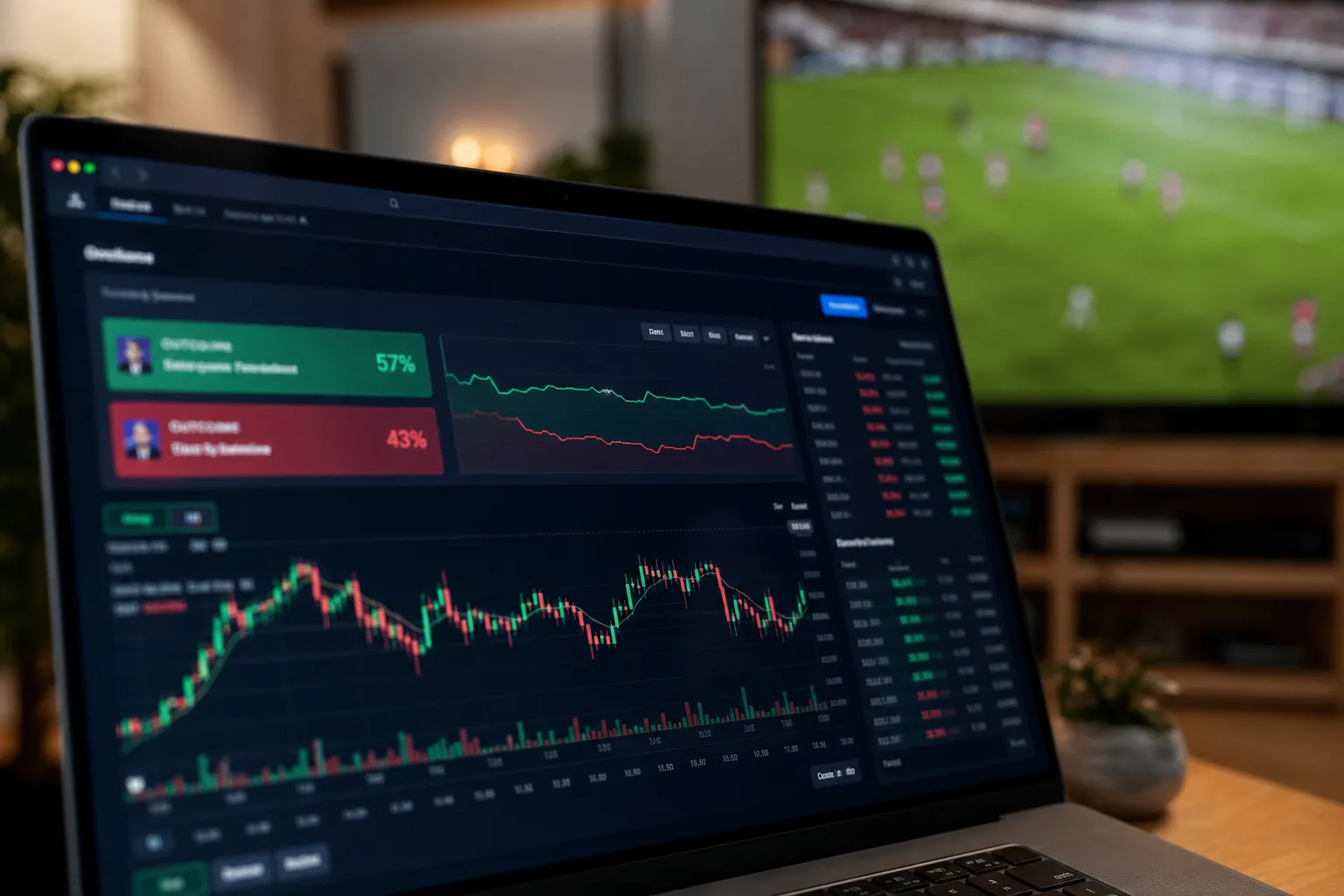
The 2026 World Cup was supposed to be a story about football. Instead, Polymarket World Cup bets are generating their own parallel tournament — one measured in wallets, spreads, and seven-figure wipeouts happening in real time, on a public ledger, for anyone to watch. And so far, the favorites are losing.
- Polymarket World Cup bets have surpassed $2.5 billion in combined volume across 362 active markets.
- One wallet turned $400,000 into nearly $9 million on Polymarket World Cup bets against Spain.
- Bettors backing Spain, Belgium, and the Netherlands to win outright lost millions when all three drew.
- A $8.6 million wager on Belgium — the tournament’s largest single bet so far — was wiped out by a 1-1 draw with Egypt.
Table of Contents
A 40-Year-Old Goalkeeper and a $9 Million Day
Spain controlled possession for nearly 75% of their June 14 group-stage opener against Cape Verde and took 27 shots at goal. By every conventional metric, this was a team that was supposed to win. They didn’t score once. Cape Verde’s goalkeeper, Vozinha — 40 years old and playing in his country’s first-ever World Cup — made save after save to earn a 0-0 draw and walk away with player-of-the-match honors.
For bettors who had backed Spain, it was a disaster. For a wallet called fishalive, it was the trade of the tournament. The account, which only joined Polymarket in June 2026 and has placed exactly two recorded predictions, redeemed approximately $4.7 million on a ‘Spain not to win’ contract and another $8.5 million on a Cape Verde +2.5 spread. Total stake: around $400,000. Total profit: close to $9 million in a single day. It stands as one of the most-discussed Polymarket World Cup bets placed during the group stage.
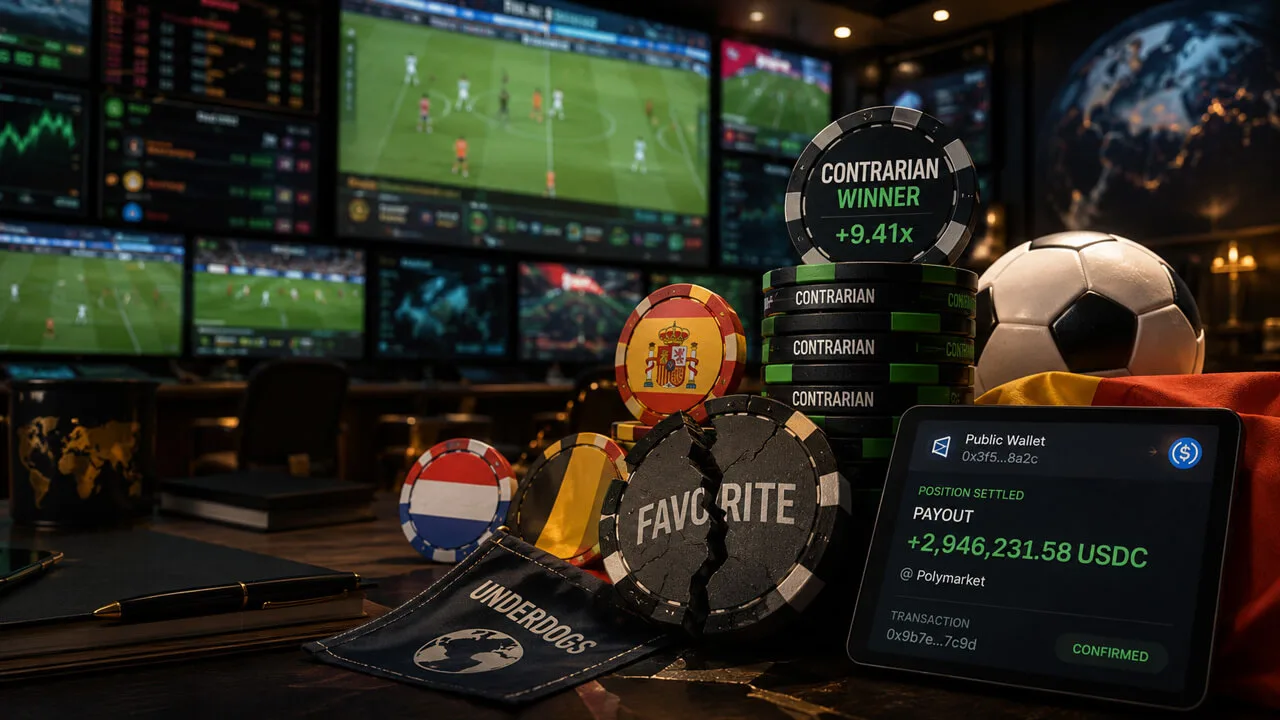
The numbers alone would have been remarkable. But the circumstances around the trade are what lit up crypto Twitter. According to Polymarket Sports, a $4.5 million position was placed just eight minutes before kickoff. The account was brand new. And every cent of it was public, traceable, and watching the payout arrive in real time. Whether that represents extraordinary insight, extraordinary luck, or something else entirely is a question the internet hasn’t stopped asking since the final whistle.
Polymarket World Cup Bets at Unprecedented Scale
To understand why individual match outcomes are generating this kind of noise, you need to look at the overall market infrastructure. Polymarket’s 2026 World Cup lineup now spans 362 active markets pulling in over $2.5 billion in combined volume. The outright tournament winner market alone accounts for $2.46 billion of that. France leads the field at roughly 17.6%, with Spain at around 13.9% and Portugal and England trailing at 10.8% and 10.5% respectively — though those odds are shifting fast as results come in. Polymarket World Cup bets on outright winners have attracted the deepest liquidity of any market category on the platform.
For context, Goldman Sachs’ pre-tournament model gave Spain a 26% chance of winning the whole thing, ahead of France at 19%. Polymarket’s crowd has since repriced France above Spain, a direct consequence of the Cape Verde result. That’s prediction markets doing exactly what they’re supposed to do — aggregating new information and recalibrating probability. The problem is that the people holding the now-devalued Spain positions don’t find that particularly comforting.
The Spain game alone generated approximately $64 million in match-level trading. That figure turns a group-stage fixture between a powerhouse and a debutant into a standalone financial event with its own news cycle. It’s a dynamic that traditional sportsbooks can’t replicate — the combination of live repricing, public wallets, and screenshot-ready profit-and-loss has made Polymarket World Cup bets a genuine fixture of sports media coverage, not just crypto coverage.

The Favorites Keep Losing — and the Bills Are Getting Bigger
The Spain result wasn’t a one-off. Within 24 hours, a trader identified as FlickRaw dropped about $4.2 million across two positions: $2.7 million on the Netherlands to beat Japan, and $1.5 million on Belgium to beat Egypt. Japan equalized twice — including a goal in the 88th minute to finish 2-2. Belgium took the lead against Egypt, conceded in the 19th minute, and eventually settled for a 1-1 draw after leveling in the 66th minute. Both bets returned nothing. These were among the most costly Polymarket World Cup bets of the opening round.
Then came the tournament’s largest single wager so far. A trader called leeeroyjenkins — yes, really — staked $8.6 million on Belgium to win outright, a position that would have paid roughly $13.1 million had Belgium managed to beat Egypt. Polymarket Sports tracked the match in real time, posting Egypt’s 1-0 halftime lead before confirming the final draw that erased the entire wager. Eight-point-six million dollars, gone. The account name almost reads like a self-aware joke at this point.
The structural problem with all of these bets is the same. Win-only contracts in soccer pay out for exactly one outcome. A 92-cent ‘Yes’ share prices in near-certainty — it tells you the market thinks the team wins roughly 92% of the time. But the moment the final whistle confirms a draw, that share is worth zero. It doesn’t matter how dominant the team was, how many shots they took, or how much of the ball they controlled. A single extra goal in favor is the only thing that matters, and soccer has an inconvenient habit of not providing it.

Why Spreads and ‘Not to Win’ Contracts Are Quietly Winning
The fishalive trade illustrates the asymmetry hiding inside these markets. While whales were piling millions into win-only positions at razor-thin odds — the betoor619 position risked close to $1 million for a potential gain of just $85,000 — the real money was on the other side, in contracts that explicitly priced in the possibility of a draw. Polymarket World Cup bets structured around spreads and ‘not to win’ outcomes have consistently outperformed their win-only equivalents this tournament.
A ‘Spain not to win’ contract and a Cape Verde spread both paid out on a 0-0. The exact result that erased every outright favorite bet that week was the same result that turned $400,000 into $9 million. That’s not just good timing — it’s a lesson in how prediction market structure rewards bettors who think about contract mechanics rather than just backing the better team.
The broader pattern that’s emerging is predictable in hindsight. Liquidity has concentrated in win-only favorite Polymarket World Cup bets because they feel safe — Spain at 92% feels like free money. But the largest asymmetric payouts have consistently come from spreads and ‘not to win’ contracts that bake draw risk into their pricing. As more whales get burned on thin-upside win-only wagers, there’s a reasonable case that capital migrates toward those hedged structures as the group stage continues.
What This Means for Prediction Markets Beyond Crypto
Polymarket World Cup bets are doing something that no previous crypto prediction market event quite managed: generating stories that resonate with a massive, non-crypto-native audience. Football fans globally understand wins, draws, and upsets. They don’t need to understand blockchain to feel the drama of an 88th-minute equalizer that just erased an $8.6 million position.
The World Cup format is almost purpose-built for prediction market virality. You get a compressed group-stage schedule that produces new matches — and new viral wallet stories — every few hours. You get national-team stakes that carry emotional weight entirely independent of money. And you get match-level contracts that resolve in roughly 90 minutes, generate instant profit-and-loss screenshots, and immediately punish bad sizing in a way that traditional sportsbooks, with their payout delays and account limits, simply can’t match. Every session of Polymarket World Cup bets produces at least one story that travels far outside crypto circles.
That said, there’s a regulatory cloud forming. The CFTC issued draft rules on June 10 aiming to formalize federal oversight of prediction markets, acknowledging that sports contracts can aid price discovery while signaling that the current laissez-faire environment won’t last indefinitely. How that framework ultimately shapes up will have major implications for how platforms like Polymarket operate — and whether the scale of activity we’re seeing right now is a preview of something permanent or a window that’s already closing.
Either way, there are still weeks of group-stage football left, dozens of matches where the ‘obvious’ favorite has a very realistic chance of not winning, and billions of dollars in active Polymarket World Cup bets waiting to resolve. The next leeeroyjenkins moment is probably already in the market. Whether it ends in a win or a wipeout is, as ever, 90 minutes away.
Frequently Asked Questions
How much total volume have Polymarket World Cup bets generated?
Polymarket’s 2026 World Cup lineup spans 362 active markets with over $2.5 billion in combined volume. The outright winner market alone has logged $2.46 billion, and a single Spain vs. Cape Verde match generated around $64 million in trading on its own.
Who is ‘fishalive’ and how did they make $9 million on Polymarket?
Fishalive is a newly created Polymarket wallet that joined in June 2026 and placed just two predictions. The account staked roughly $400,000 on a ‘Spain not to win’ contract and a Cape Verde +2.5 spread, cashing out close to $9 million after Spain drew 0-0 with Cape Verde.
Why do win-only bets on favorites carry such high risk on Polymarket?
Win-only contracts pay out for exactly one outcome. In soccer, draws are common — even dominant sides can fail to score. A 92-cent ‘Yes’ share prices in near-certainty, but it collapses to zero the moment the match ends level, no matter how dominant the favorite appeared.
What are the CFTC’s current plans for regulating prediction markets?
The CFTC issued draft rules on June 10 aimed at formalizing federal oversight of prediction markets. The proposal acknowledges that sports contracts can contribute to price discovery, but would introduce a formal regulatory framework that currently does not exist for platforms like Polymarket.