
With the World Cup heading to North America in 2026, fans are already anticipating those genuinely breathtaking moments — a free kick that bends around a wall of defenders and dips under the crossbar at the last instant. Soccer ball bending looks like something between athletic artistry and outright sorcery. It isn’t either. It’s physics, specifically fluid dynamics, and once you understand the mechanics of soccer ball bending, you’ll never watch a Trent Alexander-Arnold delivery or a late Lionel Messi curler quite the same way again.
- Soccer ball bending relies on the Magnus effect, where spin drags air to one side and deflects the ball’s path.
- Soccer ball bending isn’t possible without air — spin has zero effect in a vacuum, making Earth’s atmosphere essential.
- Air resistance quadruples when ball speed doubles, which severely limits how far ungoverned kicks can travel.
- Three of Newton’s laws of motion directly explain how a kicked ball accelerates, curves, and eventually hits the ground.
Table of Contents
Starting from Zero: Soccer in a Vacuum
To really get a grip on what’s happening to a moving ball, it helps to strip away every variable and build the picture back up from scratch. Start with the most extreme scenario imaginable: soccer in space, with no atmosphere and no gravity whatsoever.
A player in a spacesuit kicks the ball. During that brief moment of contact — roughly a hundredth of a second — the foot exerts a force, the ball compresses and springs back, and it launches away at whatever speed the kick generated. A professional player can easily send a ball traveling at 80 miles per hour. The moment contact breaks, though, no more force acts on the ball. And that means, per Newton’s first law of motion, it keeps moving in a straight line at a constant speed until something stops it. In the frictionless vacuum of space, that’s essentially forever.
No curve. No drop. Just a ball sailing off into the cosmos. It’s a useful thought experiment precisely because it tells you that everything interesting about soccer ball flight — the arc, the dip, the swerve — comes from external forces. Remove those forces and you remove all the drama. Soccer ball bending, in other words, is entirely a product of the atmosphere and gravity working together.
Gravity Enters the Game
Bring the game back to Earth but keep the atmosphere away for a moment, and now you have a single new player in the equation: gravity. The gravitational force on any object equals its mass multiplied by g, Earth’s gravitational field strength of 9.8 newtons per kilogram. What makes gravity interesting — and slightly counterintuitive — is that when you combine Newton’s second law (force equals mass times acceleration) with the gravitational force equation, the mass cancels out entirely.
The practical result is that every object on Earth accelerates downward at exactly 9.8 metres per second per second, regardless of how heavy it is. Drop a bowling ball and a marble from the same height at the same moment and they hit the ground simultaneously. Same goes for a soccer ball and a tennis ball. The gravitational force on the heavier object is larger, but so is its resistance to acceleration — they cancel perfectly.
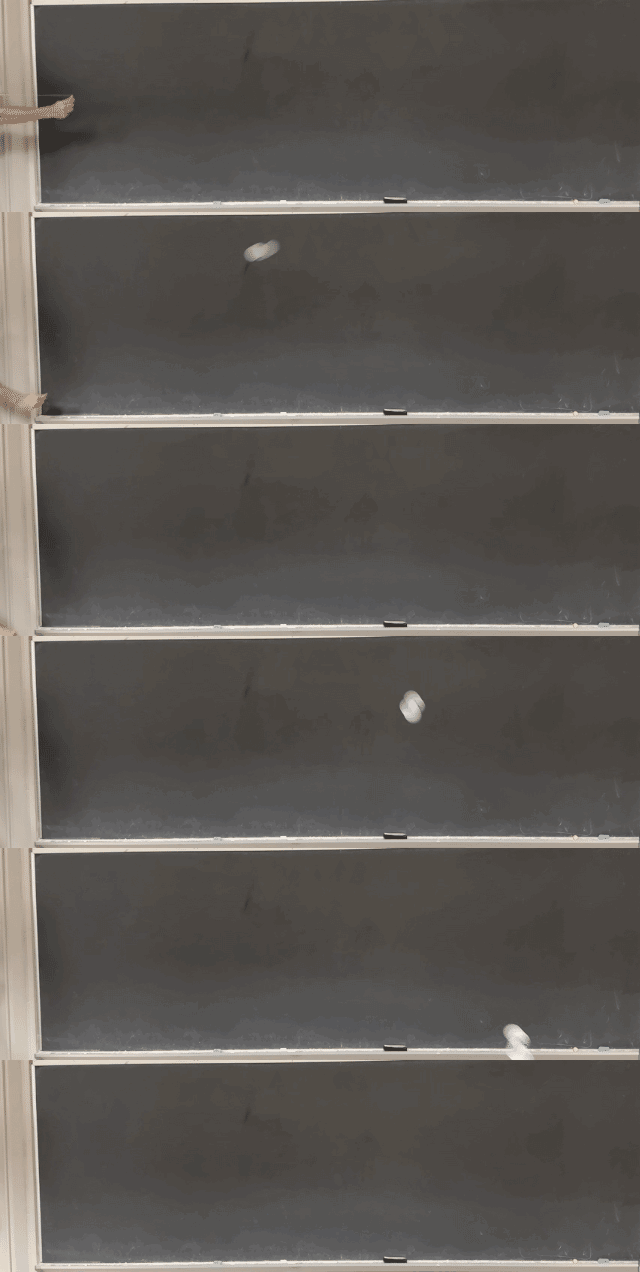
So kick a ball on an airless Earth at an upward angle and you get the classic ballistic trajectory — that familiar inverted parabola. The vertical component of velocity slows, stops, and reverses as gravity pulls the ball back down. The horizontal component? Completely unchanged, because there’s no horizontal force acting on it. The ball doesn’t slow down and then fall; it keeps moving forward at a steady pace and falls because the ground eventually intercepts it. That’s a distinction that trips up a lot of people. Without spin, there’s no soccer ball bending — just a clean arc shaped entirely by gravity.
What Air Actually Does to a Moving Ball
Now add the atmosphere, and the game gets genuinely complicated. Air resistance — drag — acts continuously on the ball, pushing back against its direction of travel. Think of the air as an enormous cloud of microscopic particles. As the ball moves forward, it collides with huge numbers of these particles, and each collision contributes a tiny braking force. Collectively, they add up to something significant.
Crucially, drag scales with the square of velocity. Double the ball’s speed and you quadruple the air resistance. That’s why a goalkeeper’s casual throw-in barely registers atmospheric interference, while a full-pace Cristiano Ronaldo free kick from 25 yards is working against a substantial opposing force the entire way to goal. Without air drag, a hard goal kick could theoretically carry the ball the length of the field and clear the stands on the other side — the atmosphere is the only thing keeping play on the pitch. Air also happens to be the medium that makes soccer ball bending possible at all, as the next section explains.
Soccer Ball Bending and the Magnus Effect
Here’s where soccer ball bending actually happens, and it requires one more ingredient: spin. When a player strikes the ball off-centre — slicing across it with the inside or outside of the foot — they impart rotational velocity. Now the ball isn’t just translating through the air, it’s also spinning, and that changes everything.
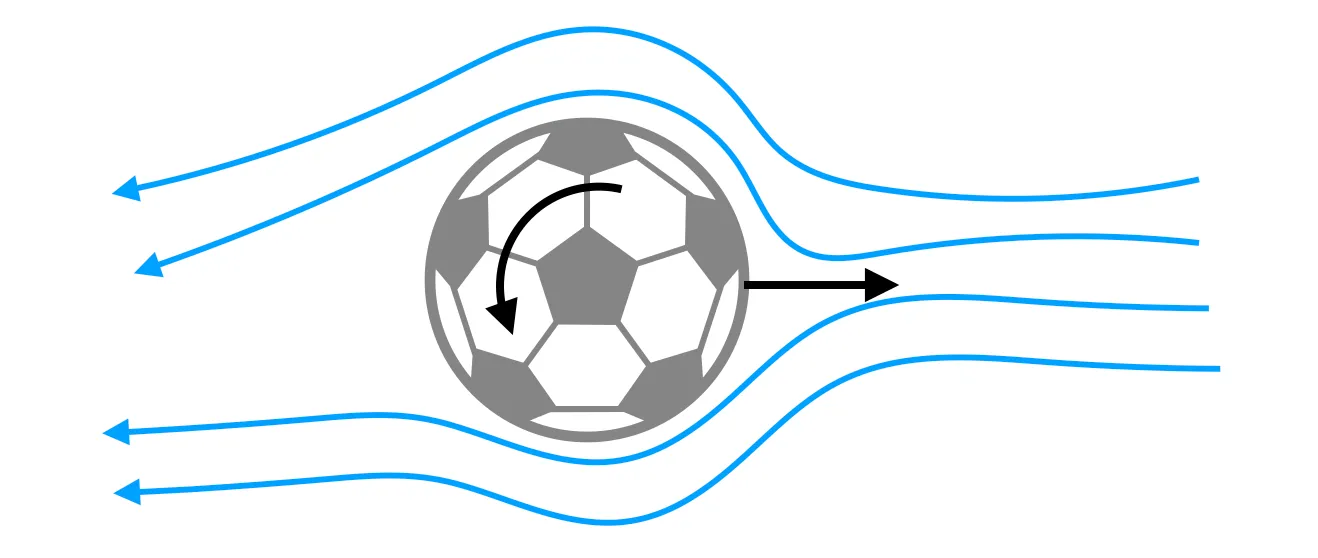
A spinning ball doesn’t just push air molecules aside as it travels. Its rotating surface grabs them and drags them along in the direction of spin. Picture a ball moving to the right while spinning counterclockwise. The top of the ball is rotating in the same direction the ball is travelling, so it pulls air along with it and sweeps it back and downward. The bottom of the ball rotates against the direction of travel, creating a zone of higher pressure underneath. The result is a net upward force on the ball — it climbs rather than drops as quickly as gravity would otherwise dictate.
Reverse the spin, and the force reverses. Put clockwise spin on a ball moving right and it curves downward faster than gravity alone would pull it. Spin it around a vertical axis and the ball curves left or right. This is the Magnus effect, and it’s the entire mechanical basis for every banana free kick you’ve ever watched. Every instance of soccer ball bending you see on a pitch is this same principle expressed through a player’s technique.
The magnitude of the Magnus force depends on four factors: the size of the ball, the roughness of its surface, how fast it’s spinning, and how fast it’s travelling. That last point matters practically. A ball struck hard and with heavy spin will curve dramatically — producing the most visually striking soccer ball bending. A lofted floater with backspin — think a goalkeeper punting downfield — behaves very differently from a low, whipped shot. It’s why players spend years developing the muscle memory to control not just power and direction but spin rate and axis.
Why Ball Design Changes the Physics
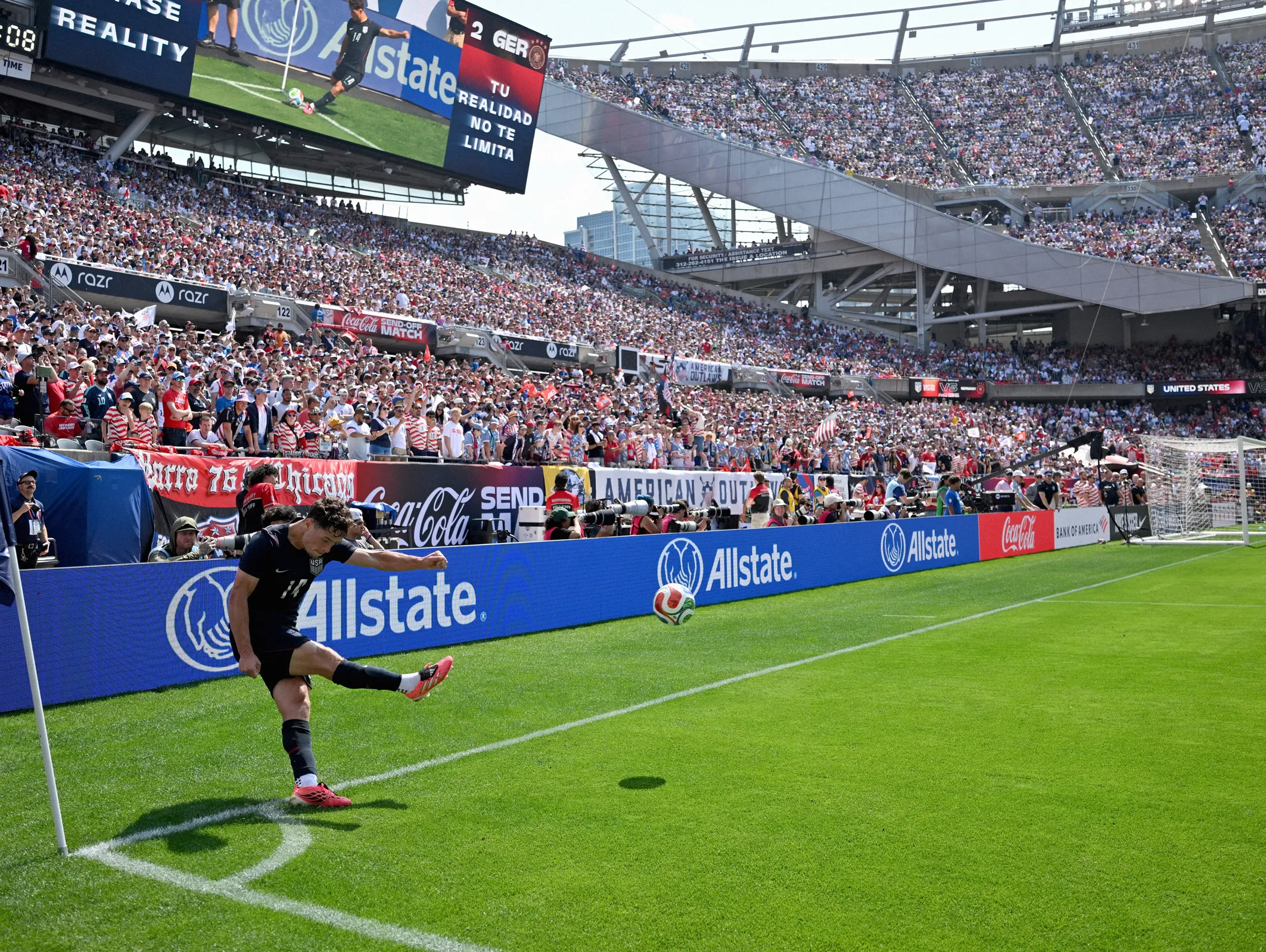
If the Magnus effect depends partly on surface texture, then the design of the ball itself becomes a performance variable — and tournament organisers know it. FIFA’s official match balls have evolved considerably over the decades, from the heavy leather bladders of the 1950s to the Adidas Jabulani at the 2010 World Cup, which became notorious for its unpredictable knuckling behaviour at high speeds. Its unusually smooth, low-panel surface interacted with airflow differently than players expected, leading to a rash of goalkeeper howlers that tournament. The reduced surface texture also made controlled soccer ball bending far harder to achieve consistently.
The knuckleball effect is actually a related phenomenon: a ball struck hard with minimal spin sits in an aerodynamic transition zone where the airflow around it alternates between smooth (laminar) and turbulent. That instability causes the ball to wobble and shift direction mid-flight in ways that are genuinely difficult to predict — not just for goalkeepers, but for the players shooting, too. It’s less controlled artistry than organised chaos, and it’s the opposite of the deliberate soccer ball bending a set-piece specialist is trying to produce.
Ball manufacturers now invest serious resources in wind tunnel testing and computational fluid dynamics modelling to characterise how their designs behave across different speed and spin regimes. What once lived entirely in players’ feet and instincts now has an entire engineering discipline behind it.
What This Means Beyond the Pitch
The fluid dynamics of soccer ball bending are genuinely elegant — three of Newton’s laws showing up in a single kicked ball, plus a 19th-century physics discovery that still governs everything from baseball curveballs to the flight paths of aircraft wings. Sports science programmes at universities from Loughborough to MIT use ball trajectory analysis to teach aerodynamics concepts that feed directly into aerospace and automotive engineering.
There’s also a growing tech angle here. Computer vision systems used in VAR (Video Assistant Referee) and broadcast analytics track ball spin rate, velocity, and trajectory in real time, extracting the exact physical parameters that determine whether a shot curves into the top corner or clips the post. Companies like Stats Perform and Second Spectrum are building predictive models that estimate shot outcome probabilities based on launch angle, spin, and defensive positioning — essentially doing the fluid dynamics calculation live, at match speed.
As player tracking technology improves heading into World Cup 2026, expect the broadcast experience to include richer in-flight data overlaid on free kicks and long-range efforts. The physics hasn’t changed since Magnus published his findings, but our ability to measure and visualise soccer ball bending in real time is moving fast. Understanding the science doesn’t diminish the beauty of a perfectly bent shot — if anything, it deepens it.
Frequently Asked Questions
What causes soccer ball bending in flight?
Soccer ball bending is caused by the Magnus effect. When a player puts spin on the ball, the rotating surface drags air in the direction of rotation. That air displacement creates an unequal pressure on opposite sides of the ball, generating a sideways or upward force that curves the trajectory.
Does the speed of the ball affect how much it curves?
Yes. The magnitude of the Magnus force depends on both the ball’s rotation rate and its velocity. A faster, more heavily spinning ball will curve more dramatically. However, faster balls also generate more air resistance — drag quadruples when speed doubles — so the two effects interact in complex ways.
Would a soccer ball travel in a straight line in space?
Essentially, yes. With no gravity and no atmosphere, Newton’s first law takes over completely. Once kicked, the ball would continue in a straight line at constant speed indefinitely. There’d be no curve, no drop, and no Magnus effect — spin becomes irrelevant without air to interact with.
How does spin direction determine which way the ball curves?
The direction of spin dictates where the Magnus force pushes the ball. A counterclockwise spin on a ball moving horizontally, for example, drags air downward from above the ball, causing the air to push the ball upward. Reversing the spin reverses the curve — which is why players can bend shots either way.