

- Pixel 10 Pro XL charging peaks at just 37W, making it one of the slowest flagship phones in 2026.
- Rival phones like the OnePlus 15 reach 64% in 20 minutes — Pixel 10 Pro XL charging only hits 45% in the same window.
- Samsung’s Galaxy S26 Ultra now charges fully in 42 minutes at 60W, leaving Google with very little room to hide.
- Unless Google meaningfully upgrades Pixel 11 Pro XL charging speed, the gap with Chinese and Korean rivals will keep widening.
Table of Contents
Pixel 10 Pro XL Charging Makes You Feel the Gap Every Single Day
Pixel 10 Pro XL charging isn’t slow in the abstract, theoretical, spec-sheet sense. It’s slow in the most practical, annoying, real-world way — the kind of slow you feel every time you glance at the cable and realise you’ve been plugged in for 45 minutes and still aren’t ready to walk out the door. After spending time with phones like the OPPO Find X9 Ultra and the Xiaomi 17 Ultra, where 20 minutes on a charger during breakfast is genuinely enough to carry you through the day, going back to the Pixel 10 Pro XL is a jarring step backwards.
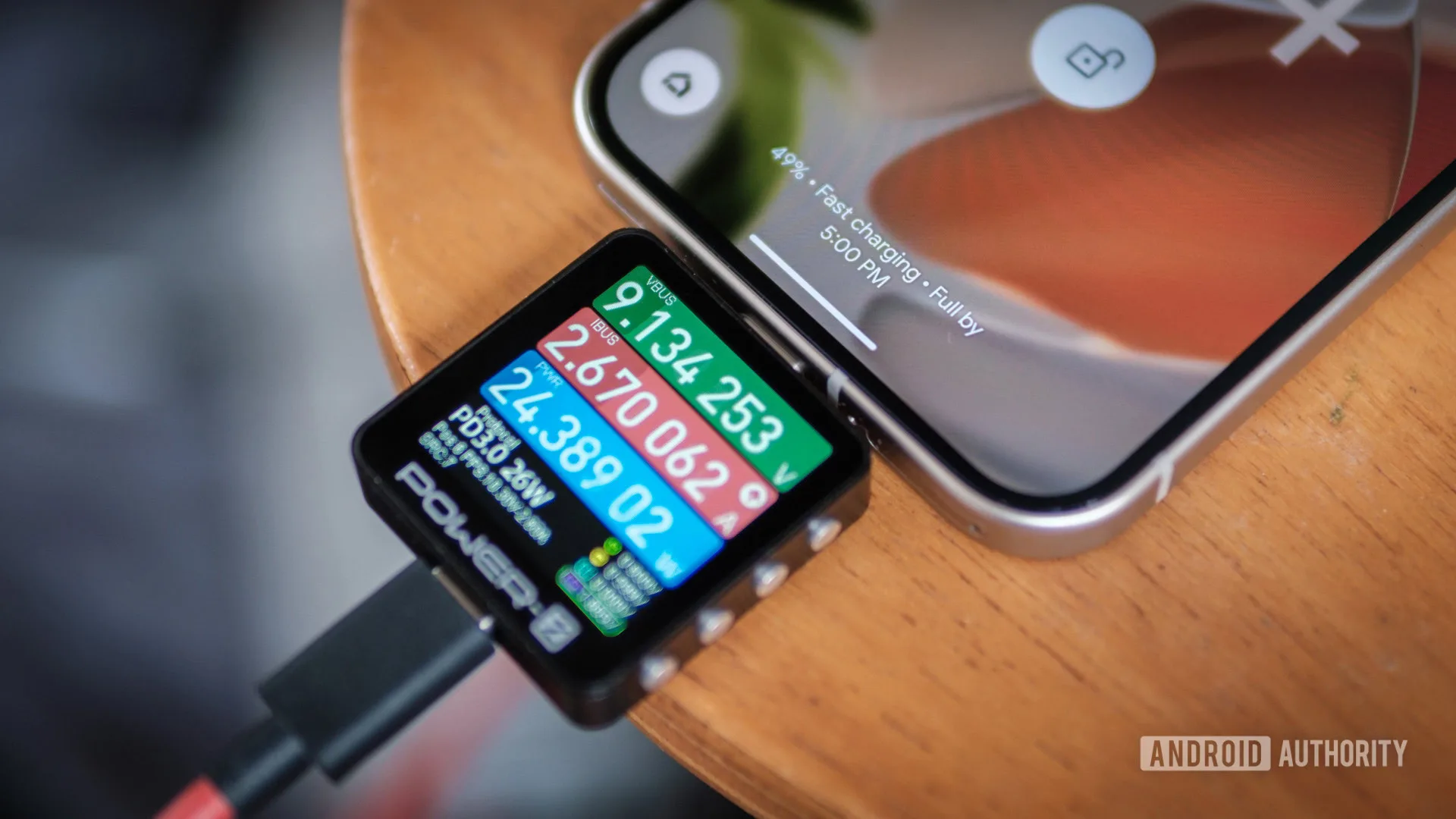
This isn’t primarily a battery life complaint. The Pixel 10 Pro XL’s 5,200mAh cell gets you through most days fine, assuming you remember to charge it the night before. The problem is what happens when you don’t — or when life just doesn’t cooperate. Twenty minutes on the plug while you scramble to get out of the house and you’re looking at 45% charge. On a OnePlus 15, that same 20 minutes gets you to 64%. That’s not a small delta. That’s the difference between leaving the house confident and leaving the house anxious. When Pixel 10 Pro XL charging is your only option in those moments, you feel every watt that’s missing.
How Bad Is the Numbers Gap, Exactly?
The raw data is hard to look at if you’re a Pixel fan. The OnePlus 15 packs a 7,300mAh silicon-carbon battery — roughly 40% more capacity than the Pixel 10 Pro XL — and still charges to full in approximately half the time. Let that sink in. A phone carrying significantly more energy, charged at a higher wattage, finishes before the Pixel 10 Pro XL even crosses 80%.
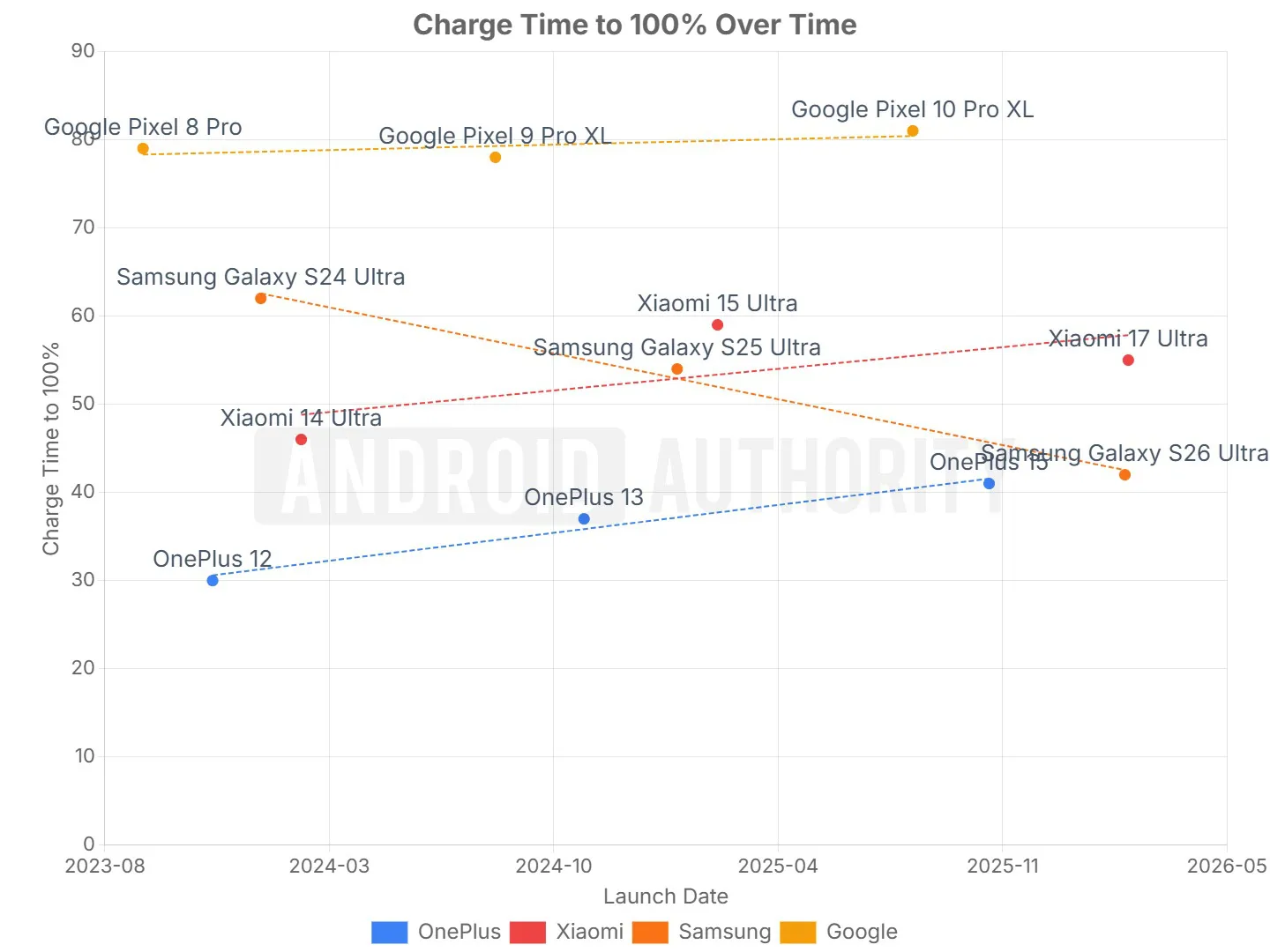
Then there’s the generational stagnation. Google bumped charging from 27W on the Pixel 8 Pro to 37W on the Pixel 10 Pro XL, which sounds like progress. But the actual time-to-full figures have barely moved across three generations. A hardware spec increase with no real-world payoff is almost worse than no change at all — it sets expectations and then fails to meet them. Samsung, by contrast, cut total charge time on its Ultra lineup by a meaningful 20 minutes between the S24 Ultra and the new Galaxy S26 Ultra, which now hits 60W and reaches full charge in just 42 minutes.
Even mid-tier Samsung models are in on the act. The Galaxy S26 Plus ships with 45W charging — faster than anything Google offers on even its most premium Pixel hardware. And Apple, long the other name on the slow-charging roll call, has at least made incremental gains with USB PD AVS support on the iPhone 17 line. That leaves Pixel 10 Pro XL charging increasingly isolated at the sluggish end of the flagship market, with fewer and fewer excuses available.
Google’s Charging Approach Has a Compatibility Problem Too
Speed is one issue. Compatibility is another. To actually hit Pixel 10 Pro XL charging speeds at the full 37W, you need a charger that explicitly supports 20V USB PD PPS. That’s a specific, somewhat niche requirement that catches a lot of people off guard. Plug in a charger that tops out at the more common 9V/3A profile and you’re back to 27W — the same ceiling the Pixel 8 Pro had years ago.
Samsung’s Galaxy S26 Ultra also uses 20V to hit 60W, but it includes 16V and 9V fallback support, meaning a wider range of third-party chargers and power banks can still deliver meaningfully high power. The rigid voltage requirement behind Pixel 10 Pro XL charging, by contrast, creates a compatibility minefield. It’s the kind of friction that shouldn’t exist on a phone costing this much in 2026, and it makes the charging story even harder to defend.
What Does Google Actually Need to Do for the Pixel 11?
There are two schools of thought among Pixel loyalists about how Google should fix this. One camp wants bigger batteries — the kind of silicon-carbon cells that give Chinese flagships their day-and-a-half endurance. The other camp, arguably the more impatient one, just wants the existing battery to fill up faster. Realistically, Google needs to do both, because a larger battery with Pixel 10 Pro XL charging speeds at 37W would just make the time-to-full situation even worse.
Neither path is straightforward. Silicon-carbon batteries remain largely the domain of Chinese manufacturers for now, and there’s no confirmed sign that Google — or Apple, for that matter — is close to adopting them at scale. Meanwhile, faster charging isn’t just about cranking up the wattage; thermal management, battery chemistry, and software all play a role in how quickly a phone can safely absorb power without degrading the cell over time. Google has historically been conservative here, and the heating issues that have occasionally plagued Pixel batteries suggest that caution isn’t entirely misplaced.
But here’s the thing: Samsung has already demonstrated that you can charge a 5,000mAh battery to 100% in 42 minutes without a proprietary charging standard, without exotic battery chemistry, and without frying the cell. It’s not a theoretical target — it’s a shipping product that people are buying right now. The bar for what ‘acceptable’ looks like in 2026 has moved, and Pixel 10 Pro XL charging no longer clears it.
For the Pixel 11 Pro XL, Google doesn’t need to out-charge a Xiaomi 17 Ultra or race to the top of a benchmark chart. It just needs to fill a reasonably sized battery in under an hour — a standard Samsung cleared years ago. Anything short of that, and Google will be writing the same apology letter to its most loyal users for a fourth generation running. At some point, patience runs out faster than the battery does.
Frequently Asked Questions
What is the maximum charging speed of the Pixel 10 Pro XL charging?
The Pixel 10 Pro XL charges at a peak of 37W using a very specific 20V USB PD PPS standard. Older chargers that don’t support 20V PPS cap out at 27W, which is the same ceiling as the older Pixel 8 Pro, adding further frustration for users with existing accessories.
How does Pixel 10 Pro XL charging compare to the OnePlus 15?
The comparison is unflattering. The OnePlus 15 reaches 64% charge in 20 minutes and takes roughly half the time to fill its 7,300mAh battery compared to the Pixel 10 Pro XL filling a smaller 5,200mAh cell. The Pixel’s charging speed deficit is significant by any measure.
Does the Samsung Galaxy S26 Ultra charge faster than the Pixel 10 Pro XL?
Yes, substantially. The Galaxy S26 Ultra charges at 60W and hits 100% in around 42 minutes, while the Pixel 10 Pro XL doesn’t even reach 80% in that same timeframe, despite carrying a slightly smaller battery. Samsung also supports multiple voltage fallbacks for wider charger compatibility.
Why does Pixel charging require a specific charger?
Google’s Pixel XL phones require a charger that supports 20V USB PD PPS to reach peak speeds. If your charger doesn’t support that specific voltage, you’re limited to 27W regardless of how powerful your charger is — a compatibility limitation Samsung and others have handled more gracefully.
Will the Pixel 11 Pro XL have faster charging?
Google hasn’t confirmed faster charging for the Pixel 11 series yet. Given that charging times have barely moved across the last three Pixel generations despite a bump from 27W to 37W, many users are hoping Google finally makes a meaningful leap, especially as Samsung has now hit 60W.

