Bitcoin capital rules buried inside an international banking framework could render every piece of pro-crypto legislation the US Congress passes completely worthless — and six Republican senators want regulators to fix that before the window closes. In a May 27 letter addressed to Federal Reserve Vice Chair for Supervision Michelle Bowman, FDIC Chair Travis Hill, and Comptroller of the Currency Jonathan Gould, the senators laid out a clear-eyed argument: you can pass all the laws you want, but if the capital math makes Bitcoin uneconomic to hold, banks won’t touch it.
- Bitcoin capital rules set by Basel impose a 1,250% risk weight, meaning banks need $1 of capital for every $1 of Bitcoin held.
- Six Republican senators are urging US regulators to rewrite Bitcoin capital rules before legislative crypto permissions become meaningless.
- The OCC, FDIC, and Fed have all eased crypto access in 2025, but left the core capital burden untouched.
- Basel is already reviewing its cryptoasset standard after the US and UK declined to implement the current framework.
Table of Contents
What the 1,250% Risk Weight Actually Does
The mechanism at the heart of this fight comes from the Basel Committee on Banking Supervision’s cryptoasset standard, which assigned Bitcoin — along with most unbacked crypto — a 1,250% risk weight. That number sounds abstract until you run the arithmetic. Under standard capital rules, a bank multiplies the risk weight of an asset by the regulatory minimum capital requirement of 8%. At 1,250%, that multiplication produces 100%. In plain English: a bank holding $100 million worth of Bitcoin must hold at least $100 million in capital against that position. This is precisely what makes Bitcoin capital rules so consequential for institutional adoption.
That’s not a surcharge. That’s a full dollar-for-dollar match. It’s capital treatment that most closely resembles holding cash to back cash, which defeats the entire purpose of a bank deploying capital productively.
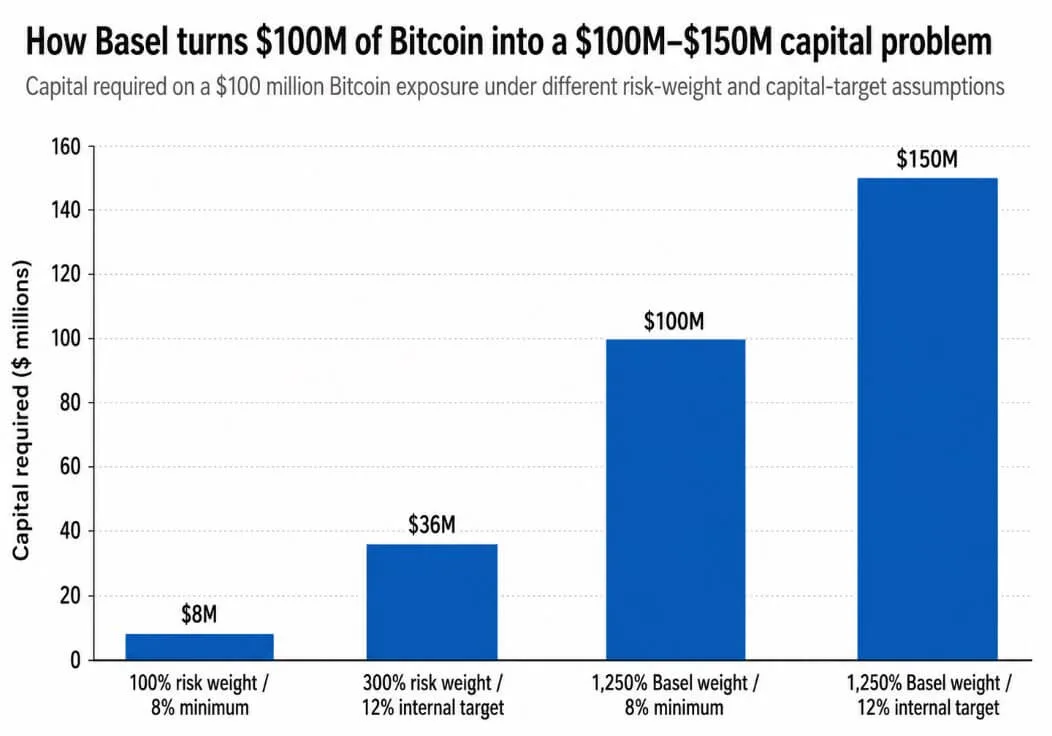
The pain gets worse for well-capitalised institutions. A bank operating with a 12% internal Common Equity Tier 1 target — not unusual for major US lenders — would need $150 million set aside against that same $100 million Bitcoin exposure. To earn a 12% return on equity from that position, the bank would need to generate around $18 million in net profit annually from the trade. Standard custody fees, market-making spreads, and client-service revenues don’t come close to that threshold. A bank can be entirely within the law on Bitcoin and still be structurally prevented from touching it. The current Bitcoin capital rules make that outcome near-inevitable for most institutions.
Bitcoin Capital Rules vs. Legislative Permission
The timing of the senators’ letter is pointed. The Senate Banking Committee advanced the CLARITY Act on May 14, 2025, by a 15-9 vote, moving it toward a full Senate floor vote. The CLARITY Act is designed to give traditional financial institutions a clearer statutory role in digital asset markets — precisely the kind of legislative normalisation the crypto industry has been lobbying for since at least 2022.
But the senators’ core argument cuts through the political celebration around that vote: legislative authorisation and economic viability are two entirely different things. A permission slip doesn’t override a capital charge. If Congress hands banks a green light while regulators leave a $150 million capital requirement on a $100 million position, the green light is functionally meaningless. Bitcoin capital rules are the mechanism that turns a legal permission into an economic prohibition.

What makes this particularly sharp is that the three agencies addressed in the letter have each spent the past several months actively signalling openness to crypto. The OCC reaffirmed in March 2025 that national banks can engage in crypto custody, stablecoin-related activities, and distributed-ledger payment functions, and stripped out the previous supervisory non-objection requirement that had created friction. The FDIC followed the same month, letting FDIC-supervised institutions pursue permissible crypto activities without prior approval. The Fed withdrew its crypto guidance in April 2025, explicitly framing the move as supporting innovation.
All three opened the door — and none of them touched the capital question. That’s the gap the senators are now pressing them to close. Until Bitcoin capital rules are recalibrated, operational permissions alone change very little for bank balance sheets.
The Senators’ Best Argument: Tokenised Securities Logic
The strongest section of the letter doesn’t actually focus on Bitcoin. It points to a March 2026 interagency FAQ on tokenised securities, jointly issued by the Fed, FDIC, and OCC, which held that eligible tokenised securities should receive the same capital treatment as their non-tokenised equivalents. The principle the agencies enshrined: the technology used to record or transfer ownership shouldn’t determine capital allocation. What matters is the underlying risk profile of the asset.
The senators’ logic is direct. If a tokenised Treasury bill is treated like a Treasury bill because its underlying risk governs the treatment, why should Bitcoin capital rules default to a blanket 1,250% weight that applies regardless of position size, hedging strategy, or custody structure? Bitcoin’s volatility, liquidity profile, and operational risks are all measurable. The agencies have already accepted the principle that technology-neutral risk assessment should drive capital treatment. The senators are asking them to apply it consistently.
Why Basel Built the Rule This Way
To be fair to the regulators, the 1,250% weight wasn’t invented to be hostile to crypto. It was built in direct response to the 2022 crypto collapse, when the failures of FTX, Celsius, Three Arrows Capital, and others demonstrated how quickly losses could cascade through interconnected institutions. The Fed, FDIC, and OCC’s 2023 joint statement catalogued the reasons for caution: extreme price volatility, unresolved legal questions around custody and ownership rights, contagion risk from exchange failures, governance weaknesses in decentralised networks, and operational risks unique to open blockchain infrastructure.
A dollar-for-dollar capital charge was Basel’s answer to that catalogue of risks. The argument was essentially: we don’t yet know how to measure these risks precisely, so we’ll require full coverage until we do. That’s a defensible position for 2022. Whether it’s still defensible in 2025 — with deeper market infrastructure, clearer custody frameworks, and multiple years of post-collapse data — is a genuinely open question. Critics argue that Bitcoin capital rules calibrated for the chaos of 2022 are poorly suited to the more structured market environment that exists today.

The Basel Committee itself appears to think the original standard needs revisiting. In November 2025, it agreed to expedite a targeted review of elements of the cryptoasset framework. By February 2026, it had reported progress on that review. Basel Chair Erik Thedéen has said directly that global crypto rules for banks need reworking, citing the fact that both the US and UK declined to implement the current framework as designed. A coalition of major financial industry groups wrote to Basel in August 2025 requesting a pause and substantial revisions, arguing the standard would make meaningful bank participation uneconomical.
The senators are pressing US regulators to act domestically at precisely the moment the international architecture underpinning the existing Bitcoin capital rules is under open review. That’s a tactically smart moment to push.
What a Recalibrated Framework Would Look Like
The senators aren’t arguing for zero capital against Bitcoin. They’re arguing for a calibrated framework — one that applies a risk weight proportional to measurable exposure rather than a blanket worst-case assumption. Reforming Bitcoin capital rules along these lines would have a substantial practical impact on what banks can and cannot do in the market.
Under a 100%–300% risk-weight band — the kind of range that has been floated in industry discussions — and standard capital targets, the capital required on a $100 million Bitcoin position would fall from the current $100 million–$150 million range to somewhere between $8 million and $36 million. That’s still a meaningful capital charge, well above what a bank would hold against a Treasury or investment-grade bond. But it’s a charge that bank economics can actually absorb.
At those levels, bank market-making, institutional custody, prime brokerage services, and structured Bitcoin products all become viable lines of business. Institutional liquidity deepens. Bid-ask spreads compress. Banks shift from being occasional service providers to genuine balance-sheet participants in the market — the kind of structural change that would have consequences far beyond just banks’ profit margins.
The question now is whether the Fed, FDIC, and OCC treat this letter as a genuine regulatory priority or as political correspondence to be acknowledged and filed. With Basel’s own review underway and Congress moving crypto legislation forward, the agencies are running out of reasons to leave Bitcoin capital rules in a holding pattern. If they wait for Basel to finish its review before acting, that review could take years. And every month the 1,250% weight stays in place is another month that legislative progress on crypto amounts to little more than paperwork.
Frequently Asked Questions
What are the current Bitcoin capital rules for US banks?
Under Basel’s framework, Bitcoin carries a 1,250% risk weight. Combined with the 8% minimum capital requirement, that means a bank needs dollar-for-dollar capital against any Bitcoin it holds — $100 million in Bitcoin requires at least $100 million in capital set aside.
Why does the 1,250% risk weight effectively ban banks from holding Bitcoin?
Because the economics simply don’t work. A bank with a 12% internal capital target would need $150 million in capital for $100 million of Bitcoin exposure, requiring roughly $18 million in annual profit just to hit a 12% return on equity. No standard custody or trading business generates returns at that level.
What is the CLARITY Act and how does it relate to this issue?
The CLARITY Act was advanced by the Senate Banking Committee and would give banks a clearer legal role in digital asset markets. But the senators’ argument is that statutory permission without fixing the capital charge is meaningless — banks get a permission slip they still can’t afford to use.
Is Basel reviewing the 1,250% risk weight for crypto?
Yes. The Basel Committee agreed in November 2025 to expedite a targeted review of its cryptoasset standard. Chair Erik Thedéen has acknowledged the rules need reworking, particularly after the US and UK both declined to adopt the existing framework as written.