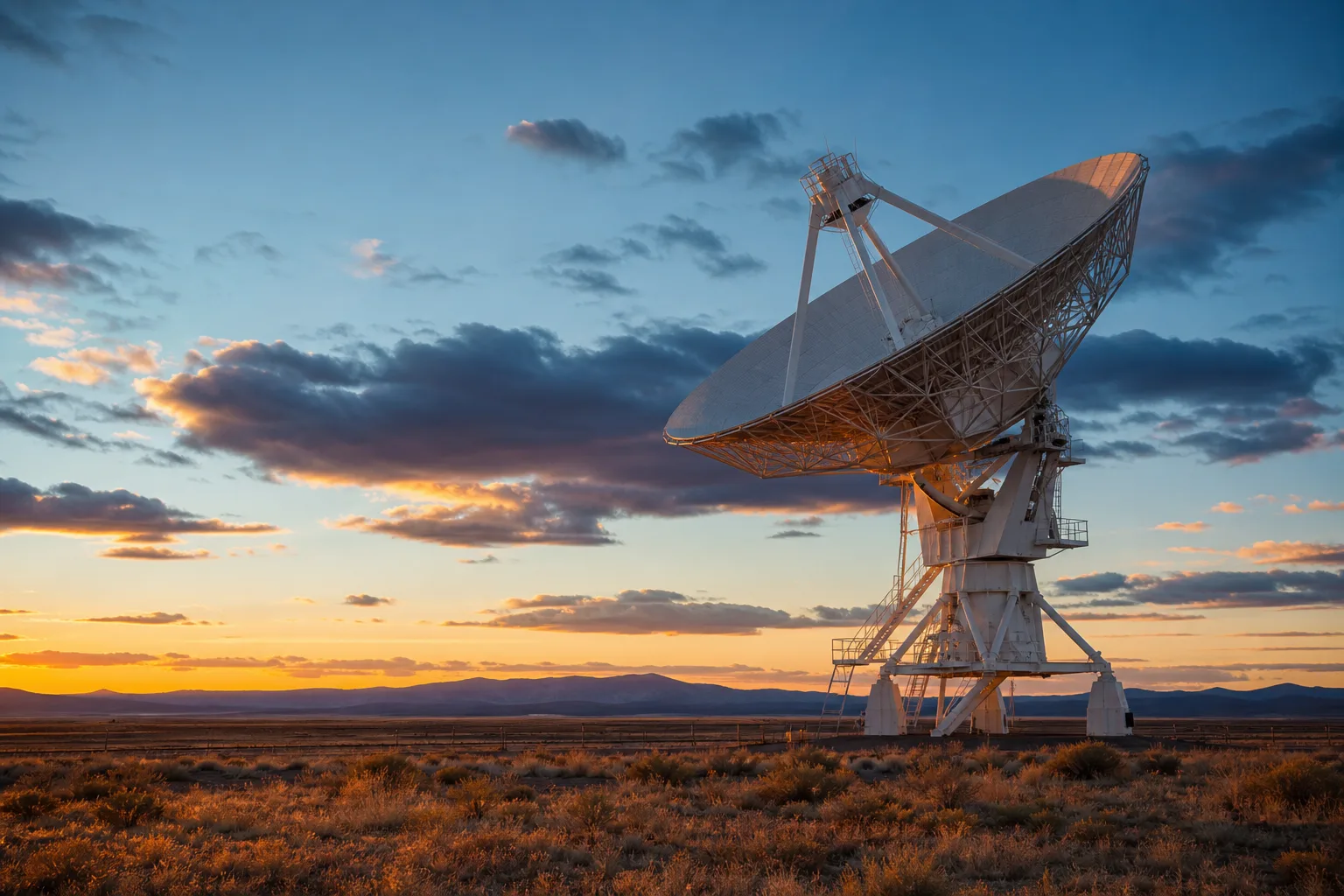
- The next-gen VLA prototype has achieved first light, a critical milestone for the planned successor to the iconic array.
- Next-gen VLA development is led by the NSF’s National Radio Astronomy Observatory after 45-plus years of VLA service.
- The original Very Large Array became culturally famous through the film Contact, based on Carl Sagan’s novel.
- A new generation of radio antennas could dramatically expand our ability to probe deep-sky phenomena.
Table of Contents
The Next-Gen VLA Takes Its First Look at the Radio Sky
The next-gen VLA has just crossed one of the most symbolic thresholds in telescope development: first light. A prototype antenna for the planned successor to the iconic Very Large Array has gathered its first radio signals from the sky, a moment that marks the transition from blueprint to reality for one of the most ambitious ground-based astronomy projects currently underway in the United States.
It’s a moment worth pausing on. First light — the first time a new telescope or prototype successfully detects real astronomical signals — is the moment where years of engineering, funding negotiations, and scientific planning either justify themselves or don’t. For the next-gen VLA, the signals came through.
Why the Original VLA Still Matters — and Why It Needs a Successor
The Very Large Array, that sweeping field of 27 giant dish antennas spread across the Plains of San Agustin in New Mexico, has been operating since 1980. That’s over 45 years of continuous service scanning the radio universe — detecting jets from black holes, mapping hydrogen in distant galaxies, tracking near-Earth objects, and contributing to nearly every major area of modern astrophysics. It was also immortalised in the 1997 film Contact, adapted from Carl Sagan’s novel, which probably did more for public awareness of radio astronomy than any press release ever could.
But 45 years is a long time in any technology. The VLA has been upgraded multiple times — most significantly between 2001 and 2012, when it became the Karl G. Jansky VLA — but there are hard limits to how far you can push hardware that was fundamentally designed in the 1970s. Sensitivity, resolution, and frequency coverage all have ceilings when you’re working with legacy infrastructure.
The next-gen VLA project, overseen by the U.S. National Science Foundation’s National Radio Astronomy Observatory (NRAO), is designed to blow through those ceilings. The planned array would consist of around 263 antennas spread across the continental United States and extend into Canada and Hawaii — a dramatically larger footprint than the current 27-dish setup in New Mexico. That scale translates directly into sensitivity and resolving power that the original VLA simply can’t match.
What First Light Actually Tells Us
Getting a prototype to first light is a proof-of-concept moment more than a scientific one. The prototype antenna isn’t making discoveries yet — it’s demonstrating that the engineering choices, receiver designs, and signal-processing systems actually work together under real-world sky conditions. That’s harder than it sounds. Radio telescope receivers operate at cryogenic temperatures to minimise thermal noise. The electronics have to handle an enormous dynamic range of signals, filtering out terrestrial radio frequency interference while staying sensitive enough to detect faint cosmic sources billions of light-years away.
The fact that the next-gen VLA prototype achieved first light suggests the core technical architecture is sound. From here, the NRAO will use data from the prototype to refine antenna designs, test signal transport and correlation systems, and work through the inevitable engineering surprises before committing to full-scale production of hundreds of antennas.
Think of it as the difference between a car manufacturer building a concept vehicle that actually drives versus one that only looks good in a showroom. First light means this thing drives.
Next-Gen VLA in the Context of Global Radio Astronomy
The next-gen VLA isn’t developing in isolation. Radio astronomy is having something of a renaissance globally. The Square Kilometre Array (SKA) project — a multinational effort building two massive radio telescope arrays in South Africa and Australia — is currently under construction and will be transformational for the field. China’s FAST telescope, a 500-metre single dish in Guizhou Province, has already been rewriting records for pulsar detection and hydrogen line surveys since it came online in 2016.
Against that backdrop, the next-gen VLA has a specific niche: high-frequency radio observations at millimetre wavelengths, combined with extremely high angular resolution from its long baselines. Where FAST is unmatched for raw collecting area and sensitivity on a single pointing, and the SKA will excel at wide-field surveys, the next-gen VLA is being optimised for detailed imaging of compact sources — think protoplanetary disks, the environments around supermassive black holes, and the chemistry of star-forming regions.
That’s not a compromise; it’s a deliberate scientific strategy. The three arrays are broadly complementary, and the astronomical community has been designing their next-generation facilities with this in mind.
The Road to Full Operations Is Still Long
First light is exciting, but let’s be honest about the timeline. The next-gen VLA is still years away from full operations. The project is currently in its design and development phase, working through the NSF’s Major Research Equipment and Facilities Construction (MREFC) process, which is the funding pathway for large-scale scientific infrastructure in the United States. Getting approved, funded, and built is a multi-year process that involves Congressional budget cycles, site preparation across multiple states, and the manufacturing of hundreds of precision antenna systems.
The NRAO has been here before. The original VLA took most of the 1970s to design and build. The Atacama Large Millimeter/submillimeter Array (ALMA) — a collaboration between North America, Europe, and East Asia in the Chilean desert — spent over a decade moving from concept to full operations. Large radio telescope projects don’t move fast. They move carefully.
What the first-light milestone does is give the project something tangible to show funders, policymakers, and the broader scientific community. It’s evidence that the engineering is real, the concept works, and the investment is justified. In the world of big science funding, that kind of concrete validation matters enormously.
What the Next-Gen VLA Could Actually Discover
Radio astronomy has a long track record of producing results that nobody predicted. Pulsars, quasars, the cosmic microwave background, gravitational wave counterparts — most of the field’s biggest discoveries came as surprises. That’s the nature of opening new windows on the universe.
The next-gen VLA’s scientific case is built around several priority areas: understanding how planets form around young stars, tracing the evolution of galaxies across cosmic time, probing the physics of extreme objects like neutron stars and black hole accretion disks, and potentially detecting the technosignatures of extraterrestrial technology — yes, SETI is still on the scientific agenda, and the next-gen VLA would be one of the most capable instruments ever built for that search.
The millimetre-wavelength capabilities are particularly interesting for astrochemistry. Complex organic molecules — the building blocks of life as we know it — emit characteristic radio signatures at these frequencies. Surveys of star-forming regions with next-gen VLA sensitivity could tell us a great deal about how common the chemical precursors to life are across the galaxy.
That’s a long way from a prototype gathering its first light in New Mexico. But first light is where every great telescope starts, and the next-gen VLA has just crossed that line.