- Forward Industries SOL holdings have lost roughly 72% of their value since September 2025, implying a $1.15B unrealized loss.
- Forward Industries SOL transfer of 455,784 tokens to Coinbase Prime signals growing pressure on its treasury strategy.
- The company remains the largest publicly listed Solana holder with over 7 million SOL on its books.
- Corporate crypto treasury holders including Strategy and FG Nexus are all showing signs of serious financial strain.
Table of Contents
Forward Industries SOL Holdings Are Sitting on a Staggering Loss
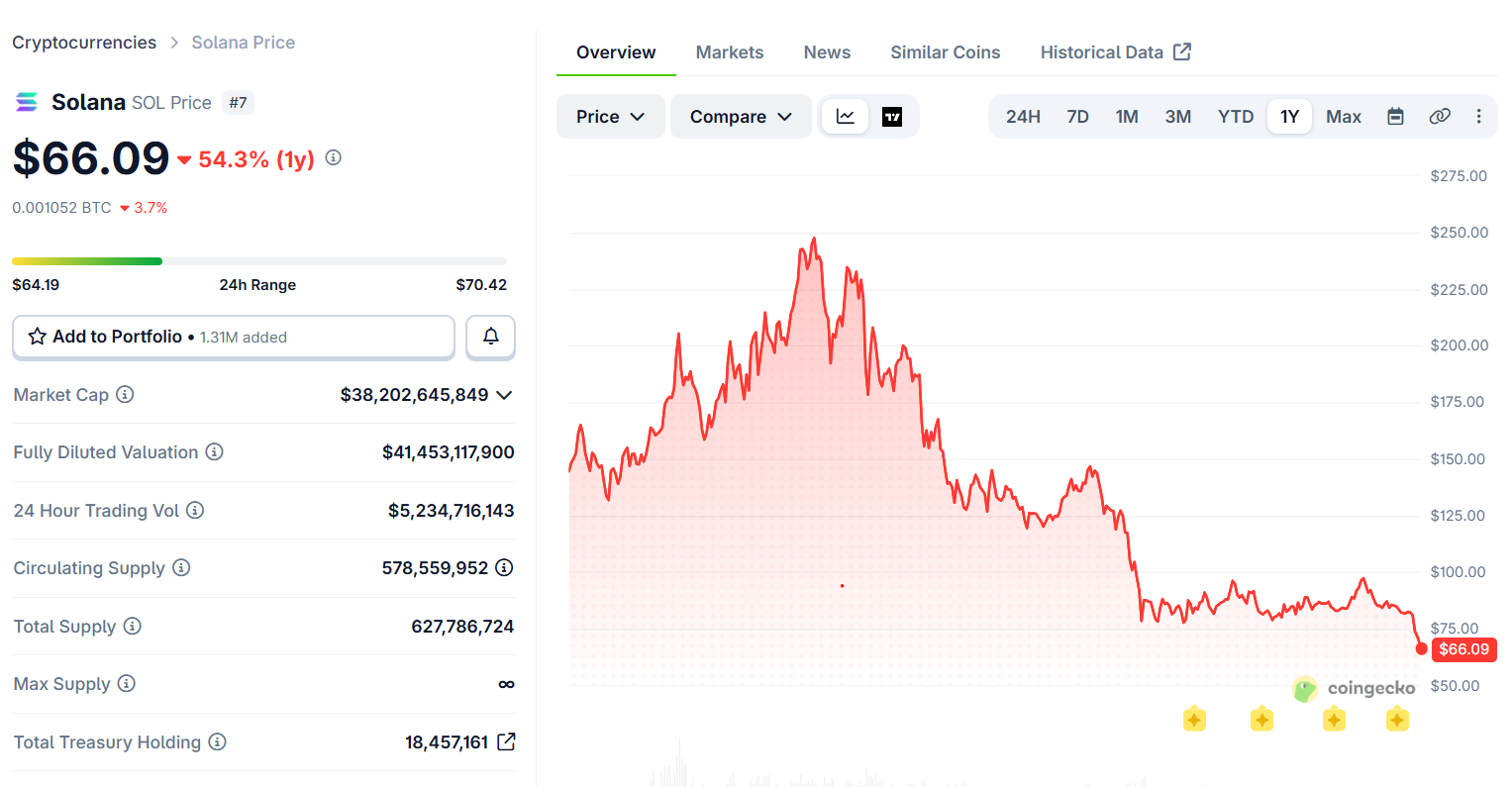
Forward Industries SOL exposure is now at the center of one of the most painful corporate crypto stories of 2025. The publicly listed company transferred 455,784 SOL — worth approximately $32 million at current prices — to Coinbase Prime this week, a move that has drawn immediate attention from on-chain analysts and investors alike. With Solana trading around $64.63 at the time of writing, the company’s entire treasury position is deeply underwater, and the market is starting to ask hard questions about what comes next.
The numbers are brutal. Forward Industries SOL accumulation began in September 2025, when the company eventually purchased approximately 6.83 million SOL for around $1.59 billion at an average cost of $232.08 per token. Since then, SOL has dropped roughly 72%. That puts the current value of those original holdings at approximately $441 million — implying an unrealized loss in the region of $1.15 billion. That’s not a rounding error. That’s a balance sheet crisis hiding in plain sight.
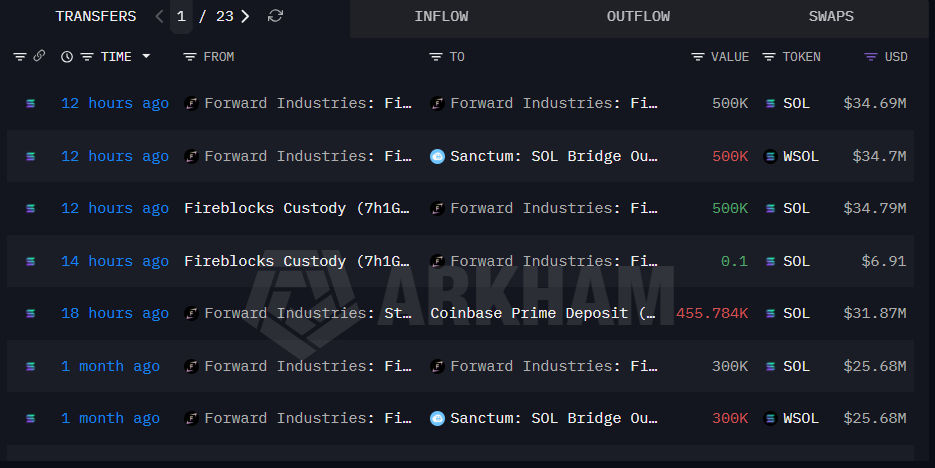
According to a December shareholder update, Forward Industries framed its Solana strategy as a differentiating move, positioning itself as the largest corporate holder of the asset. At the time, that probably sounded visionary. In the current market, it sounds like a cautionary tale. The Forward Industries SOL position still exceeds 7 million tokens according to the most recent available data, making it the single largest publicly listed holder of the token — a title that carries very different weight today than it did six months ago.
What the Coinbase Prime Transfer Actually Signals
Moving crypto to an exchange’s institutional custody arm — in this case, Coinbase Prime — doesn’t automatically mean a sale is imminent. Coinbase Prime is a sophisticated platform used by institutional investors for everything from custody and staking to over-the-counter trading. But in the current climate, a transfer of this size by a company sitting on a nine-figure unrealized loss is going to raise eyebrows regardless of intent.
The timing matters. Forward Industries SOL watchers have noted that the company hasn’t made a public statement explaining the rationale behind the move. That silence is its own form of communication. When companies are confident in their position, they typically say so. When they’re under pressure, transfers happen first and explanations follow — sometimes.
There are a few plausible explanations. The company may be preparing to liquidate a portion of its holdings to manage liquidity, satisfy debt obligations, or simply reduce balance sheet risk in response to investor pressure. Alternatively, it could be moving assets for staking, collateral purposes, or internal restructuring. Without an official statement, speculation fills the vacuum — and right now, that speculation is not favorable to Forward Industries SOL holders and shareholders alike.
Forward Industries SOL Strategy in Context: A Sector-Wide Problem
It would be unfair to single out Forward Industries SOL without acknowledging that the broader corporate crypto treasury experiment is going through a very rough patch. The strategy of holding digital assets on public company balance sheets — inspired largely by Michael Saylor’s playbook at Strategy — made a lot of sense when Bitcoin and Solana were climbing. It looks considerably shakier when prices collapse and those losses have to be disclosed to shareholders every quarter.
Strategy, the largest corporate Bitcoin holder, is arguably facing the most dramatic version of this problem. Bitcoin’s recent decline has pushed the unrealized loss on its holdings to approximately $11.2 billion. This week, Strategy also disclosed that it sold 32 BTC for roughly $2.5 million — its first Bitcoin sale since December 2022, when it offloaded 704 BTC as part of a tax-loss harvesting move before buying back in. That sale, however small relative to its overall position, is symbolically significant. It suggests even the most committed corporate crypto holders are making tactical moves under the weight of market conditions.
Meanwhile, FG Nexus — another publicly listed digital asset firm — reportedly sold an additional $17.8 million in Ether this week, adding to a string of disposals that paint a clear picture of an industry trying to manage its way through a brutal downturn. The sell-offs aren’t panic, exactly. But they’re not confidence either.

Why Corporate Solana Exposure Is a Uniquely Tricky Position
Bitcoin has been through multiple cycles of catastrophic drawdowns and recoveries. It has a decade-plus track record as a corporate treasury asset and a reasonably well-understood narrative around scarcity and digital gold. Solana is a different story. It’s a high-performance Layer 1 blockchain with genuine technical merits and a growing ecosystem, but it’s also significantly more volatile and less institutionally established than Bitcoin as a treasury reserve asset.
When Forward Industries SOL strategy was announced in late 2025, it represented a concentrated bet on a single altcoin at elevated prices. The thesis presumably rested on Solana continuing its momentum — growing developer activity, DeFi volume, and NFT market share were all trending in the right direction at the time. But altcoins amplify both gains and losses relative to Bitcoin, and Solana’s 72% decline from Forward Industries’ average cost basis illustrates that risk with uncomfortable clarity.
There’s also a liquidity dimension worth considering. Forward Industries SOL holdings exceed 7 million tokens. At current prices, that’s somewhere in the $450–$460 million range. Liquidating a position that large without severely moving the market would take time and careful execution. The 455,784 SOL moved this week represents roughly 6.5% of that total — significant, but not a wholesale exit. It’s the kind of move that could mean many things, which is precisely why the lack of communication from the company is so frustrating for investors trying to assess the situation.

What Investors Should Be Watching Now
The Forward Industries SOL situation is a live test case for how publicly listed companies should — and shouldn’t — manage crypto treasury exposure. A few things are worth watching closely over the coming weeks.
- Official communication: Any statement from Forward Industries explaining the purpose of the Coinbase Prime transfer will be market-moving. Silence breeds speculation; clarity would at least give investors something concrete to work with.
- SOL price trajectory: If Solana continues declining — some analysts have flagged $68 as a key support level that’s already been tested — the unrealized loss figure will worsen, potentially triggering additional disclosures or forced selling.
- Debt and liquidity obligations: It’s worth understanding whether Forward Industries took on debt to fund its SOL purchases. If so, margin calls or covenant triggers could accelerate any need to sell.
- Regulatory scrutiny: As more public companies disclose significant crypto losses, regulators and accounting standards bodies are paying closer attention to how these assets are reported and valued on balance sheets.
The broader lesson here isn’t that corporate crypto treasury strategies are inherently flawed. It’s that concentration risk is real, timing matters enormously, and the companies that will weather this downturn are the ones that sized their positions relative to what they could actually afford to lose. For Forward Industries SOL investors, that calculus now looks extremely difficult. Whether this week’s transfer marks the beginning of a managed exit or simply a housekeeping move, one thing is clear: the era of easy crypto treasury wins is over, and the companies that piled in near the top are now learning what balance sheet risk really means.