- Senate Republicans are demanding regulators urgently reform crypto capital rules they call dangerously miscalibrated and unfair to banks.
- The current crypto capital rules assign a 1,250% risk weight to digital assets — a figure GOP senators say has no basis in actual risk data.
- The push comes as the Senate prepares to resume debate on sweeping crypto market structure legislation this week.
- Without updated capital guidance, banks may remain effectively locked out of participating in digital asset markets.
Table of Contents
Why Crypto Capital Rules Are Back at the Centre of Washington’s Attention
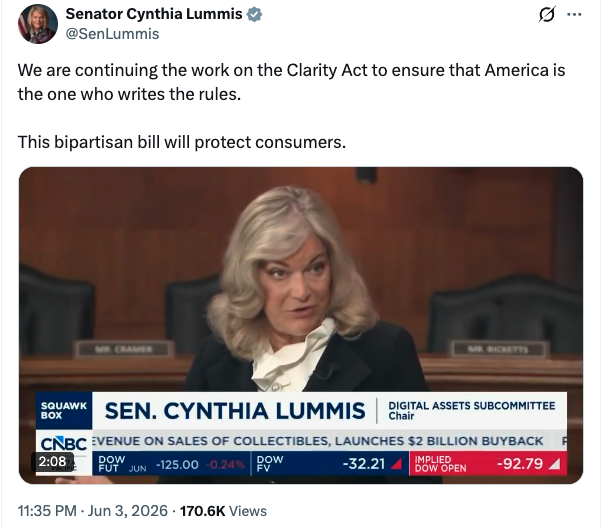
A group of Senate Republicans has formally called on financial regulators to tear up the existing crypto capital rules and start over — and their timing is anything but coincidental. The letter, spearheaded by Senator Cynthia Lummis and co-signed by Senators Dan Sullivan, Bill Hagerty, Bernie Moreno, Ted Budd, and Jon Husted, lands just as the Senate returns from recess and prepares to pick up debate on the most sweeping crypto market structure bill the U.S. Congress has ever seriously considered.
At the heart of the complaint is a number: 1,250%. That’s the risk weight the Basel Committee on Banking Supervision has assigned to crypto assets held on bank balance sheets — a figure that effectively makes it prohibitively expensive for any regulated bank to hold digital assets in meaningful quantities. The senators aren’t mincing words about it, describing the standard as “not derived from a calibrated assessment of the actual risk profile of digital assets.” In plain terms: they think it was pulled out of thin air.
The 1,250% Problem — and What It Actually Means for Banks
To understand why the crypto capital rules debate matters, you need a quick primer on how bank capital requirements work. When a bank holds a risky asset, regulators require it to set aside a proportion of capital as a buffer against potential losses. The riskier the asset, the higher the “risk weight” — which directly determines how much capital must be reserved. A 1,250% risk weight is essentially the maximum possible under Basel III frameworks. It’s the same treatment applied to the most exotic, hardest-to-value financial instruments on earth. Applying it to Bitcoin or Ethereum — assets that trade on liquid, 24/7 global markets with transparent pricing — strikes many in the industry as wildly disproportionate.
For banks, the practical effect is a near-total deterrent. Hold $1 million worth of Bitcoin on your balance sheet and you’d need to set aside roughly $125,000 in capital just to cover it — even if that Bitcoin is sitting in cold storage doing nothing. It’s one of the primary reasons why most U.S. banks have kept digital assets at arm’s length despite years of client demand, particularly from institutional and high-net-worth customers who increasingly want crypto exposure through traditional custodians rather than native crypto exchanges. Reforming crypto capital rules is therefore not merely a technical exercise — it has direct consequences for where and how Americans access digital asset markets.
The senators want regulators — specifically the Federal Reserve, the Office of the Comptroller of the Currency, and the FDIC — to build a new framework that, in their words, “accurately reflect the opportunities and risks of digital assets” and take a “technology-neutral approach.” That last phrase is telling. Technology-neutral regulation has become a watchword among pro-crypto lawmakers who want to ensure that rules govern economic function and risk, not the underlying technology itself.

Crypto Capital Rules Can’t Be Fixed in Isolation — Senate Bill Looms Large
The senators’ letter isn’t happening in a vacuum. The Senate is this week resuming debate on what’s broadly being called the crypto market structure bill — a piece of legislation that would finally draw clear jurisdictional lines between the Securities and Exchange Commission and the Commodity Futures Trading Commission when it comes to regulating digital asset markets and the companies that operate in them. It’s a question that’s been litigated in courtrooms for years while Congress has repeatedly kicked the can down the road.
The Senate Banking Committee and the Senate Agriculture Committee have each passed their own versions of the bill — one focused on securities, one on commodities — and the full Senate will now need to reconcile the two. That’s rarely a simple process, and this bill carries additional complexity. Issues including stablecoin regulation, ethics provisions, and rules specific to crypto developers all remain unresolved. To clear the Senate without an extended procedural fight, the bill needs 60 votes — a threshold that requires bipartisan support and demands compromises on all of those sticking points.
The senators’ letter explicitly argues that whatever version of the bill eventually passes, it will “undoubtedly require capital guidance” — and that regulators should get ahead of that now rather than scrambling after the legislation is signed. It’s a reasonable point. History is full of examples where Congress passed financial regulation only for implementation to stall for years because the underlying capital and accounting standards hadn’t been thought through. The senators are essentially trying to prevent crypto from becoming another one of those stories. Getting crypto capital rules right before the bill passes, rather than after, is central to that argument.

Is the Basel Framework Actually Fit for Digital Assets?
The Basel Committee’s treatment of crypto has been controversial since the framework was first proposed. When the committee released its final standards for banks’ cryptoasset exposures in December 2022, it split digital assets into two broad groups: Group 1, covering tokenised traditional assets and certain stablecoins with effective stabilisation mechanisms, which get treatment broadly in line with their underlying assets; and Group 2, covering everything else — including Bitcoin and most other cryptocurrencies — which get slapped with that 1,250% risk weight.
The logic, at the time, was defensible in a narrow sense. Crypto markets in 2022 had just lived through the implosion of Terra/LUNA, the bankruptcy of Three Arrows Capital, and a brutal bear market that wiped out hundreds of billions in value in months. Regulators were understandably nervous. But the senators’ argument is that even accounting for that volatility, 1,250% is a blunt instrument being wielded in place of actual risk modelling. Bitcoin, for all its volatility, has never gone to zero. Its liquidity profile is arguably better than many assets that attract far more favourable regulatory treatment. Critics of the current crypto capital rules point to exactly this mismatch as evidence that the framework was built on fear rather than data.
There’s also a competitive dimension here that Washington is increasingly alert to. European banks operating under different interpretations of the Basel standards, and crypto-native institutions operating outside the traditional banking system entirely, face no such constraints. If U.S. regulated banks are effectively prohibited from touching digital assets, the business doesn’t disappear — it just flows elsewhere. To competitors, to offshore exchanges, to platforms with far less regulatory oversight than a JPMorgan or a BNY Mellon would bring to the table. That’s arguably worse for consumers and for market stability, not better.
What Comes Next — and Why the Timeline Matters
Senator Lummis has been one of Washington’s most consistent voices on crypto policy for years, and this letter fits a pattern of trying to move regulatory infrastructure in parallel with legislative progress rather than waiting for one to follow the other. That’s smart politics, but it’s also a recognition that the regulatory apparatus moves slowly — and that if capital guidance isn’t developed alongside the legislation, the law could pass and still leave banks in legal limbo for years. Advocates for updated crypto capital rules argue that delay is itself a policy choice — one that continues to disadvantage regulated institutions in favour of less-scrutinised alternatives.
The immediate question is whether the prudential regulators — the Fed, OCC, and FDIC — will respond meaningfully, or whether the letter becomes another entry in the long catalogue of congressional requests that disappear into bureaucratic silence. Under the current administration, there’s more appetite for crypto engagement at the regulatory level than there was two years ago, which gives the senators’ push at least a plausible path forward.
What’s clear is that the broader architecture of U.S. crypto regulation is finally, genuinely moving — and the crypto capital rules question is no longer a side issue. If Congress passes a market structure bill and the capital framework doesn’t follow, regulated banks will remain spectators in a market their clients increasingly want access to. That’s a gap the industry, lawmakers, and arguably the regulators themselves have every reason to close.