

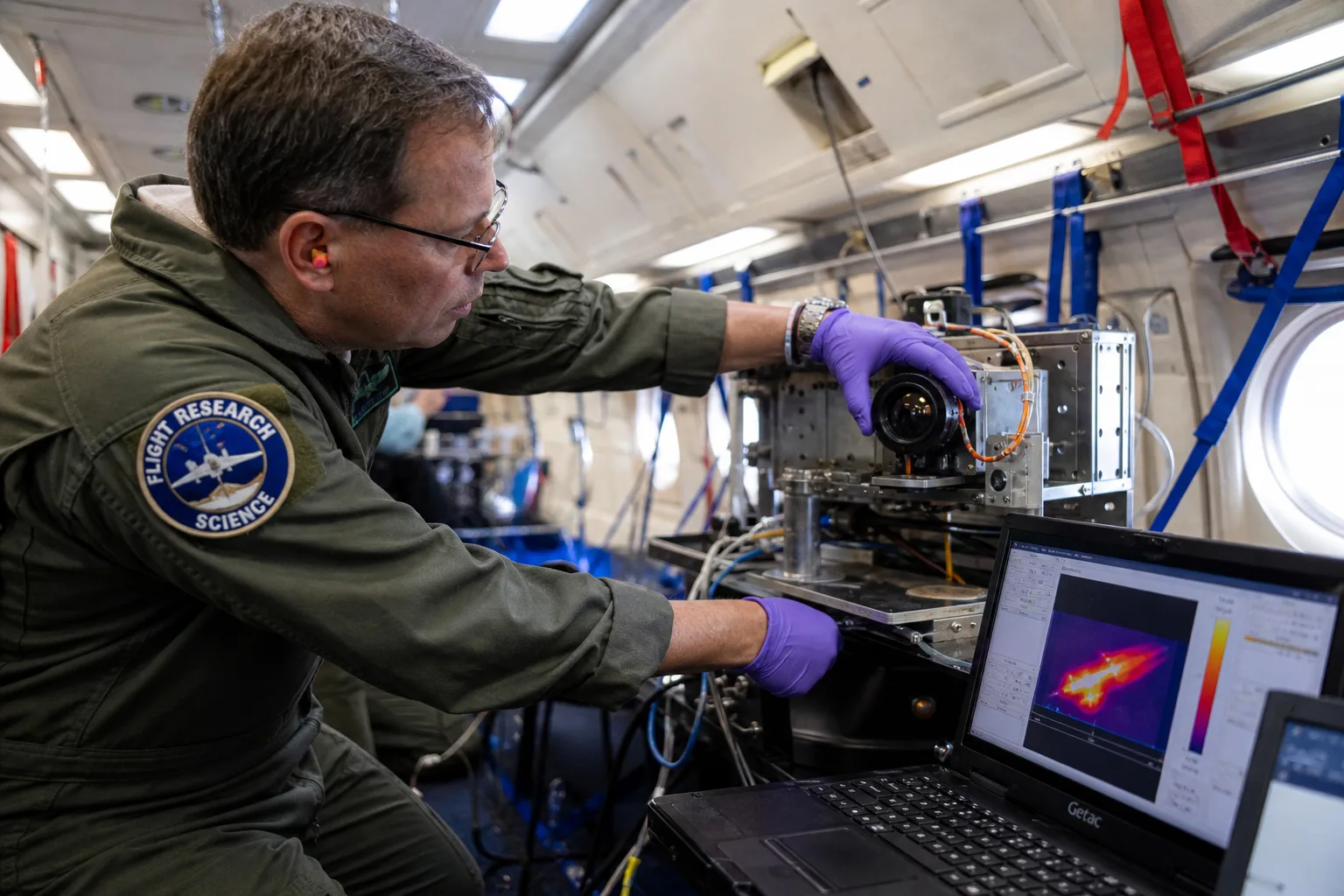
- Researchers tested smart surfaces for boiling heat transfer aboard a zero-gravity parabolic flight aircraft for the first time.
- The #SmartSkin project combined boiling heat transfer, 3D-printed surfaces, and electric field control into one experimental platform.
- Experiments were conducted on Novespace’s Air Zero G aircraft, producing rapidly shifting gravity conditions to stress-test the technology.
- Findings could reshape thermal management in spacecraft, satellites, and high-performance electronics where gravity can’t be relied on.
Table of Contents
Boiling Heat Transfer Has a Zero-Gravity Problem
Boiling heat transfer is one of the most efficient ways to move thermal energy away from a hot surface — it’s the principle behind everything from nuclear reactor cooling loops to the liquid cooling systems in high-end gaming PCs. But there’s a catch that engineers have wrestled with for decades: it works beautifully on Earth, and surprisingly poorly the moment you remove gravity from the equation.
A research team led by Davoud Jafari at the University of Twente, working alongside colleagues at the University of Pisa, has just completed a series of parabolic flight experiments designed to crack exactly that problem. Their platform — developed under the banner of the #SmartSkin project — combines 3D-printed smart surfaces, electric field manipulation, and boiling heat transfer into one integrated system, all tested aboard Novespace’s Air Zero G aircraft under rapidly shifting gravity conditions.
It’s a genuinely tricky problem to study. In normal terrestrial conditions, buoyancy does a lot of the heavy lifting during boiling. Vapor bubbles form on a heated surface, grow, and then detach upward because they’re lighter than the surrounding liquid. That natural departure keeps the surface wetted and the heat moving. Strip out gravity, and those bubbles don’t go anywhere. They merge, spread across the surface, and form an insulating vapor film — a phenomenon called dry-out — that can cause temperatures to spike dangerously. For spacecraft electronics or life-support thermal systems, that’s not a theoretical inconvenience; it’s a potentially catastrophic failure mode.
What the #SmartSkin Experiment Actually Did
The parabolic flight format is well-suited to this kind of research precisely because it’s so disruptive. On each parabola, the Air Zero G aircraft climbs steeply and then pushes over the top of the arc, giving everyone and everything aboard a period of near-weightlessness — true microgravity conditions, at least close enough for experimental purposes. That’s followed by a pull-out phase where occupants experience elevated g-levels. Repeat that sequence multiple times per flight, and you’ve got a rapid-fire testing regime that would take months to replicate on a space station.
What makes the Twente-Pisa approach distinctive is the integration. Rather than studying any one variable in isolation, the team built an experimental platform that addresses boiling heat transfer, surface geometry, and active control simultaneously. The smart surfaces themselves are fabricated using additive manufacturing — 3D printing, in plain terms — which allows the researchers to engineer precise micro-scale features into the surface topology. These features influence where and how bubbles nucleate, giving the team a degree of passive control over the boiling process before any active intervention is applied.
The active ingredient is the electric field. By applying an electric potential across the boiling surface, the team can directly influence bubble dynamics — altering nucleation rates, bubble departure frequency, and the tendency of bubbles to coalesce. It’s essentially a knob for boiling behavior, and in zero gravity, where you can’t rely on buoyancy to do the work, having that knob matters enormously.
Why Additive Manufacturing Changes the Game for Thermal Engineering
There’s a broader trend worth placing this work inside. Additive manufacturing has been quietly transforming thermal engineering over the past several years, enabling surface architectures that simply can’t be machined conventionally. Companies like Conflux Technology have already commercialized 3D-printed heat exchangers for motorsport and aerospace applications, and NASA has been exploring printed thermal management components for deep-space hardware.
What the University of Twente team is doing pushes further. The combination of printed micro-structures with active electric field control means the surface isn’t just passively optimized — it’s responsive. The term ‘smart surface’ gets used loosely in materials science, but in this context it has a fairly precise meaning: a surface whose effective thermal behavior can be tuned in real time based on operating conditions. That’s genuinely useful when the operating conditions include the complete absence of gravity.
For boiling heat transfer specifically, surface micro-structure influences something called the nucleation site density — the number of locations on a surface where bubbles prefer to form. More sites, more bubbles, more heat removed per unit area, up to a point. Engineer those sites too aggressively and you can trigger the very vapor film formation you’re trying to prevent. Getting that balance right in microgravity, where the system behaves differently at every stage of a parabolic arc, is the kind of experimental challenge that can’t be solved from a desk.
Implications for Space Hardware and High-Power Electronics
The immediate relevance of this research is for spacecraft thermal management — a field under increasing pressure as satellite hardware gets denser and more power-hungry. Modern low-Earth orbit satellites, particularly in broadband constellation roles like those operated by SpaceX’s Starlink or Amazon’s Project Kuiper, pack substantial computing and RF power into compact form factors. The thermal loads involved are significant, and the standard passive radiator approach has limits. Two-phase cooling systems — which exploit boiling heat transfer — offer much higher heat flux capacity, but only if the boiling process can be reliably controlled without gravitational assistance.
Beyond satellites, there’s a clear path toward crewed deep-space missions. Long-duration hardware aboard a lunar gateway station or a Mars transit vehicle will face sustained microgravity conditions, meaning any cooling system dependent on Earth-normal boiling dynamics is a liability. Research like the #SmartSkin project is laying the groundwork for thermal systems that actively manage their own behavior regardless of the gravitational environment they’re in.
There’s also a terrestrial angle that’s easy to overlook. Data centers are the obvious target. Liquid immersion cooling and two-phase cooling technologies are attracting serious investment from hyperscalers looking to handle the thermal density that AI workloads — particularly large GPU clusters — are generating. The physics of bubble dynamics on engineered surfaces is directly applicable, and the kind of fine-grained control the Twente team is developing translates to better thermal management at the chip level, gravitational considerations aside.
What Comes Next for the SmartSkin Research
Parabolic flight campaigns are valuable, but they’re a stepping stone. The microgravity windows and the constant g-level transitions make for a noisy experimental environment. The logical next phase for work like this is extended microgravity testing — either aboard the International Space Station or, increasingly, through commercial platforms like Axiom Space’s planned station modules or the in-orbit research services being developed by companies like Varda Space Industries.
The University of Twente and University of Pisa collaboration has built something worth watching: a genuinely integrated experimental platform that treats surface design, manufacturing method, and active thermal control as a single engineering problem rather than three separate ones. That systems-level thinking is exactly what space-grade thermal management needs as missions get longer, hardware gets hotter, and the margin for passive solutions keeps shrinking.
Frequently Asked Questions
Why does boiling heat transfer behave differently in zero gravity?
On Earth, buoyancy causes vapor bubbles formed during boiling to rise away from a hot surface naturally. In zero gravity, that buoyancy disappears, so bubbles can coalesce and blanket the surface, drastically reducing cooling efficiency. Understanding this behavior is critical for designing thermal systems in space hardware.
What is a parabolic flight and how does it simulate zero gravity?
A parabolic flight involves an aircraft flying a series of arc-shaped maneuvers, during which experiments experience periods of near-weightlessness followed by periods of hypergravity. The experiments described were conducted aboard the Air Zero G aircraft operated by Novespace. It’s a cost-effective way to test hardware before committing to an orbital mission.
How does electric field control improve boiling heat transfer on smart surfaces?
Applying an electric field to a boiling surface can actively manipulate vapor bubble formation and departure. By tuning the field strength, researchers can prevent bubble coalescence and keep the surface wetted, maintaining efficient heat removal even when gravity isn’t available to do the job passively.
What is the #SmartSkin project and who is behind it?
The #SmartSkin project is a research initiative led by Davoud Jafari at the University of Twente, in collaboration with the University of Pisa. It integrates additive manufacturing, boiling heat transfer, and electric field control into a single experimental platform, aimed at developing adaptive surface technologies for demanding environments.

