The June 2026 new moon arrives at 10:54 p.m. EDT on June 14, and it brings with it something amateur astronomers wait months for: a stretch of genuinely dark nights. No moonlight washing out the sky, no competing glow on the horizon. Just stars, planets, and the kind of clarity that makes you remember why you bought that telescope in the first place.
- The June 2026 new moon peaks at 10:54 p.m. EDT on June 14, gifting observers several moonless nights for deep-sky viewing.
- During the June 2026 new moon window, Venus, Jupiter, and Mercury all appear in the western sky after sunset in a rare three-planet lineup.
- Mercury reaches its greatest eastern elongation just one day after June 14, making this one of its best evening appearances of 2026.
- Dark skies around the new moon reveal the Milky Way’s glowing core, along with constellations Scorpius, Libra, and the lesser-known Ophiuchus.
Table of Contents
What the June 2026 New Moon Actually Means for Observers
A new moon isn’t a visible event — it’s an absence of one. When the Moon swings between Earth and the Sun, its dark face is turned toward us, and the night sky effectively gets a reset. For casual observers, that means faint stars and constellations that typically get drowned out by moonlight suddenly become accessible. For serious astrophotographers, it’s prime time to shoot deep-sky objects without battling the lunar glare that ruins long-exposure shots.
The June 2026 new moon peaks at 02:54 GMT on June 15, so the nights of June 13–16 are your best windows on either side of the event. After that, the waxing crescent returns and gradually starts reclaiming the sky — it’s a narrow window, and it’s worth making the most of it.
Three Planets in the Western Sky After Sunset
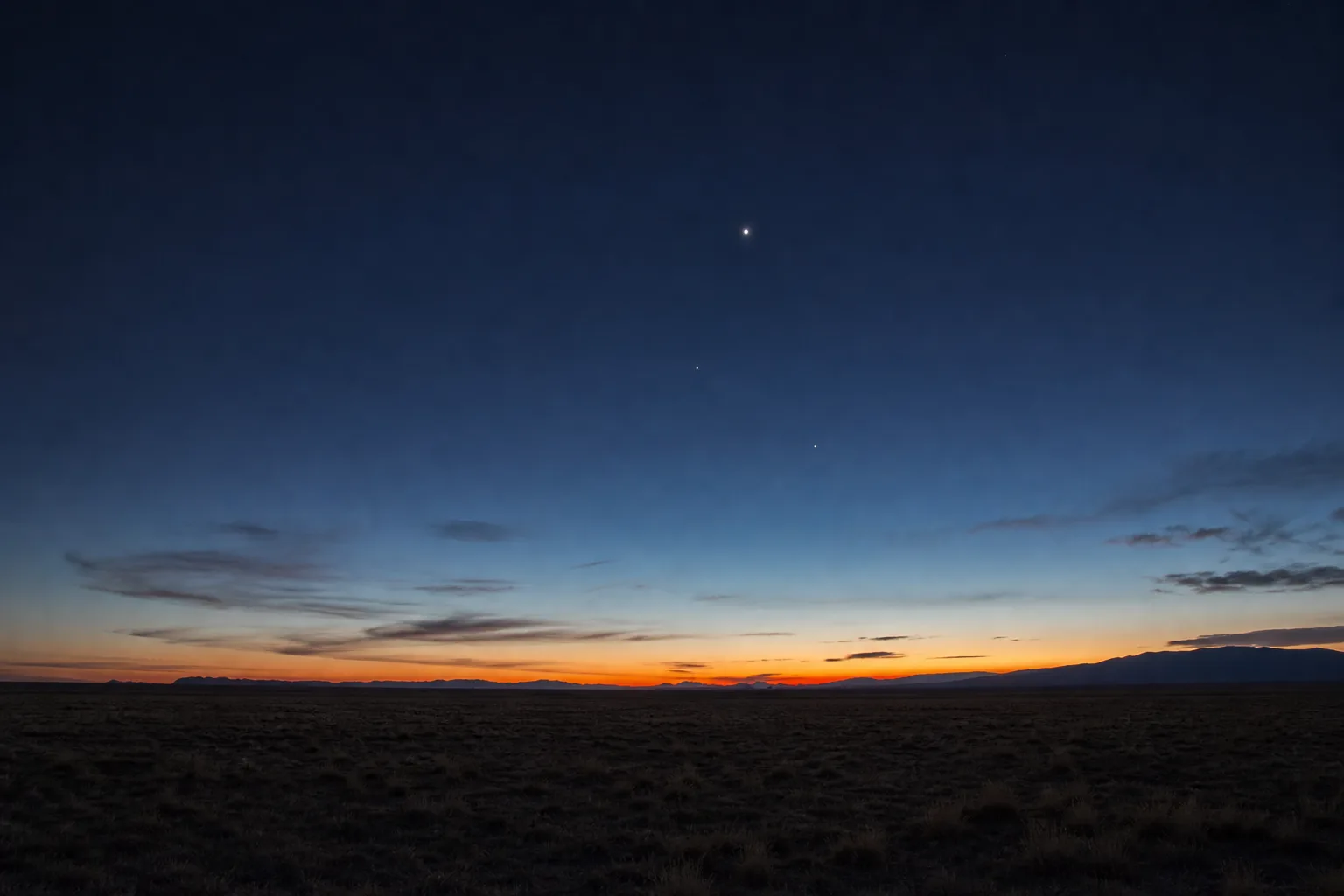
Look west shortly after sunset on June 14 and you’ll be treated to something that doesn’t happen all that often: three planets in a loose but unmistakable lineup. Venus is the brightest and easiest to find, shining steadily a little more than three degrees above Jupiter. Just days earlier, on June 9, the two shared a close conjunction — one of those events where planets appear almost close enough to touch from our vantage point, though they’re obviously separated by hundreds of millions of kilometres in reality.
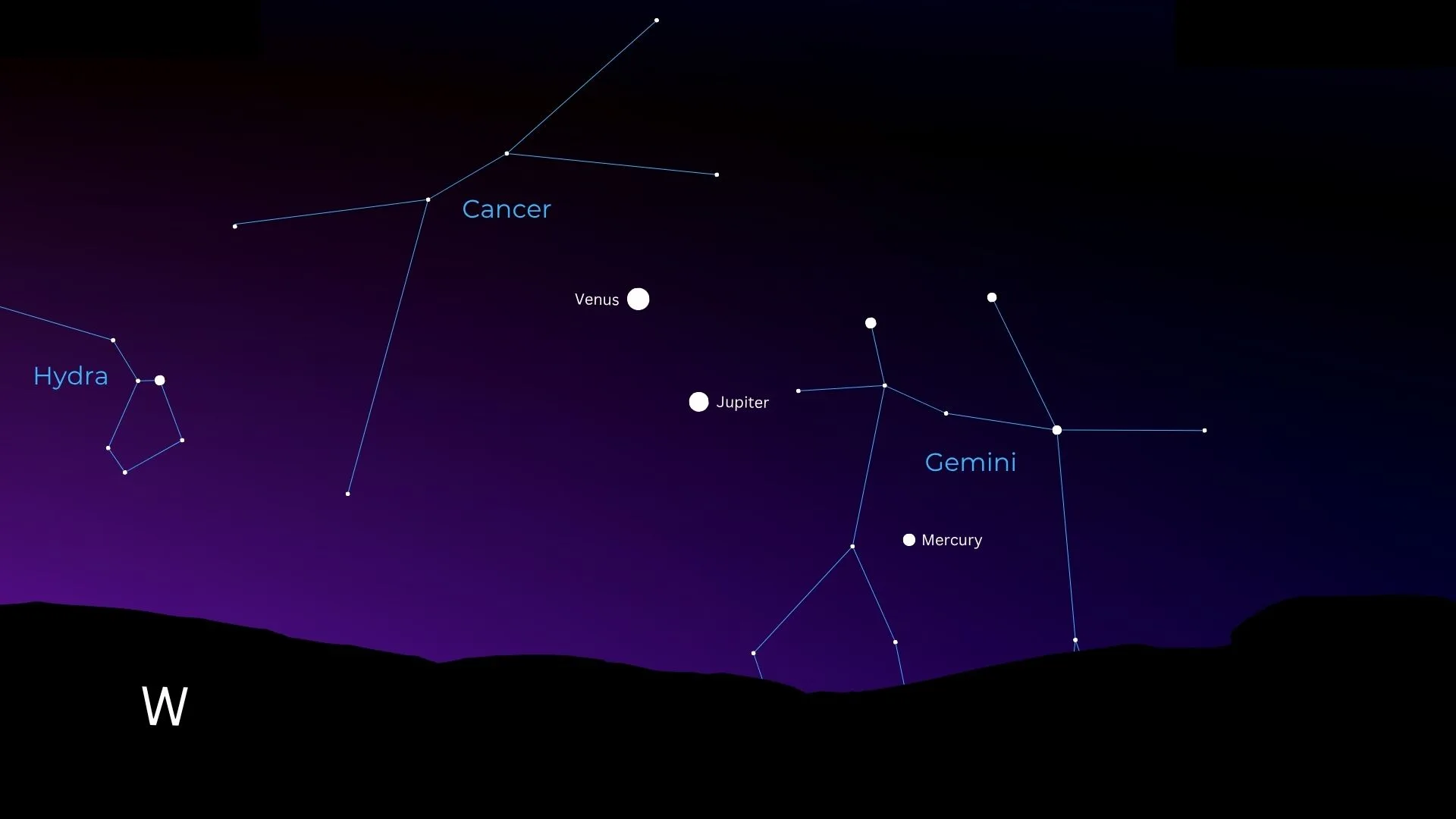
Below and to the lower right of Jupiter, look for Mercury. The innermost planet is currently putting on one of its strongest evening performances of the year. On June 15, just one day after the June 2026 new moon, Mercury reaches greatest eastern elongation — the point in its orbit where it appears farthest from the Sun in the evening sky and therefore stays visible the longest after sunset. The three planets form a rough diagonal line across the western twilight, separated by roughly 10 degrees from top to bottom. To visualise that angular gap: make a fist, hold it at arm’s length against the sky, and that’s approximately 10 degrees. Mercury and Jupiter are about a fist-width apart.
There’s a catch with Mercury, as always. It sets less than two hours after the Sun, so you need a clear, flat western horizon — no hills, buildings, or tree lines to get in the way. Go somewhere elevated or find a western-facing open field if you want a real shot at spotting it. A pair of binoculars won’t hurt either, especially in the lingering twilight.
Mars and Saturn in the Predawn Sky
Night owls and early risers get their own show. Mars is visible in the predawn hours in the days surrounding the June 2026 new moon, sitting less than 10 degrees above the eastern horizon before sunrise. Its reddish tint makes it fairly distinctive — it doesn’t twinkle the way stars do, which is the quick test for distinguishing a planet from background stars at low altitude.
Saturn is the better catch for those willing to be up before dawn. The ringed planet is sitting higher in the east among the stars of Pisces, making it easier to observe comfortably. And for those with a decent telescope, Neptune lurks within 10 degrees to Saturn’s upper right. You won’t see Neptune with the naked eye — it’s far too faint at magnitude 7.9 — but an 8-inch reflector from a genuinely dark location should reveal its characteristic blue-grey disk. It’s not dramatic, but there’s something quietly satisfying about picking out a world that’s 4.5 billion kilometres away.
Constellation Highlights: Scorpius, Libra, and the Forgotten Ophiuchus
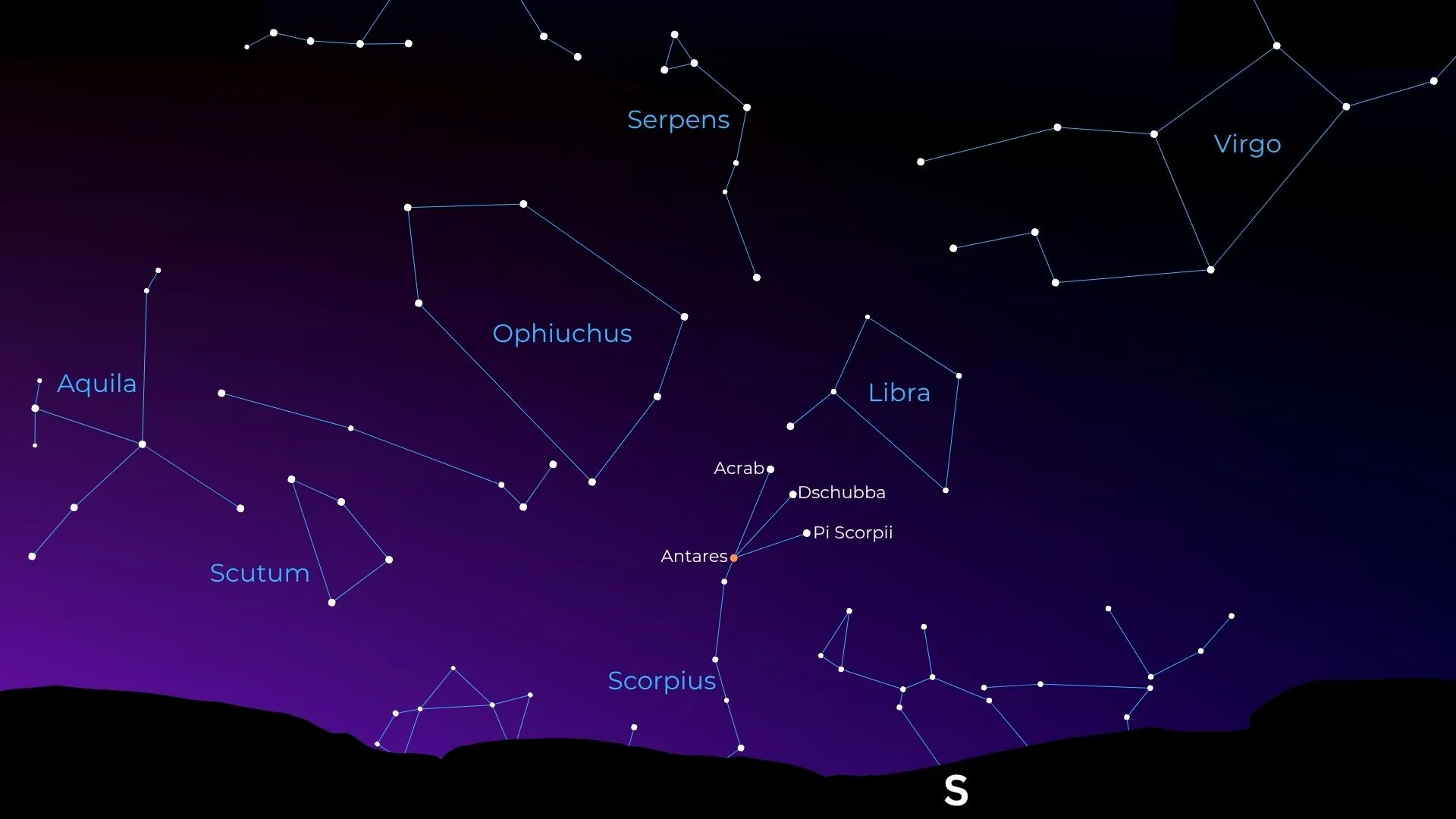
The June 2026 new moon is also a good excuse to spend time with the southern constellations that get overlooked during moonlit nights. Turn southeast after sunset and look for Antares, the red supergiant star at the heart of Scorpius. It glows between 10 and 20 degrees above the horizon depending on your latitude, its warm orange-red colour making it hard to confuse with anything nearby. The stars Dschubba, Pi Scorpii, and Acrab form the scorpion’s claws above and to the right of Antares — it’s one of the more geometrically satisfying constellations to trace once you know where to start.
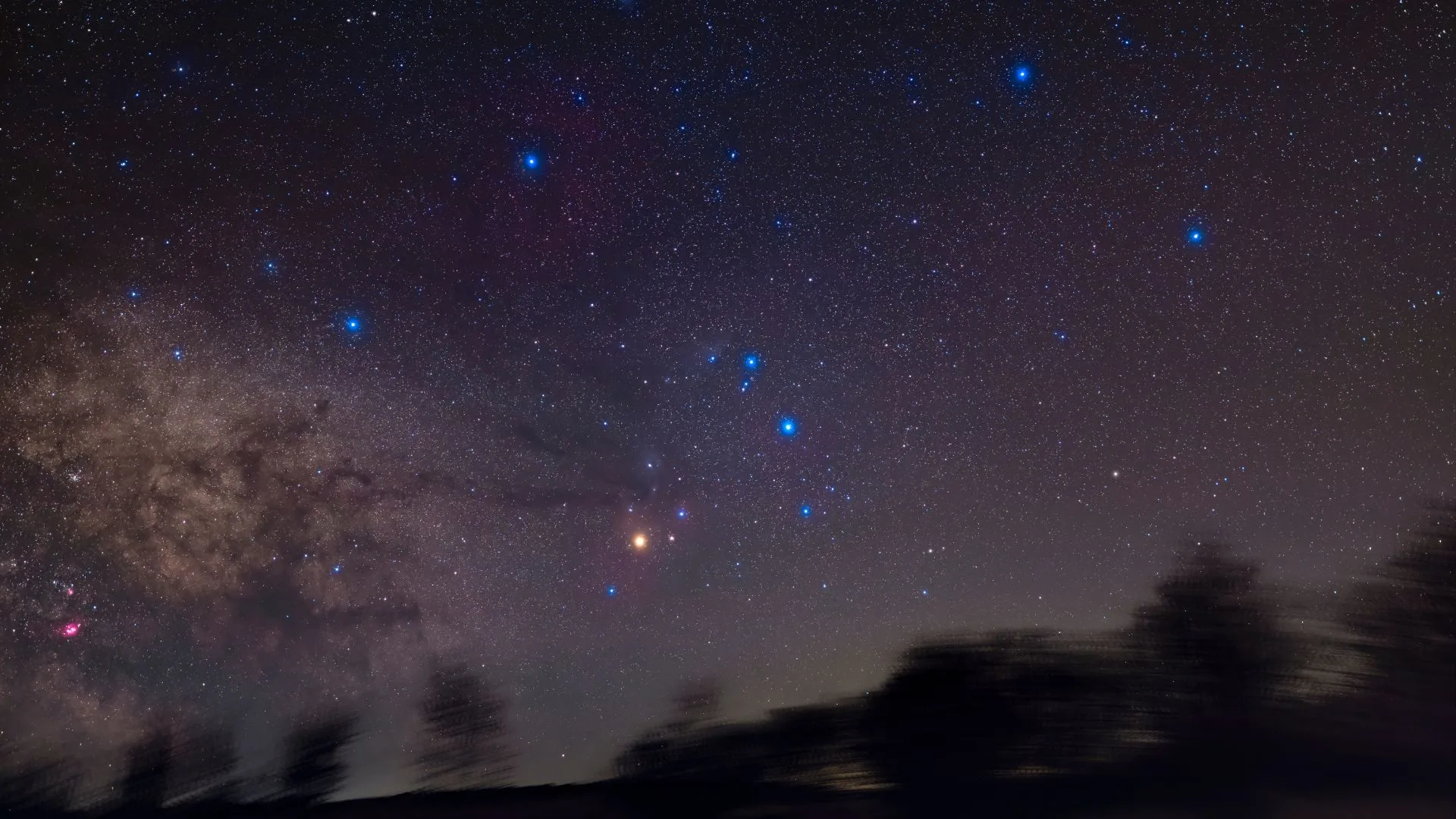
Above the claws of Scorpius, look for the kite-shaped asterism that marks Libra, the celestial scales. It’s a constellation with a curious distinction: it’s the only one in the zodiac — arguably the only one in the entire sky — named after an inanimate object. Every other constellation is a person, a creature, or a mythological beast. Libra stands alone as a set of weighing scales, and it’s been associated with balance and justice since at least ancient Roman times.
Just to Libra’s left is Ophiuchus, the ‘snake bearer,’ a constellation that generates genuine debate among astronomers and astrologers alike. The Sun passes through the southern edge of Ophiuchus for roughly two weeks every year, which has led some to argue it deserves recognition as a 13th zodiacal constellation alongside the traditional twelve. In-The-Sky.org notes this peculiarity in detail. Ophiuchus was catalogued by the ancient Greek astronomer Ptolemy in the 2nd century AD and is typically depicted as a figure holding a giant snake — which is itself a separate constellation, Serpens, split into two halves that straddle Ophiuchus on either side. It’s an odd arrangement that reflects how constellation boundaries were drawn up organically over centuries rather than by any systematic plan.
The Milky Way Returns
Perhaps the most rewarding aspect of the June 2026 new moon for anyone within striking distance of genuinely dark skies is the return of the Milky Way in its full glory. Around midnight in mid-June, the galaxy’s bright central bar rises from the southern horizon and arcs overhead through the Summer Triangle — the prominent asterism formed by Vega (in Lyra), Altair (in Aquila), and Deneb (in Cygnus). It’s a view that simply doesn’t exist from most suburban locations, which is part of why these few moonless nights per month matter so much to the stargazing community.
For astrophotographers, this is the window. A camera on a basic tracker mount, a wide-angle lens in the 14–24mm range, and a reasonably dark site are all you need to capture a usable Milky Way shot. The technical barrier has dropped enormously in recent years — modern mirrorless cameras like the Sony A7S III or the Nikon Z6 III handle high-ISO noise well enough that even a static tripod shot can yield impressive results in June skies, especially with some light stacking in post-processing software like Sequator or DeepSkyStacker.
The June 2026 new moon window isn’t just a single night — treat it as a four- to five-night observing campaign. Each clear evening offers a slightly different arrangement of planetary positions as Mercury continues its rapid orbital motion, and the predawn hours give you a completely separate set of targets. Planning your sessions around the June 2026 new moon means you can tackle three planets at dusk, two more at dawn, and a galaxy arcing overhead in between — making this one of the more well-stocked observing windows of the year.
Frequently Asked Questions
When exactly is the June 2026 new moon?
The June 2026 new moon occurs at 10:54 p.m. EDT on June 14, which is 02:54 GMT on June 15. This is when the Moon passes between Earth and the Sun, leaving the surrounding nights free from moonlight interference.
Can I see Mercury with the naked eye during the June 2026 new moon?
Yes, Mercury should be visible to the naked eye from a clear, unobstructed western horizon after sunset around June 14. It sits roughly 10 degrees below Jupiter, but it sets less than two hours after the Sun, so timing is tight.
What is Ophiuchus and why does it matter to stargazers?
Ophiuchus is an ancient constellation first recorded by Ptolemy in the 2nd century AD. Some consider it a 13th zodiacal constellation because the Sun passes through its southern edge for about two weeks each year. It’s best seen during dark, moonless nights.
Where is the best place to view the Milky Way during the new moon?
The Milky Way’s bright core is best seen from a dark-sky location well away from city light pollution. Around midnight in late spring and early summer, it arcs upward from the southern horizon through the Summer Triangle stars — Vega, Altair, and Deneb.