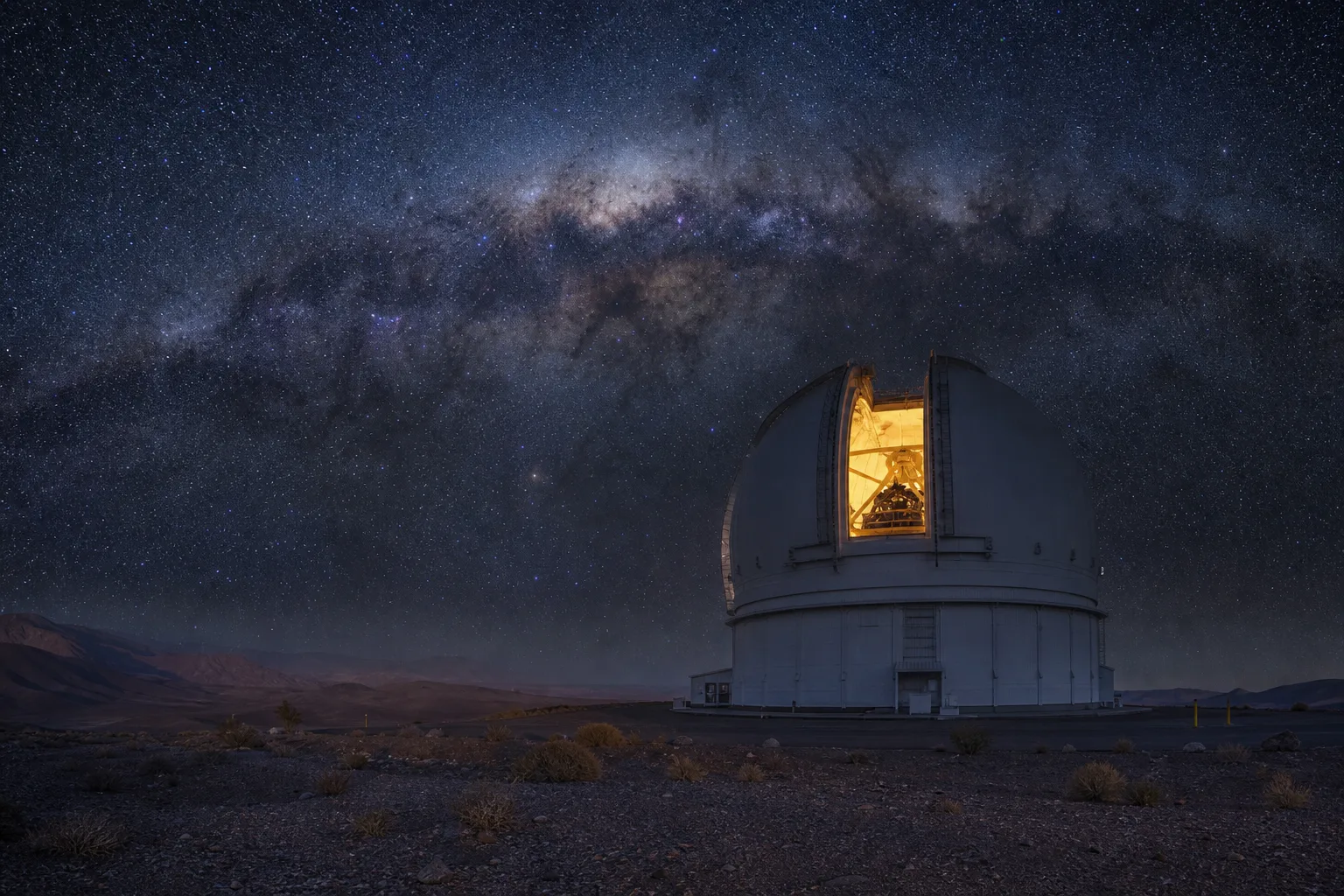
One of the most quietly powerful assumptions in all of science is that the universe, viewed at large enough scales, looks roughly the same no matter which direction you point your telescope. It’s called the cosmological principle, and it’s baked into virtually every major equation cosmologists use. Now, fresh DESI universe data — drawn from the most detailed three-dimensional map of the cosmos ever constructed — is putting that assumption under serious pressure.
- DESI universe data mapped 47 million galaxies across 11 billion light-years, the most detailed cosmic survey ever completed.
- Astronomers Labini and Galoppo used DESI universe data to challenge the assumption that space looks identical in every direction.
- Their findings, published in Nature, contradict the cosmological principle — a bedrock assumption underpinning modern physics models.
- If confirmed, the results could force a rethink of the standard cosmological model that has guided physics for decades.
Table of Contents
What DESI Actually Built
The Dark Energy Spectroscopic Instrument spent years cataloguing the positions of galaxies with extraordinary precision. Earlier this year it wrapped up an observation campaign that charted 47 million galaxies stretching across 11 billion light-years of space. To put that in perspective: 11 billion light-years takes you most of the way back toward the Big Bang. This isn’t a sample — it’s practically the entire observable universe’s history laid out in a single dataset.
The primary mission of DESI was to study dark energy — the mysterious force accelerating the expansion of the universe — by measuring something called baryon acoustic oscillations, essentially the fossilised ripples from the early universe that serve as a cosmic ruler. That work has already produced striking results hinting that dark energy may be weakening over time. But the sheer scale of the DESI universe data invites other questions too, and astronomers Francesco Sylos Labini and Marco Galoppo decided to ask one of the biggest: is the universe actually isotropic?
DESI Universe Data and the Isotropy Problem
In their paper, published in Nature, Labini and Galoppo analysed the DESI universe data to test whether the distribution of galaxies looks statistically equivalent regardless of direction. The answer, they say, is that it doesn’t. The universe appears to show directional variation — what physicists call anisotropy — at scales where the standard model insists things should have smoothed out.
This is a direct challenge to the cosmological principle. The principle doesn’t just say space is roughly uniform; it’s the mathematical foundation that allows cosmologists to build workable models of the whole universe from local observations. Abandon it, or even seriously weaken it, and you’re not just tweaking one equation. You’re questioning the scaffolding holding up the entire edifice of modern cosmology — including the Lambda-CDM model, the ‘standard model’ of cosmology that describes a universe made mostly of cold dark matter and dark energy.
To be clear, this isn’t the first time the cosmological principle has faced awkward evidence. The so-called ‘cold spot’ in the cosmic microwave background, the Hercules–Corona Borealis Great Wall (a galaxy filament so large it arguably shouldn’t exist under standard models), and a handful of other anomalies have nagged at cosmologists for years. What makes the Labini and Galoppo result different is the quality and sheer volume of the underlying DESI universe data. Earlier challenges could be — and often were — waved away as statistical noise or selection effects. That’s harder to do with 47 million galaxies.
Why This Is Harder to Dismiss Than Previous Anomalies
Scale matters enormously in cosmological statistics. A survey of a few million galaxies might show apparent anisotropy simply because you haven’t sampled enough of the sky, or because the particular patch you observed happened to contain an unusual concentration of structure. With tens of millions of galaxies spanning cosmic distances, those explanations start to thin out. The DESI universe data simply offers a statistical foundation that previous surveys could not match.
That said, the scientific community will scrutinise this work intensely before drawing sweeping conclusions. Results that challenge foundational principles tend to attract both enthusiastic support and fierce methodological critique, and rightly so. Questions will be raised about how the DESI team handled systematic errors, whether the angular selection of observed sky patches could introduce directional biases, and how the statistical tests were constructed. Labini and Galoppo will need their methods to hold up to that level of examination — and the fact that the paper landed in Nature suggests it has already cleared a significant peer-review bar.
It’s also worth separating what the paper claims from what it doesn’t. Finding that the DESI universe data shows anisotropy is not the same as proving the cosmological principle is completely wrong. It may point toward a more subtle breakdown — perhaps isotropy holds at even larger scales, or perhaps the deviation is real but small enough that existing models need only modest corrections. The most dramatic interpretation (that we need to throw out Lambda-CDM entirely) is one possibility, not a certainty.
What It Would Mean If the Finding Holds
If the anisotropy signal survives independent replication, the implications ripple outward quickly. The cosmological principle is what justifies treating any region of the universe as representative of the whole — it’s the reason cosmologists can build a model of the entire cosmos from observations made from a single galaxy (ours). Without it, those extrapolations become much shakier.
There’s also a connection to the Hubble tension — the persistent disagreement between different methods of measuring how fast the universe is expanding. Some theorists have proposed that a universe that isn’t perfectly isotropic could partly explain why measurements made from the local universe and measurements made from the early universe keep disagreeing. The DESI universe data finding doesn’t resolve that tension, but it adds another piece of evidence that something in our baseline model may be off.
For the broader physics community, a confirmed breakdown of isotropy at large scales would be one of the more significant theoretical disruptions in decades. New cosmological models capable of accommodating directional variation would need to be developed, tested against all existing data, and ultimately reconciled with everything from gravitational wave observations to the light curves of distant supernovae.
What Comes Next
DESI itself continues to operate, and its dataset will only grow. Independent teams will almost certainly run their own anisotropy analyses against the same public DESI universe data — that kind of cross-checking is how cosmology works, and it’s healthy. The Vera C. Rubin Observatory in Chile, when fully operational, will generate its own independent deep-sky survey with different instrumentation and methodology, providing another check on these results.
The Euclid space telescope, reportedly now delivering its first science data, is another instrument that will be able to speak to large-scale structure questions at comparable depth. If multiple independent surveys with different systematic errors all point in the same direction — toward a universe that isn’t perfectly isotropic — that consensus will be very difficult for the field to ignore.
For now, Labini and Galoppo have done what good science is supposed to do: taken a high-quality dataset, asked a fundamental question, and published an answer that demands a response. Whether that answer reshapes cosmology or eventually gets explained away, the conversation it starts is one of the most consequential in modern physics.
Frequently Asked Questions
What does DESI universe data actually show about cosmic isotropy?
The DESI universe data, drawn from a map of 47 million galaxies spanning 11 billion light-years, suggests the universe may not look statistically identical in all directions at large scales — a property known as isotropy that underpins the standard cosmological model.
What is the cosmological principle and why does it matter?
The cosmological principle states that the universe is both homogeneous (the same everywhere) and isotropic (the same in every direction) at large scales. It’s a foundational assumption in modern cosmology. If it fails, entire frameworks built on top of it — including the standard Lambda-CDM model — may need revision.
Who conducted the analysis of the DESI data?
Astronomers Francesco Sylos Labini and Marco Galoppo analysed the DESI survey data. Their findings were published in the journal Nature.
Has the cosmological principle been questioned before?
Yes. Several prior studies have hinted at large-scale anisotropies. The DESI result is significant because it draws on a larger and more precise galaxy dataset than previous challenges to the principle.