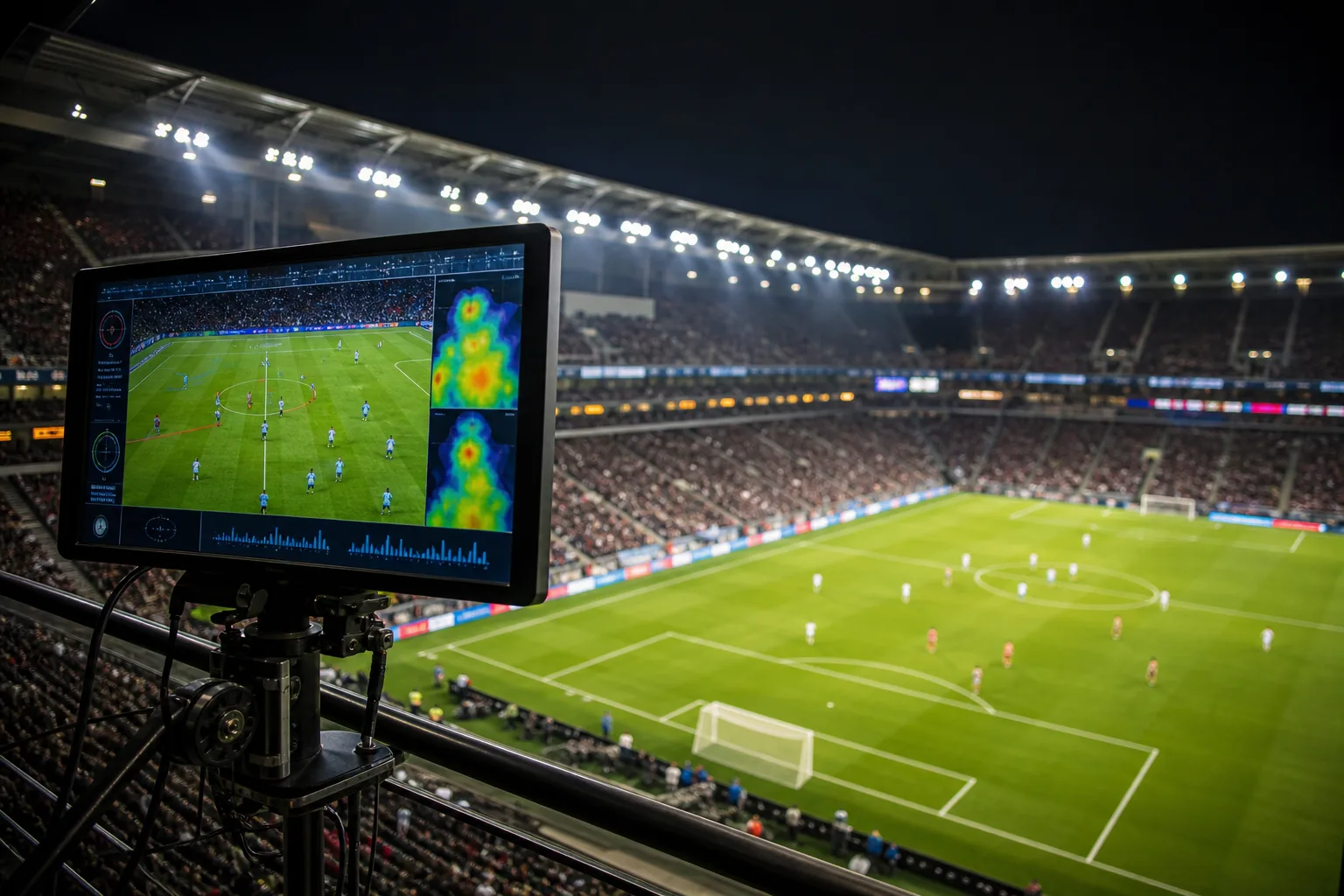
The build-up to any World Cup is always dominated by squad selections, stadium drama, and geopolitical noise — but quietly, steadily, FIFA World Cup AI infrastructure is becoming just as consequential as the players on the pitch. With the 2026 tournament set to span the United States, Canada, and Mexico across 16 host cities, football’s governing body is betting heavily that machine learning and computer vision can handle the scale, speed, and scrutiny that comes with the biggest single sporting event on the planet.
- FIFA World Cup AI systems are being selected to improve on-field officiating, performance analytics, and broadcast experiences.
- FIFA World Cup AI builds on tools already tested at the 2022 Qatar tournament, including semi-automated offside and ball-tracking tech.
- Sports organisations globally are racing to embed machine learning into live competition environments, with football leading the way.
- The 2026 tournament co-hosted by the US, Canada, and Mexico will be the largest World Cup in history, amplifying the stakes for every tech deployment.
Table of Contents
FIFA World Cup AI: What’s Actually Being Deployed
It’s tempting to treat ‘AI at the World Cup’ as a vague marketing promise — the kind of thing a vendor throws into a press release. The reality is more specific, and honestly more interesting. FIFA World Cup AI deployments break down into three distinct categories: officiating support, performance analytics, and fan-facing broadcast tools.
On the officiating side, the 2022 Qatar tournament was a meaningful proof of concept. Semi-automated offside technology — which combines dedicated tracking cameras per stadium with a single sensor inside the official match ball — generated limb-position data on every player multiple times per second. The system could produce an offside alert in a matter of seconds, compared to the several minutes that traditional VAR reviews sometimes demanded. Fans noticed. So did broadcasters, who were able to show 3D animated reconstructions of offside lines almost immediately after an incident.
For 2026, FIFA is pushing this further. The expanded 48-team format means more matches, more officiating crews, and more chances for consistency to break down. AI systems that can surface standardised, data-driven alerts become more valuable — not less — when you’re managing a greatly increased number of games across three countries.
The Performance Analytics Arms Race
While officiating tech gets the headlines, the more quietly transformative FIFA World Cup AI work is happening in team preparation. Every major national federation heading into 2026 will have access to some form of AI-assisted scouting and opponent modelling. The gap between sides that use these tools well and those that don’t is widening.
Companies like Stats Perform have been supplying machine-learning-driven event data to clubs and federations for years. Their models can ingest decades of match footage, tag every press trigger, transition, and set-piece pattern, and generate tactical tendency reports at a granularity that a human analyst team simply couldn’t produce on a World Cup preparation timeline. When a coaching staff has six weeks to prepare for a group-stage opponent, an AI system that can compress 200 hours of video analysis into a structured briefing document isn’t a luxury — it’s a competitive necessity.
Player load management is the other pillar. Elite clubs and national teams are using GPS-derived workload data, fed into predictive models, to estimate injury risk across a tournament schedule. The 2022 World Cup’s compressed calendar — squeezed into November and December to avoid Qatar’s summer heat — made this acutely relevant. Expect 2026, with its longer travel distances across a geographically sprawling host, to drive even more sophisticated use of these systems.
Broadcast and Fan Experience: AI Behind the Camera
Away from the pitch entirely, broadcasters and FIFA’s commercial partners are deploying FIFA World Cup AI tools to reshape how billions of viewers experience the tournament. Automated camera direction — where computer vision systems track the ball and flag high-probability moments to human directors — is already standard in second-tier football coverage. At a World Cup, where every broadcast second is worth serious money, AI that can pre-empt a goal celebration by framing the right camera half a second earlier is genuinely valuable.
Then there’s the commentary and statistics layer. AI-generated real-time data overlays — expected goals figures, pressure maps, pass-completion heatmaps — have become part of the visual grammar of televised football. What’s changing is the speed and specificity. Systems can now surface contextual stats (‘this is only the third time in World Cup history a team has scored two goals in the first ten minutes of a knockout game’) within seconds of an event occurring, feeding both on-screen graphics and commentary teams simultaneously.
Some broadcasters are also quietly testing AI-generated audio commentary for secondary language feeds — a significant consideration when a 48-team World Cup draws audiences across dozens of linguistic markets that traditional commentary budgets can’t fully serve.
The Limits — and the Honest Concerns
None of this is without friction. The semi-automated offside system in Qatar, while faster than manual VAR, still generated controversy when it flagged marginal calls decided by a player’s armpit or toenail. The technology was accurate within its defined parameters; the question was whether those parameters reflected what fans and players actually consider the spirit of the offside rule. That’s a philosophical problem no algorithm fully solves.
There’s also a data equity issue that the sport hasn’t resolved. FIFA World Cup AI tools — particularly the high-end analytics platforms — are expensive, and access to them is uneven. A national federation from western Europe or South America can afford sophisticated AI-driven preparation; a first-time qualifier from a smaller federation may not. If AI genuinely improves competitive outcomes, it risks reinforcing the advantages already enjoyed by the wealthiest footballing nations, which runs counter to the sport’s stated globalisation agenda.
FIFA has acknowledged this tension without fully addressing it. The governing body has talked about making certain data resources available to all competing federations, but the implementation details remain thin.
What 2026 Actually Tells Us About AI in Sport
The 2026 World Cup will be, among other things, the largest live-event stress test that FIFA World Cup AI systems have ever faced. Sixteen cities. Three time zones. An expected global audience of billions for the final. If the technology holds up — if the offside calls are fast and defensible, if the broadcast integrations are seamless, if no high-profile AI failure becomes a tournament-defining moment — it will accelerate adoption across every other major sport almost immediately.
The NFL, the NBA, cricket’s ICC, and Formula 1 are all watching. Sports administrators everywhere understand that AI-assisted officiating and analytics aren’t a future consideration anymore — they’re a present infrastructure decision. The World Cup, as it always does, will either validate or complicate that assumption at the highest possible stakes. Based on the trajectory from 2022, the smart money is on validation. But football has a long history of humbling smart money.
Frequently Asked Questions
What FIFA World Cup AI tools are already being used in professional football?
Semi-automated offside technology using player-tracking data and computer vision to generate near-instant offside calls has been deployed at recent World Cup tournaments. Ball-tracking systems and AI-assisted video review have also become increasingly common in top-tier football.
How does AI improve officiating accuracy at a World Cup?
AI systems process positional data from multiple cameras and sensors in real time, flagging potential offside positions or foul incidents within seconds. This reduces human error and gives referees data-backed decisions rather than relying solely on video replays.
Will AI replace human referees at the World Cup?
No. Current FIFA-approved systems are designed as decision-support tools, not replacements. Human referees retain final authority, with AI surfacing data and alerts that inform their calls rather than override them.
Which companies are supplying AI technology to FIFA for the World Cup?
FIFA has worked with various technology providers for ball and player tracking as well as data analytics to process match statistics. Specific vendor selections and partnerships continue to be announced on a rolling basis.