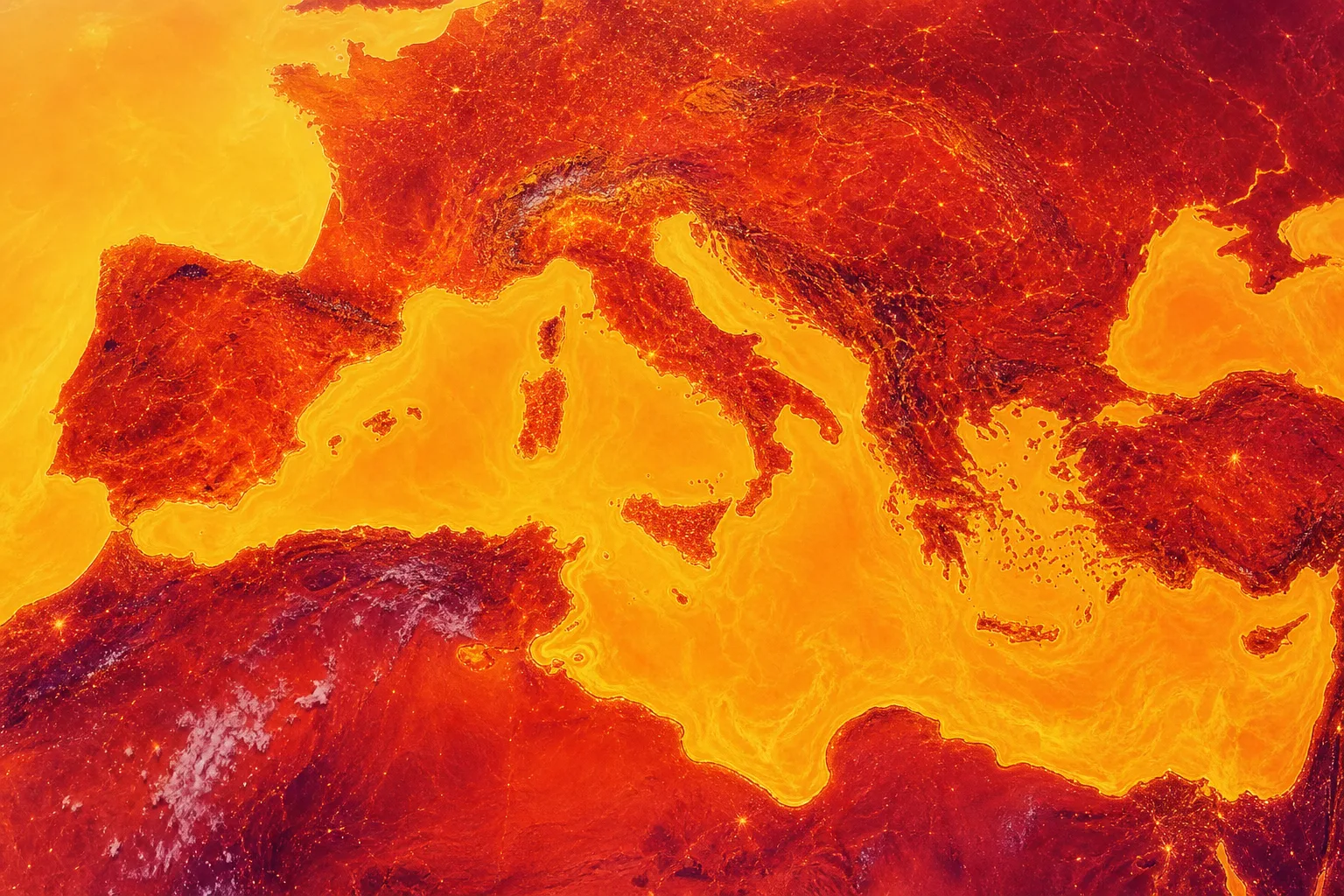
The Europe heat wave that swept across the continent earlier this month wasn’t just felt on the ground — it was visible from orbit. ESA’s Sentinel-3 satellite, circling Earth in a sun-synchronous low orbit, captured thermal data on June 23 that paints a startling picture of just how extreme this event really was. The images aren’t just dramatic. They’re scientifically essential.
- The Europe heat wave has been linked to over 1,300 deaths across the continent, per WHO estimates.
- ESA’s Sentinel-3 satellite recorded Europe heat wave surface temperatures as high as 55°C in parts of Spain and France.
- France recorded its hottest June day ever on June 23, when Sentinel-3 captured the thermal imagery.
- WHO chief Tedros Adhanom Ghebreyesus warned that Europe is warming at twice the global average rate.
Table of Contents
What Sentinel-3 Actually Saw During the Europe Heat Wave
On June 23 — the same day France recorded its hottest June day in history — Sentinel-3’s Sea and Land Surface Temperature Radiometer (SLSTR) was scanning the continent from above. The resulting thermal map, released by the European Space Agency, uses a color scale ranging from cooler blues to searing reds and violets, and the picture across southern and western Europe is almost entirely the wrong color.
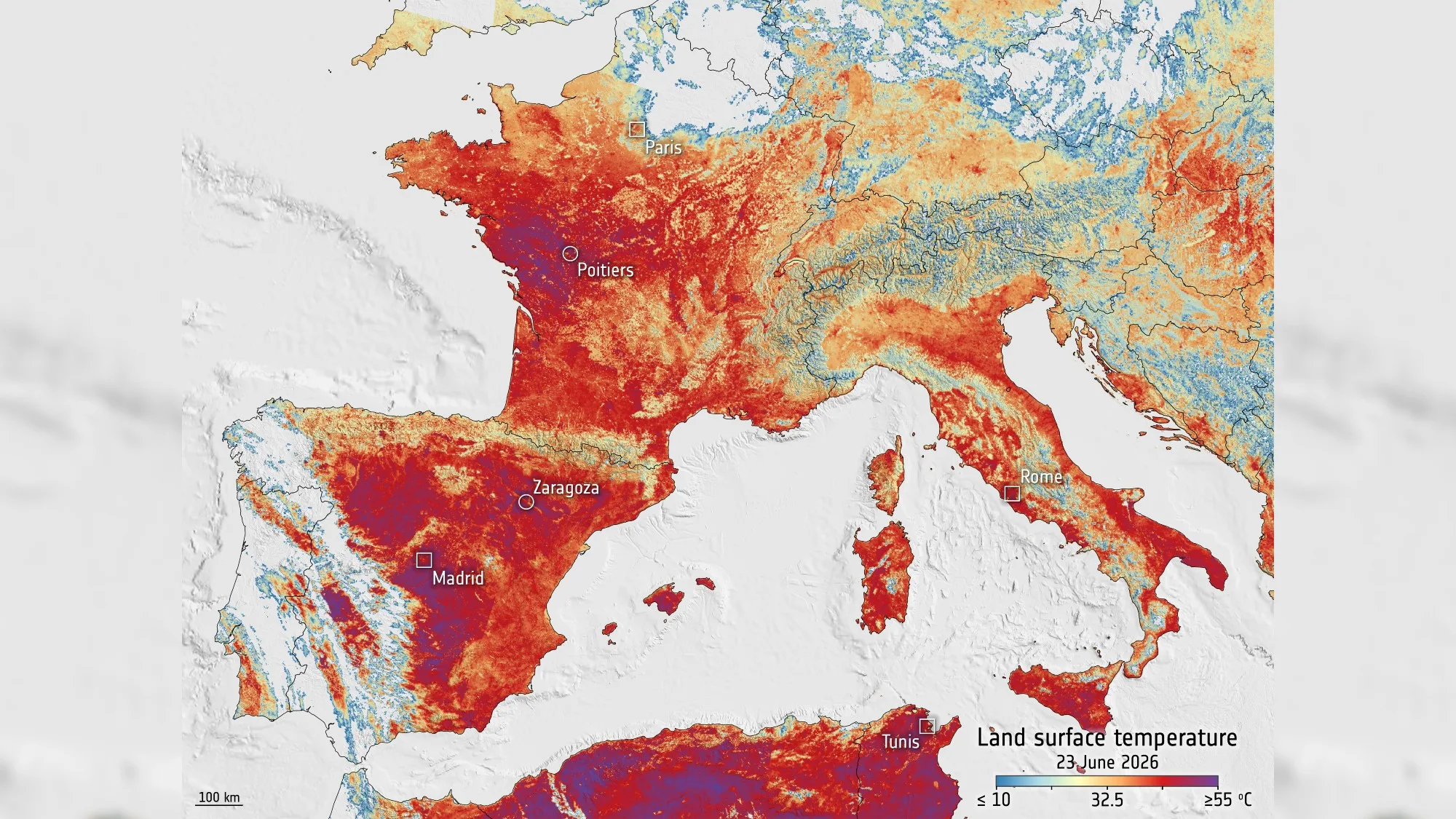
Surface temperatures in parts of central Spain, western France, and northern Africa hit 131°F — that’s 55°C. Madrid clocked in at 118°F (48°C). Rome reached 111°F (44°C). These aren’t air temperatures as measured in the shade two meters above ground, which is the standard meteorological measurement most people are familiar with. Land surface temperatures can run significantly hotter than ambient air temperatures, particularly on dark asphalt or bare soil under direct sunlight. That distinction matters for understanding the real thermal stress on ecosystems, infrastructure, and human health.
The SLSTR instrument works by detecting the infrared radiation emitted by Earth’s surface — essentially measuring how much heat objects on the ground are radiating back into the atmosphere. Because it covers both land and water simultaneously, Sentinel-3 gives researchers a continuous, high-resolution view of thermal anomalies in near real time, which is exactly the kind of data climate scientists need when events like this unfold.
The Human Cost: Over 1,300 Deaths and Counting
The Europe heat wave wasn’t just a meteorological record-setter. The World Health Organization has estimated that more than 1,300 deaths may be directly linked to this event — a toll that, historically, tends to be revised upward as researchers apply excess-mortality analysis in the weeks and months that follow. Heat is a particularly insidious killer. It doesn’t leave obvious wreckage the way a hurricane or earthquake does, which means it often gets less public attention than its body count warrants.
WHO chief Tedros Adhanom Ghebreyesus addressed the crisis directly, posting on X that Europe is the fastest-warming continent on Earth, heating at twice the global average. That’s a remarkable statement, and it should probably be getting more column inches than it does. Europe — historically associated with temperate, cool climates — is now outpacing the global warming rate by a factor of two. The implications for public health infrastructure, agriculture, energy demand, and urban planning are significant.

Southern European cities like Madrid, Rome, and Athens have been investing in heat action plans for years, but urban heat islands — where dense construction, concrete, and minimal greenery amplify already-high temperatures — mean that even well-prepared cities struggle when temperatures push this far beyond historical norms. The Europe heat wave appears to have exceeded the thresholds that existing preparedness frameworks were designed around.
Why Satellite Data Is Now Central to Understanding Extreme Heat
Thirty years ago, understanding a Europe heat wave in real time meant aggregating data from ground weather stations — a patchwork approach with obvious geographic gaps, particularly over rural areas, coastlines, and mountain ranges. Sentinel-3 changes that equation entirely. Flying in sun-synchronous orbit, the satellite passes over the same points on Earth at the same local solar time each day, which makes it possible to build temporally consistent data sets — crucial for tracking how surface temperatures evolve over the course of a heat event.
The Copernicus programme, the EU’s Earth observation initiative under which Sentinel-3 operates, was specifically designed to provide continuous, open-access environmental monitoring at the continental scale. That “open-access” part matters. Research teams, national meteorological agencies, emergency services, and urban planners across Europe can all pull Sentinel-3 data without licensing fees or bureaucratic friction. In a crisis situation — which an active heat wave with a rising death toll absolutely is — that speed of access can translate into faster, better-informed public health responses.
There are now two Sentinel-3 satellites in orbit (Sentinel-3A and Sentinel-3B), flying in formation to maximize revisit frequency. Together they can cover the entire Earth’s surface in under two days. For a slow-moving but intensifying heat dome sitting over Europe for multiple days, that revisit cadence is more than adequate to track the event’s spatial footprint and intensity over time.
Europe’s Warming Trajectory — and What Comes Next
The Europe heat wave isn’t happening in isolation. It follows a pattern that climate scientists have been documenting for decades: European summers are getting hotter, heat waves are becoming more frequent, and the gap between “record high” and “previous record” is widening with each cycle. The 2003 European heat wave killed an estimated 70,000 people and was then considered a once-in-a-generation event. It’s now beginning to look like a preview.
Mediterranean climate zones are pushing northward. Parts of southern France and northern Spain that once had climates comparable to the British Midlands are now experiencing summer temperature profiles closer to what North Africa saw two or three decades ago. That’s a rapid shift by any historical standard, and it’s happening within single human lifespans.
For the satellite operators and climate scientists working with Sentinel-3 data, the job is increasingly not just to document these events in hindsight but to build the predictive models that can help authorities get ahead of them. Machine learning tools trained on years of SLSTR thermal data are already being used to identify which urban neighborhoods are most vulnerable to heat stress — a kind of thermal risk mapping that could eventually feed directly into city-level emergency response systems.
None of this makes the Europe heat wave less deadly in the present tense. But it does suggest that the infrastructure to understand, predict, and ultimately respond to these events is growing more capable with each passing year — provided the political will to act on the data keeps pace with the science producing it.