

- NASA space science is coming to the 2026 FIFA World Cup through a free public exhibit at Fan Festival Houston from June 11 to July 19.
- NASA space science research aboard the ISS studied how internal mass distribution affects soccer ball stability and rotation in microgravity.
- Artemis II crew members will appear at Fan Festival Houston on June 20 following their historic lunar mission.
- Wind tunnel tests at NASA’s Ames Research Center informed how panel shape and seam depth affect ball flight consistency in major tournaments.
Table of Contents
NASA Space Science Is Heading to Houston — and the World Cup
When the 2026 FIFA World Cup kicks off on June 11, the biggest sporting event on the planet will have an unexpected co-star: NASA. The agency is setting up a full exhibit at the FIFA Fan Festival™ in Houston, running through July 19, and it’s free to attend. For every match of the tournament, fans heading to East Downtown Houston will be able to walk through displays on the International Space Station, the Artemis lunar program, and — in one of the more unlikely crossovers in recent memory — the aerodynamics of a soccer ball. NASA space science, it turns out, has been quietly shaping the game for years.
The Houston location isn’t incidental. Johnson Space Center, home to NASA’s astronaut corps and mission control, sits just outside the city. JSC Director Vanessa Wyche will personally introduce select Artemis II crew members on June 20, following their mission around the Moon. The crew will take part in World Cup activities ahead of the Netherlands-Sweden match and then hit the Fan Festival main stage to talk about what it’s actually like to fly beyond low Earth orbit. It’s a rare moment where NASA space science connects the space community and the global football audience in a way that genuinely overlaps — and NASA is making the most of it.
What Microgravity Has to Do With a Soccer Ball
The link between NASA space science and professional football isn’t as thin as it might sound. In 2019, NASA partnered with the ISS National Laboratory to run experiments aboard the International Space Station specifically focused on how a soccer ball’s internal mass distribution affects its flight. The microgravity environment on the ISS is uniquely useful here: strip away gravity, and you can isolate the physics of rotation and stability in ways that Earth-based testing simply can’t replicate cleanly.
The findings matter because modern match balls are no longer just stitched leather and air. Since 2022, Adidas has been embedding electronics inside every official ball used at major tournaments — sensors that track speed, position, and contact data in real time for referees, broadcasters, and analysts. That’s genuinely useful technology, but those sensors add mass. And mass that isn’t evenly distributed changes how a ball spins and holds its line through the air. The ISS research helped clarify exactly how much that matters, and under what conditions the effect becomes pronounced enough to affect play.
The underlying physics isn’t unique to sport. Understanding the relationship between an object’s center of mass and its geometric center is fundamental to aerospace engineering — it’s how you predict the trajectory of satellites, spacecraft reentry vehicles, and aircraft. The fact that the same equations apply to an Adidas match ball flying at 100 km/h is a genuinely elegant piece of applied science, and NASA space science has been enabling exactly this kind of dual-use knowledge transfer for decades.
The Brazuca Wind Tunnel Tests That Started It All
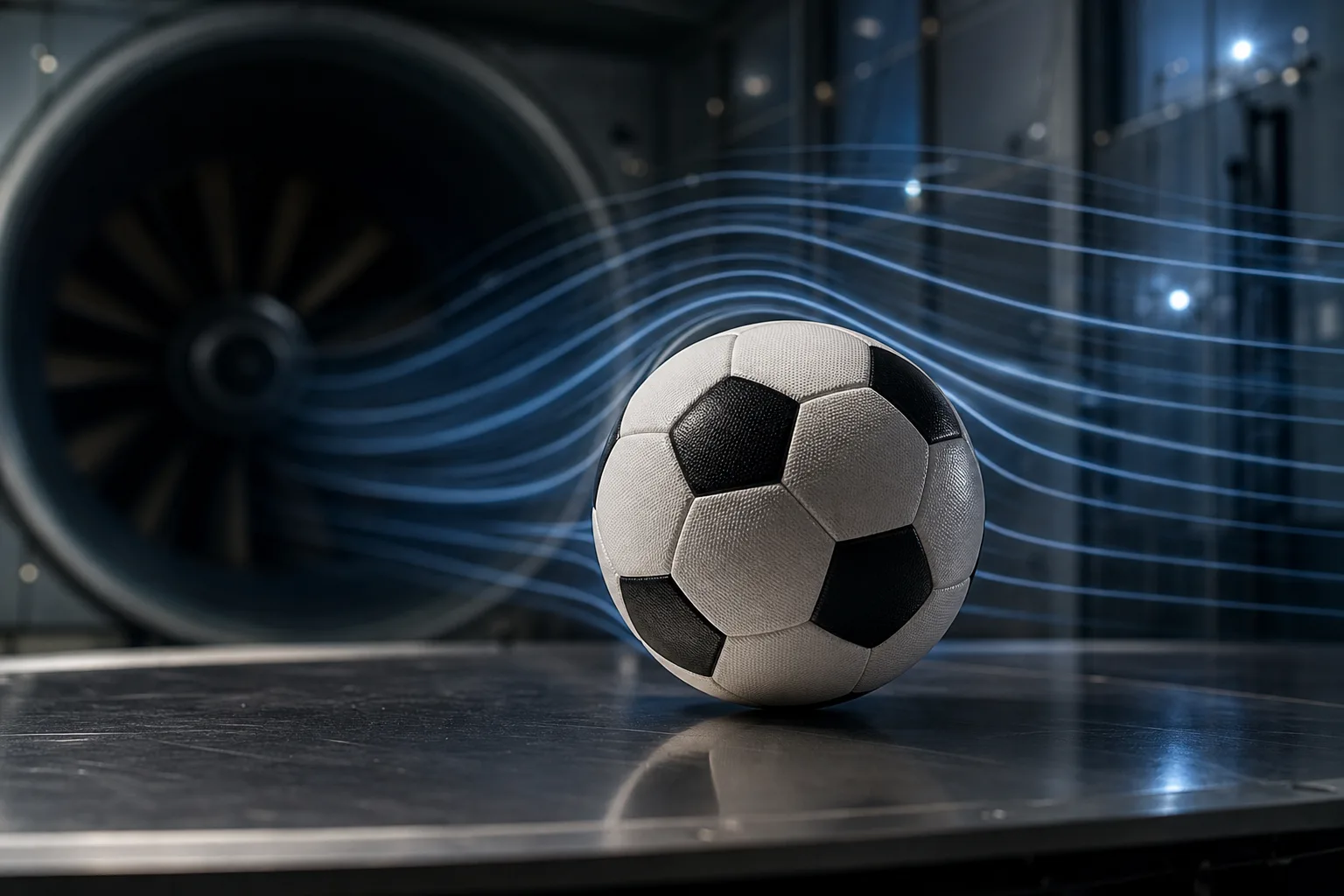
The ISS work built on earlier research that’s worth understanding on its own terms. Ahead of the 2014 FIFA World Cup in Brazil, engineers at NASA’s Ames Research Center in California’s Silicon Valley put the Adidas Brazuca ball through rigorous wind tunnel testing at the Fluid Mechanics Laboratory. The goal was to understand aerodynamic behaviour at match conditions — and specifically to get a handle on ‘knuckling.’ This work remains one of the clearest examples of NASA space science applied directly to consumer sports equipment.
Knuckling is the nightmare scenario for goalkeepers: a ball struck with low spin that begins to wobble and dart unpredictably as it travels. The effect happens when airflow across the ball’s seams becomes unstable, and it’s notoriously difficult to model because small changes in seam geometry produce outsized changes in behaviour. NASA’s wind tunnel tests pinpointed the speed ranges and flow conditions where knuckling was most likely with the Brazuca’s specific panel configuration. From there, researchers could identify how adjustments in panel shape, seam depth, and surface texture could either suppress the effect or amplify it — depending on what ball manufacturers actually wanted to achieve.
That kind of granular aerodynamic data is enormously valuable to FIFA and its official ball suppliers. A ball that behaves too unpredictably alienates top players and produces chaotic matches; one that’s too stable removes the skill involved in dead-ball delivery. The sweet spot is technically demanding to hit, and NASA’s fluid dynamics tools are genuinely among the best in the world for mapping it out.
NASA Space Science Meets Sports Technology — A Longer Trend
It’s tempting to treat this as a novelty story — space agency turns up at football tournament, everyone takes photos. But the technology transfer dimension here is real and has real precedent. NASA’s spinoff program has been documenting commercial applications of space research since 1976, and the list runs from memory foam mattresses to water filtration systems to scratch-resistant lenses. Sports technology is a newer but growing part of that story, and NASA space science is increasingly central to it.
The Adidas sensor ball programme is a useful case study in how quickly that transfer can happen. The sensors embedded in official match balls used at the 2022 Qatar World Cup and Euro 2024 directly supported semi-automated offside technology — a system that’s already changed how the game is officiated at the highest level. Understanding how those sensors affect ball flight, rather than just assuming they’re neutral, is a legitimate engineering problem. NASA’s research gives manufacturers and FIFA a more honest picture of what they’re deploying.
Now, NASA and Adidas are presenting a joint demonstration — dubbed a ‘STEMonstration’ — that physically shows how differently balanced soccer balls spin and move in microgravity. The experiment is designed to make the physics tangible for a general audience rather than staying locked in academic papers. That’s a smart piece of science communication, and it fits a broader push by both NASA and the sports industry to connect their work to public curiosity rather than just B2B relationships.
Why This Matters Beyond the Tournament
There’s a strategic dimension to NASA’s World Cup presence that goes beyond public outreach. The agency is currently navigating significant budget pressures and political scrutiny over the Artemis programme’s cost and timeline. Putting Artemis II crew members on a stage in front of a global football audience — which FIFA estimates at several billion viewers across the tournament — is exactly the kind of earned media that a traditional press conference can’t buy. It’s NASA space science meeting the world where it actually lives, rather than waiting for the world to come to a launchpad.
For the sports technology industry, the collaboration signals something worth watching. As sensor hardware in officiating becomes more sophisticated — and as FIFA, World Rugby, and other governing bodies look at more embedded tech in balls, boots, and pitches — the aerodynamic and biomechanical implications need to be understood properly. Space agencies, with their decades of experience in fluid dynamics, materials testing, and sensor miniaturisation, are a natural but underutilised resource for that kind of work. NASA space science applied to sports may still be a niche conversation inside the industry, but the 2026 World Cup exhibit is its highest-profile demonstration yet — and it almost certainly won’t be the last.
Frequently Asked Questions
How does NASA space science actually improve soccer ball design?
NASA researchers studied how a ball’s internal mass distribution affects its motion and rotation using the ISS microgravity environment. That work, done in partnership with the ISS National Laboratory in 2019, informed how embedded sensors inside match balls — like those Adidas has used since 2022 — influence flight stability during play.
What is the NASA exhibit at FIFA Fan Festival Houston?
NASA is hosting a free exhibit at Fan Festival Houston open for every match of the tournament between June 11 and July 19, 2026. Visitors can explore ISS research, Artemis missions, and the physics connecting space exploration to everyday life, including sports technology.
What is soccer ball ‘knuckling’ and why does NASA care about it?
Knuckling is the unpredictable movement a ball makes during low-spin kicks, caused by unstable airflow across the seams. NASA engineers at Ames Research Center measured the speeds and airflow conditions where this effect is most pronounced during wind tunnel tests on Adidas’s Brazuca ball, which was developed for the 2014 FIFA World Cup.
Which Artemis crew members will appear at the 2026 World Cup?
Select Artemis II crew members will attend Fan Festival Houston on June 20, 2026, introduced by Johnson Space Center Director Vanessa Wyche. The appearance follows their mission around the Moon, and the crew will speak on the main stage and take part in World Cup activities ahead of the Netherlands-Sweden match.

