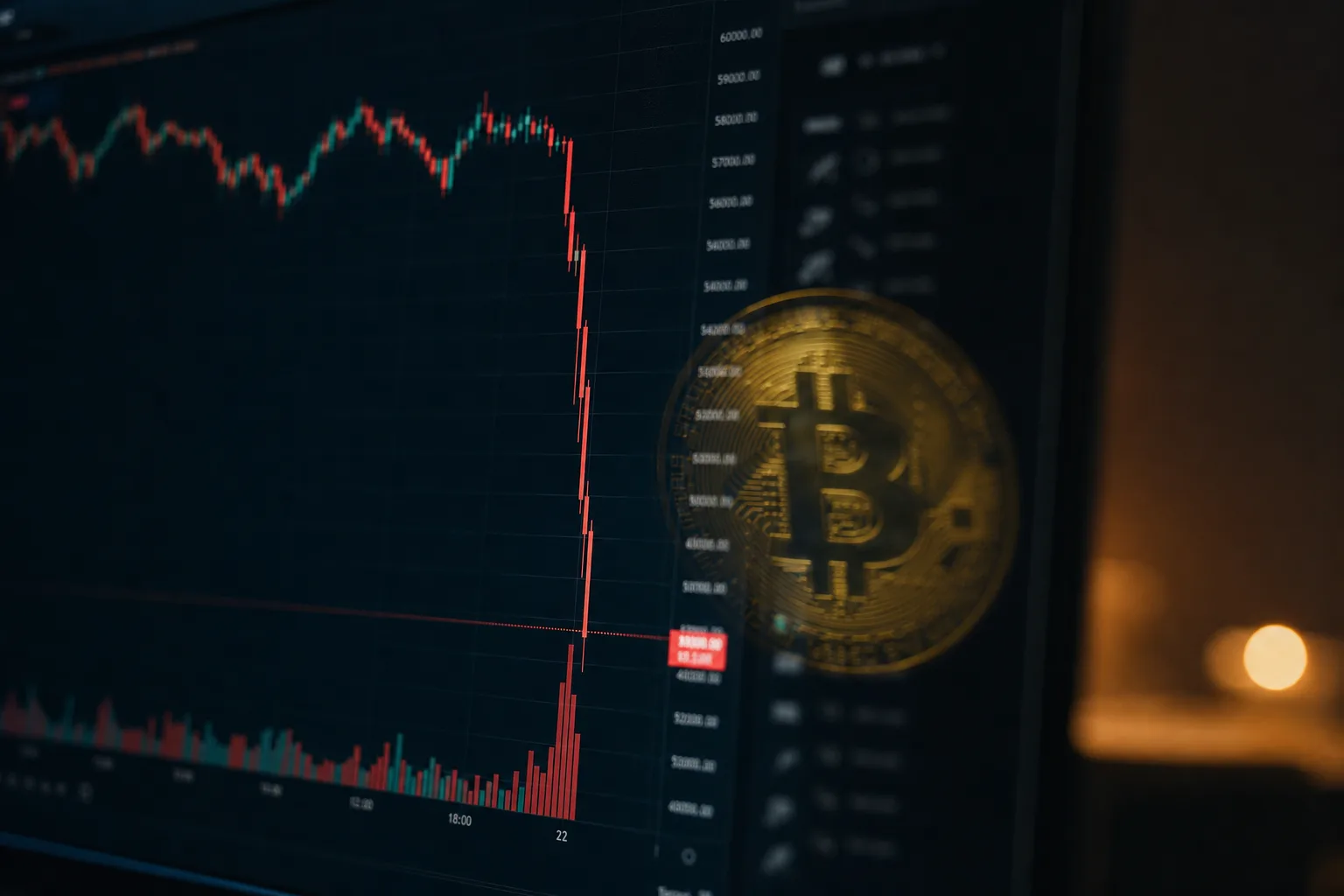
The Zcash crash landed hard this week, wiping billions of dollars from ZEC’s market cap in a single session after developers disclosed a four-year-old vulnerability buried inside the network’s Orchard privacy pool. At its worst, ZEC dropped more than 40% intraday — briefly sliding below $300, a level it hadn’t touched since early April — before stabilising around $339. For context, the token had been trading near $675 just days earlier. That’s not a correction. That’s a collapse.
- The Zcash crash sent ZEC down more than 40% in a single day after a four-year-old minting vulnerability was disclosed.
- The Zcash crash is amplified by one brutal unknown: nobody can confirm whether the bug was ever exploited.
- ZEC briefly traded below $300, erasing months of gains that had taken the token from under $200 to nearly $675.
- Despite the selloff, Zcash is still up more than 580% over the past year — though recapturing recent highs looks distant.
Table of Contents
What Actually Happened With the Zcash Vulnerability
The bug, which sat undetected for roughly four years, would have allowed a malicious actor to mint counterfeit ZEC tokens — essentially creating new coins out of thin air without the network’s knowledge. The vulnerability was located in one of Zcash’s private transaction pools, the very infrastructure that gives the coin its core identity as a privacy-focused asset. Developers patched it earlier this week, but the patch itself opened a can of worms that the market is still trying to close.
Here’s the problem: because Zcash’s privacy architecture is designed to conceal transaction details, there’s currently no reliable way to determine whether anyone actually exploited the bug before it was fixed. That uncertainty — not the vulnerability itself — is what’s driving the price action, according to analysts closely watching the situation.
Nicolai Sondergaard, a research analyst at blockchain analytics firm Nansen, put it plainly:
“The price reaction reflects that uncertainty more than the bug itself. A patched vulnerability in a minor privacy coin would ordinarily be a footnote. The -30% move is the market assigning non-trivial probability to the scenario where some counterfeiting did occur and is permanently undetectable without the proposed upgrade.”
That’s a fairly damning framing. Markets can price in bad news. What they struggle with is open-ended bad news — the kind where you don’t know whether the worst-case scenario already happened and you’re simply unable to find out. That’s the position ZEC holders find themselves in right now, and it’s a key reason the Zcash crash has proven so difficult to shake off.
The Zcash Crash Came at the Worst Possible Moment
Timing, as always in crypto, matters enormously. The disclosure didn’t land during a quiet period — it arrived while the privacy coin narrative was building real steam. ZEC had climbed roughly 3x since April, outperforming Bitcoin and most major altcoins on the back of growing interest in financial privacy tools. Regulatory pressure on traditional finance, AI-driven data surveillance concerns, and broader anxieties about government monitoring had all stoked demand for coins that promised genuine transactional anonymity.
Ish Asad, a research analyst at Bitwise, told Decrypt:
“The news came at a time when the privacy narrative was surging and ZEC was up about 3x since April, outperforming Bitcoin and other major cryptocurrencies. As a result of that timing, ZEC plummeted 40%.”
The irony is brutal. The very feature that makes Zcash attractive — its shielded transaction pool — is the same feature that makes the vulnerability’s impact impossible to fully audit. Privacy-by-design cuts both ways when something goes wrong, and the Zcash crash has made that tension impossible to ignore.
Arthur Hayes Dumped His ZEC — and He’s Not Alone
Perhaps the highest-profile casualty of the panic selling was BitMex founder Arthur Hayes, who announced on social media that he’d exited his entire ZEC position. His reasoning was notably philosophical rather than purely financial. Hayes said the exploit “violated his narrative mental map” — meaning the Orchard Pool incident directly contradicted the story he’d told himself about why Zcash was worth holding. If the privacy layer can’t be trusted, the premise of owning a privacy coin collapses.
That said, Hayes wasn’t closing the door permanently. He acknowledged that privacy “is priceless” and said he’d have no problem buying back at higher prices if the network can demonstrate a credible path to recovery. It reads less like a permanent break-up and more like a forced reset — which, given his public profile, might actually signal an eventual return of institutional-adjacent interest if Zcash addresses the underlying issues convincingly. High-profile exits like his are a reminder of just how quickly the Zcash crash eroded confidence among influential holders.
Can ZEC Actually Recover?
The Zcash crash hasn’t erased all long-term gains — ZEC is still up more than 580% over the past twelve months even after this week’s selloff. But recovering the ground lost in a matter of hours is a different challenge entirely. Jake Kennis, a senior research analyst at Nansen, is sceptical that a swift rebound is on the cards, pointing to both the scale of the drop and the trading volume that accompanied it — over $3 billion in 24 hours at the height of the panic.
According to Kennis, a real recovery would likely require at least one of three things: a broader resurgence of the privacy coin narrative across the market, a major protocol-level upgrade that definitively addresses the counterfeiting concern, or a larger rotation of capital into privacy assets generally. None of those are imminent. And before any of them can drive a sustained move higher, Kennis says ZEC would first need to “find its footing” — trader shorthand for the messy, slow process of establishing a new price floor after a steep decline.
Asad takes a more optimistic view, though he frames it carefully. His argument is that the market has a tendency to overshoot in both directions — and that the fundamental case for Zcash hasn’t actually changed.
“Oftentimes the market gets ahead of itself and reprices, sometimes dramatically, in real time,” he said. “But the fundamental story does not change: Zcash is a clone of Bitcoin with added privacy and encryption features, which will have a market of its own.”
That’s a reasonable point, but it carries an implicit assumption: that the market will eventually conclude no counterfeit minting took place, or that any inflation of the supply was negligible. If evidence emerged suggesting meaningful exploitation of the bug, that reassessment would need to be walked back sharply. For now, the Zcash crash leaves bulls in the uncomfortable position of arguing a case they cannot fully prove.
What This Means for Privacy Coins Broadly
The obvious question is whether competitors like Monero — arguably the most widely used privacy coin — stand to benefit from Zcash’s distress. The instinct makes sense on the surface: traders burned by ZEC might rotate into alternative privacy assets. But Kennis pushes back on that logic. A high-profile vulnerability in any privacy protocol doesn’t make investors more confident in the category — it makes them warier of the entire premise. The credibility of the privacy coin concept takes a hit regardless of which specific coin is affected.
That’s worth sitting with. The privacy coin space has spent years trying to shed its association with illicit finance and build a legitimate narrative around individual financial freedom and data sovereignty. An undetectable counterfeiting bug — even a patched one — feeds exactly the kind of doubt that makes mainstream adoption harder to argue for. The Zcash crash isn’t just a setback for ZEC holders; it’s a speed bump for the broader story the category has been trying to tell.
The path forward for Zcash hinges on what the development team does next. A proposed protocol upgrade that would retroactively allow auditing of the affected pool — even if partial — would go a long way toward rebuilding trust. Without that, the uncertainty Sondergaard describes isn’t going away. And in crypto, sustained uncertainty rarely resolves in the bulls’ favour. Zcash has the technology, the history, and — even post-crash — a stronger performance record than most of its peers. Whether that’s enough to write the next chapter depends entirely on whether the team can turn an unanswerable question into an answered one.