

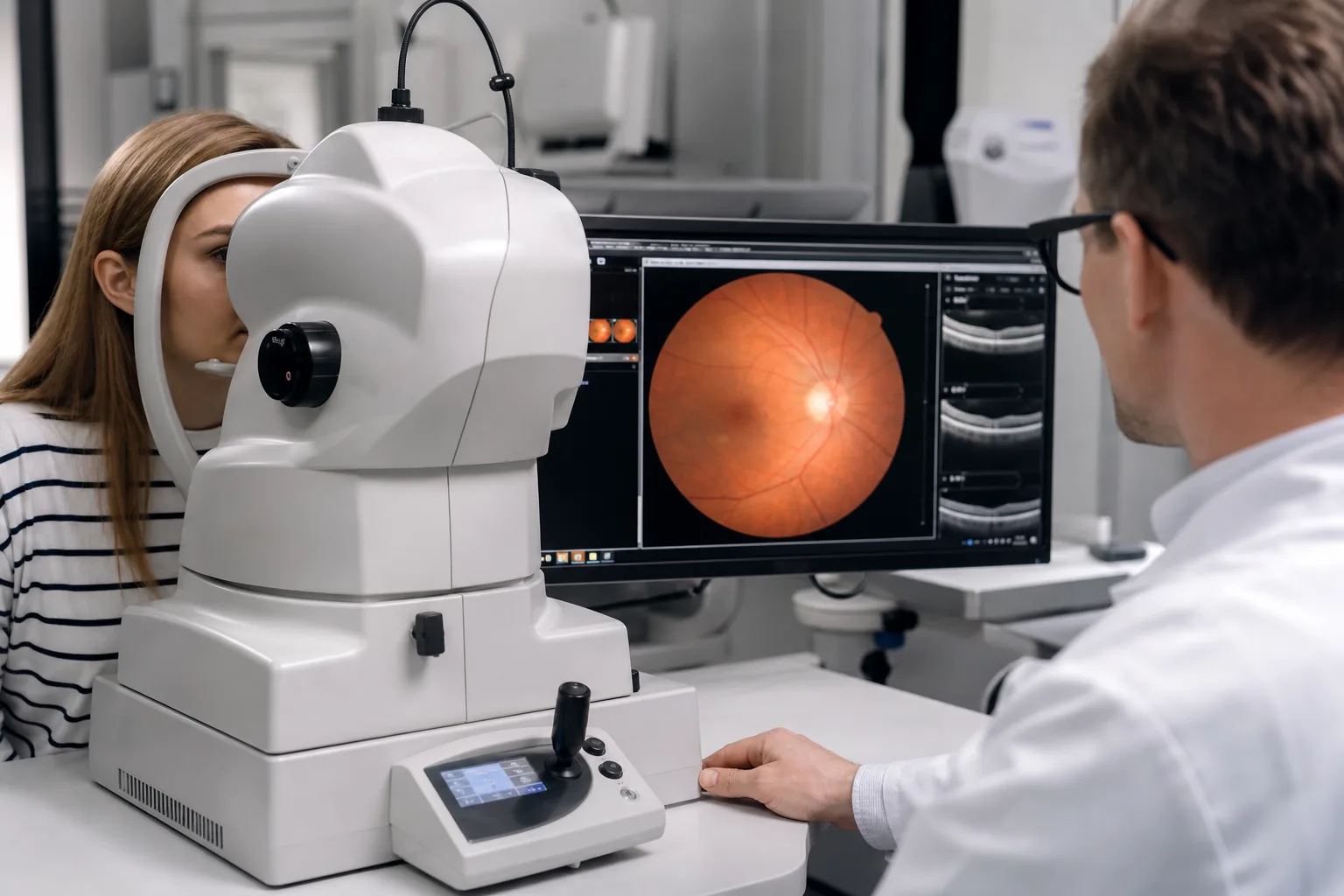
- AI eye disease diagnosis is now approaching the accuracy of experienced ophthalmologists in clinical studies.
- New AI eye disease diagnosis tools could dramatically expand access to screening in underserved communities worldwide.
- The technology analyses retinal images to flag conditions like diabetic retinopathy and macular degeneration early.
- Researchers say automated screening could reduce diagnosis delays and ease pressure on overstretched eye care systems.
Table of Contents
AI Eye Disease Diagnosis Is Getting Serious
AI eye disease diagnosis has moved well beyond proof-of-concept. A new wave of research is showing that machine learning models can analyse retinal scans with a level of accuracy that genuinely challenges — and in some cases matches — what a trained ophthalmologist delivers in a clinic. That’s not a small claim. It has real consequences for how millions of people around the world access eye care.
The latest findings, published in peer-reviewed medical research and covered by News-Medical, highlight how novel AI architectures are improving the detection of some of the most sight-threatening conditions known to medicine: diabetic retinopathy, age-related macular degeneration, and glaucoma. Each of these diseases can steal vision silently, often causing irreversible damage long before a patient notices symptoms. Early detection isn’t just helpful — it’s often the difference between keeping your sight and losing it.
How the Technology Actually Works
At its core, the AI systems being developed for eye disease screening are deep learning models trained on enormous libraries of retinal fundus images and optical coherence tomography (OCT) scans. These are the same types of images that an eye specialist reviews during a standard examination — detailed photographs of the retina’s structure, blood vessels, and the optic nerve.
What makes modern AI eye disease diagnosis tools different from earlier attempts is the sophistication of the neural network architectures involved. Earlier models struggled with edge cases — rare presentations of disease, images taken on lower-quality equipment, or patients with multiple overlapping conditions. Newer approaches, drawing on techniques like transformer-based vision models and ensemble learning, handle this variability far better.
The models don’t just flag whether disease is present or absent. The better ones produce graded outputs — telling clinicians how severe a condition appears, which quadrant of the retina is affected, and how urgent a follow-up might be. That’s clinically meaningful information, not just a binary yes-or-no answer.
The Numbers That Matter
Research in this space has started producing figures that are hard to dismiss. Studies have shown deep learning systems achieving sensitivity and specificity rates for diabetic retinopathy detection that sit above 90% — figures that are competitive with, and sometimes exceed, what human graders achieve under controlled conditions. A landmark 2016 study published in the New England Journal of Medicine by Google researchers was one of the first to put those numbers in front of the medical establishment and make the field take notice. The research that’s followed has only reinforced the core finding.
For conditions like AMD, where the window for effective intervention is narrow, that level of accuracy in AI eye disease diagnosis matters enormously. Catching neovascular AMD — the aggressive, wet form of the disease — early enough for anti-VEGF injections to work can preserve central vision for years. Miss it, and the damage is often permanent within months.
The Access Problem AI Could Actually Solve
Here’s where the story becomes more than just a technology benchmark. There’s a genuine, chronic shortage of ophthalmologists in many parts of the world. Sub-Saharan Africa, South Asia, and large rural regions across Latin America face ophthalmologist-to-population ratios that make regular retinal screening essentially impossible at scale. The World Health Organization has estimated that over 2.2 billion people globally have some form of vision impairment, with a significant portion of those cases being preventable or treatable — if only they’d been caught in time.
Automated AI eye disease diagnosis changes the arithmetic. A trained ophthalmic technician, or even a community health worker with the right equipment and software, can capture a retinal image. The AI does the analysis. A flagged result gets triaged to a specialist for review. Suddenly you’ve built a screening pipeline that doesn’t require a retinal specialist to be in the same room — or even the same country.
This isn’t science fiction. Google’s Verily has been running diabetic retinopathy screening pilots in India and Thailand for years. Eyenuk received FDA clearance for its EyeArt AI system for autonomous diabetic retinopathy detection back in 2020. IDx Technologies — now rebranded as Digital Diagnostics — was actually the first AI diagnostic system to receive FDA De Novo authorisation for any disease area, specifically for diabetic retinopathy screening without a clinician in the loop. These aren’t startups chasing a concept. They’re deployed systems with real-world track records.
What Clinicians Are Actually Saying
The reception from ophthalmologists has been more measured than the technology press might suggest. Most eye specialists don’t see AI as a replacement — they see it as a triage filter. Their concern isn’t the accuracy of the models on benchmark datasets. It’s the messiness of real-world clinical environments: variable image quality, patients with poorly controlled diabetes and cataracts that obscure the retinal view, electronic health record systems that weren’t built to integrate AI outputs cleanly.
There’s also the question of liability. When an AI system misses a case — and no system has perfect sensitivity — who’s responsible? The clinician who relied on it? The hospital that deployed it? The software vendor? These questions don’t have clean answers yet, and they slow down adoption in ways that pure accuracy benchmarks can’t address.
What the research community and the clinical world seem to agree on is that AI eye disease diagnosis works best as an augmentation layer — not as a standalone oracle. The most effective implementations pair automated screening with a clear pathway for human review of uncertain or high-risk cases. That hybrid model is where most serious deployments are landing.
Where This Goes Next
The next frontier isn’t just better accuracy on the diseases we already screen for. Researchers are discovering that retinal imaging may reveal far more than eye disease alone. Studies have shown that AI analysis of retinal scans can predict cardiovascular risk, estimate biological age, detect early signs of neurological conditions like Alzheimer’s disease, and even identify markers of systemic diseases like anaemia. The eye, it turns out, is an extraordinarily information-rich window into overall health.
If that potential is validated at scale, AI eye disease diagnosis becomes something much broader: a general-purpose health screening tool that happens to use an eye camera as its input. The retina’s blood vessels are the only part of the human circulatory system directly visible without invasive procedures. That’s a significant advantage for non-invasive monitoring, and the AI community is beginning to exploit it seriously.
For now, the immediate story is still about getting proven retinal disease detection into the hands of the clinicians and health systems that need it most. The technology is clearly capable. The regulatory frameworks are slowly catching up. And the case for deploying these tools at scale — especially in high-burden, low-resource settings — is becoming harder to argue against with each new study that lands.

