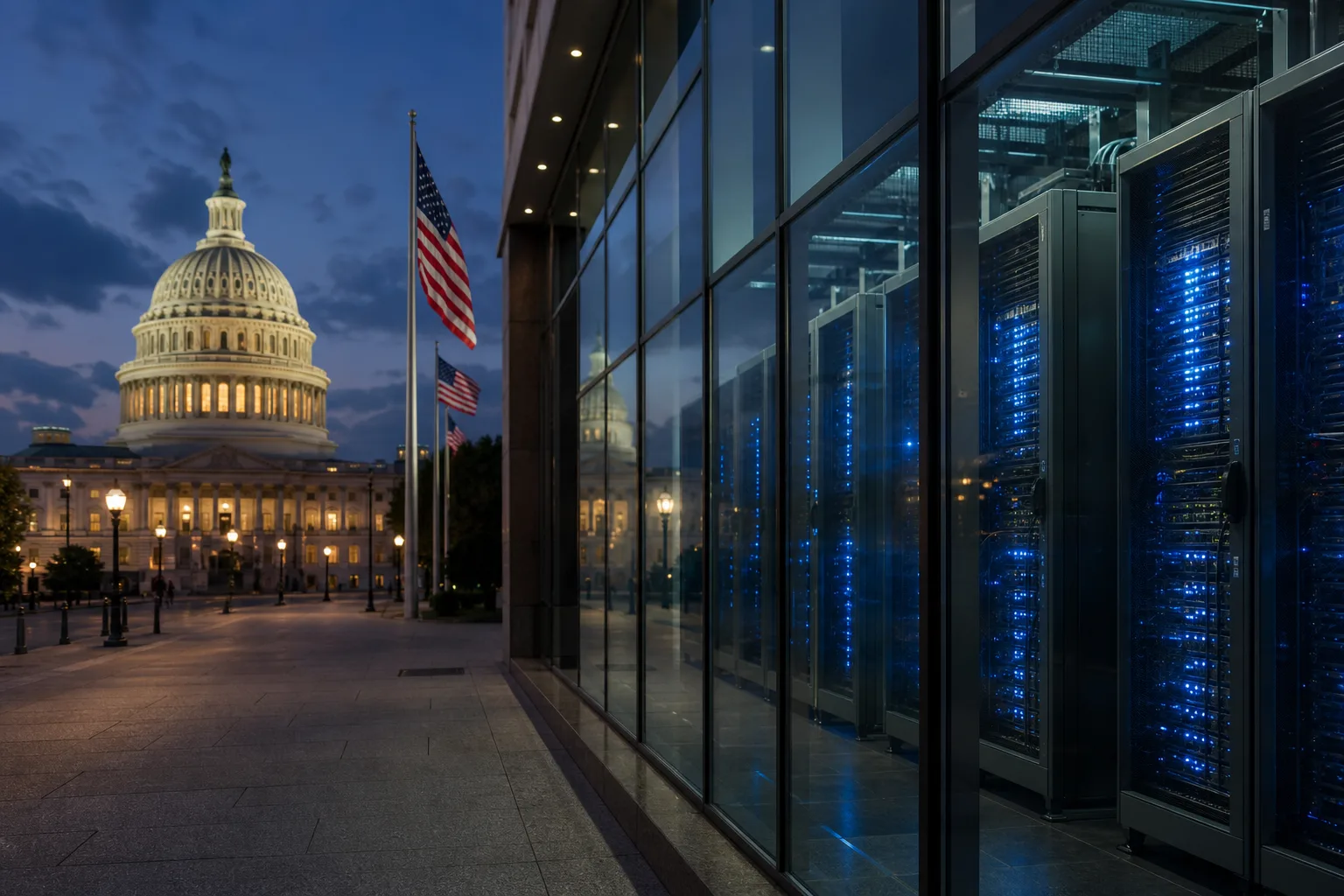
- Trump is considering a government AI stake in top US AI companies as part of a broader national strategy.
- A government AI stake could give Washington direct financial interest in firms like OpenAI and Anthropic.
- The proposal raises serious questions about conflicts of interest, regulatory independence, and market distortion.
- No formal legislation or executive order has been issued yet, but the idea signals a shift in how Washington views AI ownership.
Table of Contents
Washington Wants a Cut of the AI Boom
The idea of a government AI stake in America’s leading artificial intelligence companies — think OpenAI, Anthropic, Google DeepMind — would have sounded like a fringe talking point just two years ago. Now it’s coming directly from President Donald Trump, who has told advisers and reporters that he’s actively weighing whether the federal government should hold a financial interest in the country’s top AI firms. It’s a striking proposal, and the implications stretch far beyond a balance sheet entry in the US Treasury.
Trump floated the concept in conversations reported by The Washington Post, framing it as a way for the American public to benefit financially from AI development — development that has, so far, largely enriched a small circle of investors, founders, and tech executives. On the surface, the logic isn’t hard to follow. The US government has poured billions into AI-adjacent infrastructure, defense research, and chip manufacturing incentives. Why shouldn’t taxpayers see a return from a government AI stake in these rapidly growing firms?
But the distance between a reasonable-sounding idea and sound policy can be enormous, especially when it comes to something as consequential — and politically charged — as artificial intelligence.
Why a Government AI Stake Is More Complicated Than It Sounds
Let’s start with the most obvious problem: conflict of interest. If the federal government holds an equity-style government AI stake in OpenAI or Anthropic, what happens to regulation? The same administration that profits from those companies would be responsible for overseeing them. That’s not a theoretical concern — it’s a structural problem that would undermine the credibility of any AI policy coming out of Washington.
There’s also the question of which companies qualify. The AI landscape isn’t a neat list of five names. It includes hundreds of startups, several major cloud providers with deep AI operations, and international players with US-based subsidiaries. Deciding who gets the government stamp of ownership — and who doesn’t — is an inherently political act that could distort competition in ways that are hard to reverse.
Then there’s the precedent. The US has historically kept the government at arm’s length from direct equity ownership in private tech companies. Yes, DARPA funds research. Yes, the CHIPS Act subsidizes semiconductor manufacturing. But those are grants and incentives, not ownership stakes. A shift to actual equity would be a significant departure from the market-driven model that’s defined American tech policy for decades.
Is This Really New? What Other Countries Have Done
It’s worth looking at what this would actually resemble in practice. State-owned or state-backed investment in tech isn’t unusual globally. China’s government has long held strategic stakes in major technology companies through state funds and direct shareholding. The UK’s National Wealth Fund has invested in strategic industries. Singapore’s Temasek is a sovereign wealth fund with major technology holdings.
What makes the Trump framing different — and politically loaded — is the context. This isn’t being proposed as a sovereign wealth fund strategy with independent governance. It’s being discussed by a president who has already demonstrated a willingness to use executive power to reward allies and pressure critics in the tech sector. The governance structure around any such government AI stake would matter enormously, and so far, there’s no detail on that front.
The irony is that a well-structured US sovereign wealth fund investing in strategic AI infrastructure could genuinely make sense as policy. Several economists and national security analysts have argued that the US needs a more active industrial policy in AI to compete with China’s state-directed model. But that argument depends entirely on the investment being managed independently, transparently, and without political interference — conditions that are hard to guarantee under any administration, let alone this one.
What the AI Industry Actually Thinks
Publicly, the major AI companies have said very little. That’s not surprising. Openly opposing a presidential proposal isn’t a smart move when you’re also seeking government contracts, favorable regulation, and access to federal data. OpenAI, Anthropic, and others have all been cultivating relationships with the Trump administration — Sam Altman attended Trump’s inauguration and has been publicly supportive of collaboration between the AI industry and the White House.
Behind the scenes, though, the reaction is reportedly mixed at best. Investors and board members at major AI firms are uneasy about what a government AI stake would mean for valuations, exit strategies, and corporate governance. Venture capital funds that backed these companies early didn’t sign up for a government co-investor with potentially unlimited political leverage over business decisions.
There’s also a talent dimension. Researchers and engineers at top AI labs are already sensitive to questions about who controls their work and how it’s used. A federal ownership stake would almost certainly accelerate departures to international competitors or academic institutions — precisely the opposite of what a US AI strategy should aim for.
The Bigger Picture: AI as a National Asset
What Trump’s proposal — vague as it is — does capture correctly is the growing sense in Washington that AI is too strategically important to be treated as just another industry. The Biden administration felt this too, pushing through export controls on advanced chips, investing in domestic semiconductor production, and issuing an executive order on AI safety. The framing has shifted: AI isn’t just a business sector, it’s a national security asset.
Where administrations differ is in the mechanism. Biden’s approach leaned on regulation, research investment, and allied coordination — the EU AI Act, the Bletchley Park summit, the executive order framework. Trump’s instinct appears to be more transactional: if AI is valuable, the government should own a piece of it. That transactional logic is exactly what makes the government AI stake debate so politically charged.
Neither approach is without flaws. Regulatory frameworks can stifle the very innovation they’re meant to guide. Direct ownership brings conflicts that are nearly impossible to manage cleanly. What’s actually needed is something harder to achieve than either: a coherent long-term strategy that balances national security interests, market competition, and public accountability without turning AI policy into a political football.
Right now, the government AI stake idea is still just that — an idea. No executive order has been signed, no legislation drafted, no specific companies named. But the fact that it’s being discussed at the presidential level tells you something important about where Washington’s head is at. AI is no longer just Silicon Valley’s problem to solve. Whether government involvement ends up helping or hurting that mission depends almost entirely on how — and by whom — it’s actually designed.
Frequently Asked Questions
What would a government AI stake actually mean for companies like OpenAI?
It would mean the federal government holds a financial interest in private AI companies, potentially giving Washington influence over their direction, governance, or profits. For companies like OpenAI, already navigating a complex nonprofit-to-commercial transition, that kind of entanglement could complicate investor relationships and strategic independence.
Has the US government ever taken a stake in private tech companies before?
Not in the way being discussed here. The government has invested in tech through DARPA grants and defense contracts, but taking an equity-style stake in commercial AI firms would be largely unprecedented in the modern US tech industry.
Which AI companies could be affected by a government AI stake?
Trump hasn’t named specific companies publicly, but the most likely candidates given their scale and strategic importance would be OpenAI, Anthropic, Google DeepMind, and Microsoft’s AI division. All are considered leading players in the US AI landscape.
Could a government AI stake affect AI regulation?
Almost certainly, yes. If the government holds a financial interest in AI companies, its ability to regulate them impartially becomes questionable. Critics argue it creates a structural conflict of interest that could weaken oversight at exactly the moment it’s needed most.