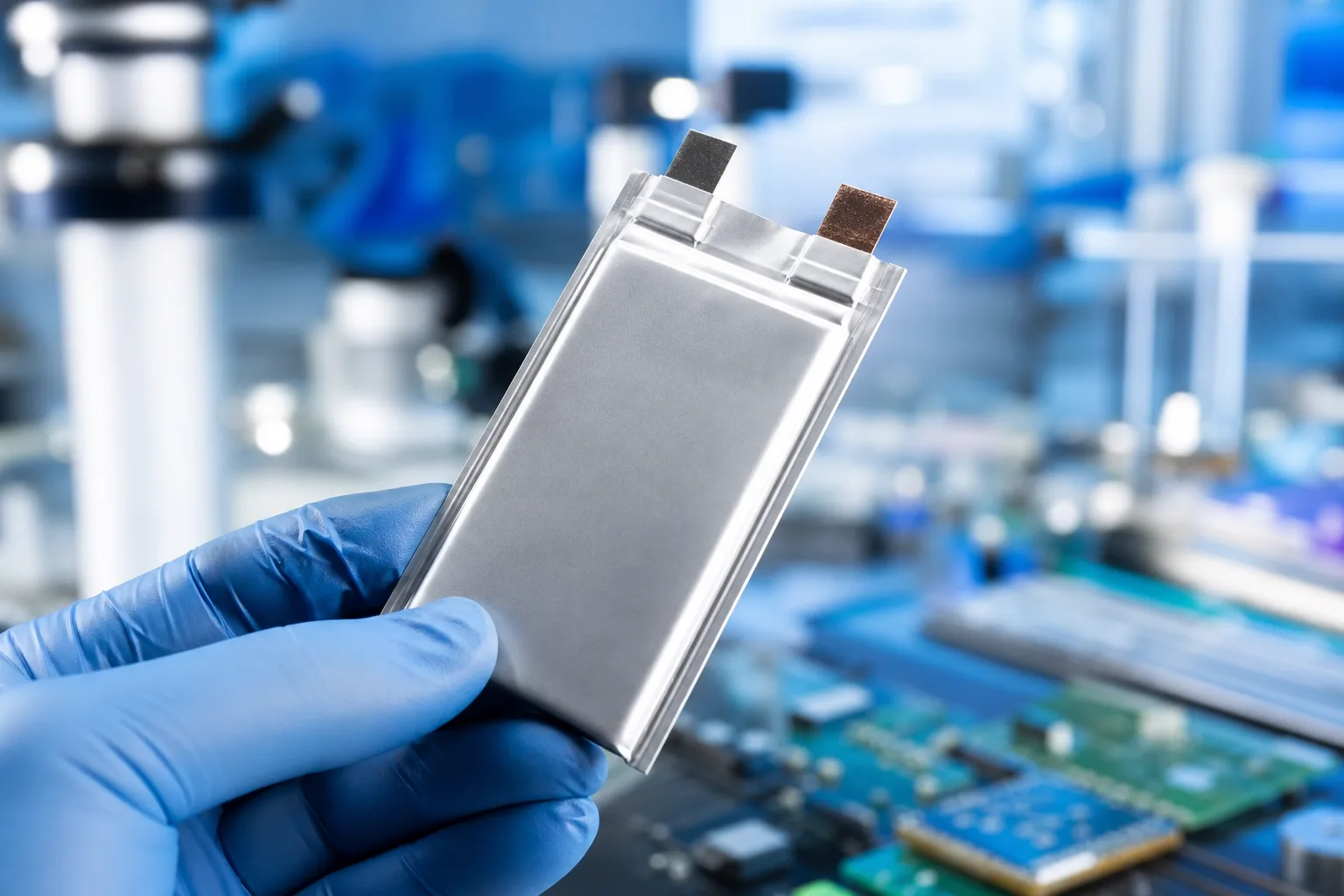
- Solidion Technology’s AI battery patents now exceed 30, covering advanced lithium anode protection for space-grade applications.
- The company’s AI battery patents include what it claims is the highest-performing patented lithium anode protection technology available.
- Solidion is targeting both aerospace and commercial EV markets with its battery portfolio, spanning multiple chemistries and formats.
- Space-grade energy storage demands extreme reliability — a challenge that’s pushing battery innovation well beyond what EVs require.
Table of Contents
AI Battery Patents and the Race to Power Space
Solidion Technology is making a serious play for the space energy storage market, and its growing portfolio of AI battery patents is the clearest signal yet of how seriously the company is taking that ambition. With more than 30 patents now filed or granted — including what the Texas-based firm describes as the highest-performing patented lithium anode protection technology in existence — Solidion is positioning itself at a genuinely unusual intersection: advanced battery chemistry meets orbital-grade reliability requirements.
That’s not a small claim. Lithium anode protection is one of the most stubborn unsolved problems in battery engineering. Lithium metal anodes offer dramatically higher energy density than the graphite anodes used in today’s mainstream lithium-ion cells — we’re talking potential energy density improvements of 50% or more — but they’re notoriously prone to dendrite formation. Those microscopic lithium spikes punch through the separator, cause short circuits, and in terrestrial applications that means a fire hazard. In space, it means a dead satellite or a failed mission with no recovery option.
Solving that problem reliably, at scale, in environments ranging from the vacuum of low Earth orbit to the temperature swings of deep space missions, is the kind of engineering challenge that demands exactly the kind of multi-layered patent protection Solidion appears to be building.
What Makes Space-Grade Battery Design So Demanding
It’s easy to underestimate how different designing a battery for space is compared to designing one for an electric vehicle or a consumer device. In an EV, if a cell degrades faster than expected, you notice it as reduced range over months or years. There’s a service network, a warranty process, a path to replacement. In space, none of that exists.
Satellites and spacecraft need energy storage systems that can survive thousands of charge-discharge cycles across extreme thermal environments — often cycling between -100°C and +100°C or beyond depending on orbit — without degrading in ways that affect mission performance. They need to maintain that reliability with zero possibility of physical intervention. And increasingly, as NASA and other agencies push toward longer deep-space missions, the energy density requirements are going up while the mass budgets stay brutally tight.
That’s where Solidion’s pitch gets interesting. The company’s AI battery patents aren’t just about the electrochemistry. The “AI” component refers to integrating artificial intelligence into battery management and optimization — using machine learning to monitor cell health, predict degradation, and dynamically manage charge cycles in ways that extend operational life. In a space context, that kind of intelligent management could be the difference between a satellite that meets its 15-year design life and one that fails at year eight.
Silicon and Lithium: The Chemistry Behind the Claims
Solidion’s technology portfolio reportedly spans silicon-dominant anode materials as well as the lithium metal anode protection work that’s drawing the most attention. Silicon anodes are themselves a hot area — companies like Sila Nanotechnologies and Group14 Technologies have raised hundreds of millions chasing the same basic promise: silicon can store roughly ten times more lithium ions per unit mass than graphite, which means higher energy density cells if you can manage silicon’s nasty habit of expanding and contracting dramatically during cycling.
Solidion’s approach to this problem, based on what’s publicly available from its patent filings, involves proprietary coating and structural protection methods designed to stabilize the anode interface across repeated cycles. The company claims its lithium anode protection technology outperforms other patented approaches on the market — a claim that’s difficult to independently verify without access to comparative test data, but one that, if accurate, would represent a meaningful technical differentiator in an extremely competitive field.
The AI battery patents covering these techniques give Solidion a potential licensing business on top of any direct manufacturing or supply chain play. That dual-track model — develop the IP, then either manufacture or license — is increasingly common among materials science startups that don’t want to be purely at the mercy of capital-intensive fabrication.
Why the Timing Matters for Space Energy Storage
The commercial space sector is expanding faster than at any point in history. SpaceX’s Starlink constellation alone involves thousands of satellites, each requiring reliable power systems. Amazon’s Project Kuiper is gearing up for mass deployment. Defense contractors are launching proliferated low Earth orbit constellations for communications and surveillance. The European Space Agency and NASA are both deepening their investments in lunar infrastructure under the Artemis program, where surface power systems will be critical.
All of this creates genuine, near-term demand for better space-grade battery technology. The traditional approach — using heritage-qualified cells from established suppliers like EaglePicher or Saft — works, but it’s conservative by definition. Heritage qualification means proven-in-space technology, which by its nature lags the current state of the art by years or even a decade. New entrants with superior chemistry and credible qualification pathways have a real window here.
Solidion’s decision to pursue 30-plus AI battery patents specifically targeting space applications suggests the company sees that window clearly. Whether it can execute on the promise is a separate question — patent portfolios don’t build satellites, and the gap between laboratory performance and flight-qualified hardware is enormous. But the strategic logic is sound.
The Commercial EV Connection
Solidion isn’t purely a space play. The company has also been public about its interest in the electric vehicle market, where silicon and lithium metal anode technologies are equally relevant. The commercial EV battery market is worth hundreds of billions of dollars, and automakers from GM to Toyota are actively searching for next-generation anode materials that can push range and charging speed beyond what today’s graphite-based cells deliver.
That dual-market approach — space and EVs — is actually a sensible hedge. Space applications command premium pricing and often drive technology development forward faster than volume consumer markets, but the volumes are small. EVs offer the scale that can turn a materials technology into a real business. Solidion’s AI battery patents are designed to be relevant across both contexts, which gives the company more flexibility in how it chooses to commercialize its IP.
What Comes Next for Solidion
The patent portfolio announcement is a milestone, but it’s also a signaling move. In deep tech, patent counts matter to investors, potential partners, and acquirers. Publishing a 30-plus patent figure — especially one tied to a specific high-profile claim about lithium anode performance — is as much about market positioning as it is about legal protection.
The harder questions are about validation and commercialization. Has Solidion’s lithium anode technology been tested in simulated space environments? Are there active partnerships with satellite manufacturers, launch providers, or government agencies? Is the company working toward any formal qualification standards — MIL-SPEC, ECSS, or NASA’s own battery standards? These details will determine whether the AI battery patents translate into actual revenue or remain impressive IP on paper.
What’s clear is that the convergence of space investment, AI-driven systems management, and next-generation battery chemistry is creating a genuinely new category of opportunity. Solidion may be early to stake out territory in it, but if the underlying technology performs as claimed, being early with 30-plus patents in a field that’s about to matter enormously could prove to be very good timing indeed.