- AI public opinion is turning negative, with growing resistance to data centers and skepticism about chatbot usefulness.
- While AI public opinion deteriorates, the industry’s political influence in Washington has never been stronger.
- Communities near proposed data center sites are pushing back hard on noise, energy use, and environmental impact.
- The gap between how AI executives and ordinary people experience this technology has rarely been wider.
Table of Contents
The Party in Washington Nobody Outside DC Is Celebrating
AI public opinion rarely comes up at the kinds of Washington gatherings where the industry’s biggest names have been turning up lately — and that disconnect is becoming impossible to ignore. While tech executives celebrate regulatory goodwill and photo opportunities with policymakers, polls and on-the-ground reporting tell a different story: ordinary Americans are growing steadily more skeptical of artificial intelligence, the infrastructure it demands, and the promises being made on its behalf.
That’s not a minor PR problem. It’s a structural tension that’s going to shape how this technology gets built, deployed, and eventually regulated — regardless of how many dinners happen inside the Beltway.
The AI industry’s political moment is real and significant. Lobbying budgets have ballooned. Executives from Google, Microsoft, Amazon, and Meta have all made Washington a priority in ways they hadn’t before the current generative AI wave. And they’ve found an audience. Policymakers across party lines have generally been receptive, framing AI investment as a competitiveness issue — America versus China — which tends to short-circuit more critical conversations about costs and consequences.
But while that consensus holds in committee rooms, it’s fraying in the communities where AI’s physical infrastructure actually lands. AI public opinion at the local level is a very different conversation than the one happening on Capitol Hill.
Data Centers: Where AI Public Opinion Gets Personal
Ask people in abstract terms whether they support artificial intelligence and you’ll get muddled, ambivalent answers. Ask residents living near a proposed hyperscale data center whether they want it in their backyard, and the answer gets much sharper.
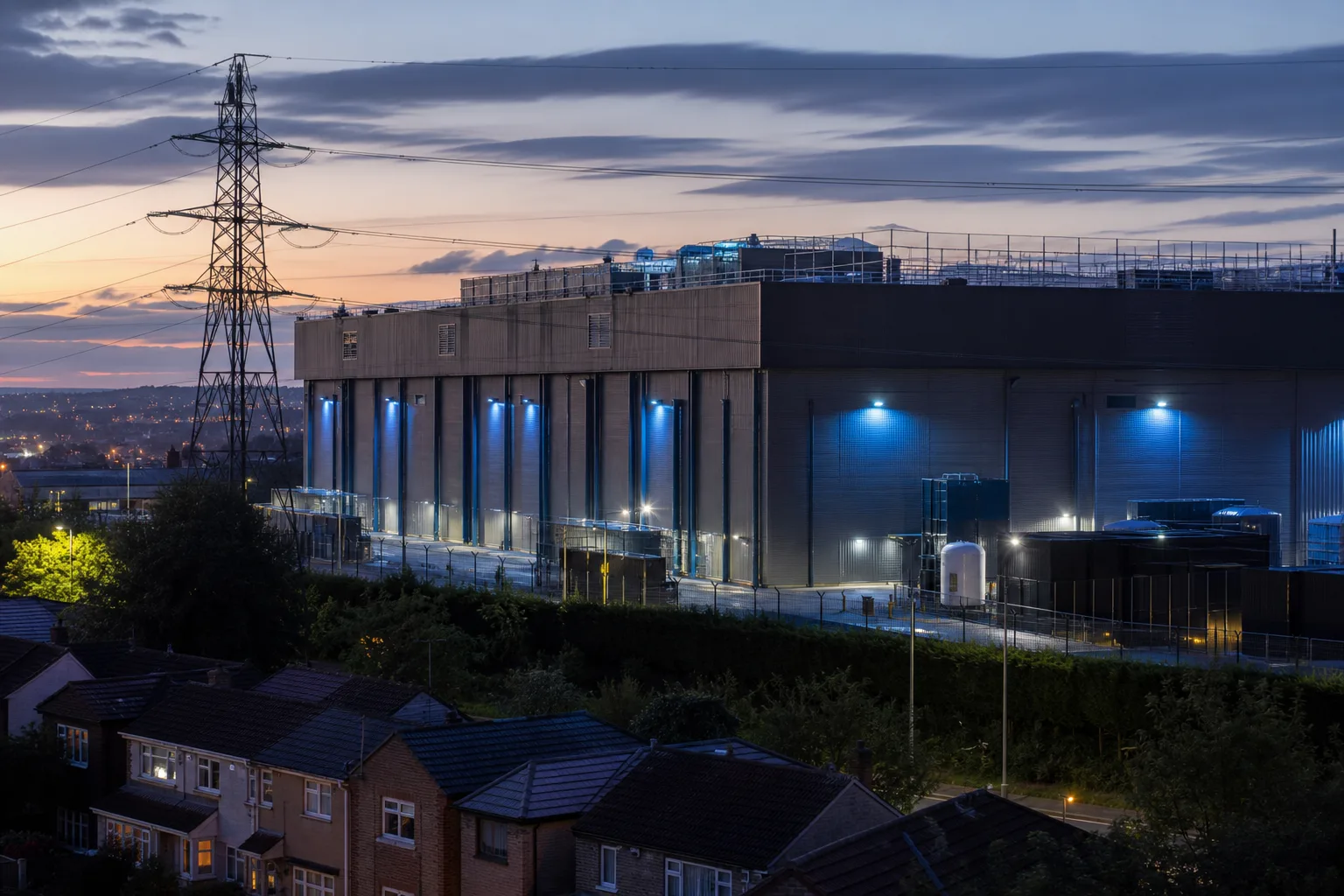
Opposition to data center development has emerged as one of the most concrete flashpoints in the broader AI public opinion story. These facilities — the physical backbone of every chatbot, image generator, and AI API on the market — are not subtle neighbors. They run twenty-four hours a day. They consume electricity at a scale that can genuinely strain regional power grids. They require enormous volumes of water for cooling, a particular flashpoint in drought-prone regions of the American Southwest. And the jobs they create, while well-paying, are often far fewer than the industry’s announcement press releases imply.
Communities in Virginia, Texas, Georgia, and beyond have seen organized pushback against new data center projects — zoning battles, local ballot measures, and the kind of sustained neighborhood opposition that doesn’t get resolved with a company blog post. The International Energy Agency has projected that data centers could account for a significant and growing share of global electricity demand through the rest of this decade, which gives local resistance movements a legitimate empirical foundation, not just aesthetic complaints about industrial eyesores.
This is a problem the industry has systematically underestimated. For years, data centers were invisible infrastructure — nobody thought much about where the cloud lived. That era is over.
Chatbots Haven’t Won the Public Over Either
On the consumer side, the picture is almost as complicated. AI public opinion toward chatbots like ChatGPT, Google’s Gemini, and Microsoft’s Copilot has moved through a familiar cycle: initial curiosity, experimentation, and then — for a large portion of users — quiet disengagement.
The headline user numbers the industry publishes are real but misleading. ChatGPT has reportedly amassed a vast number of active users, but “active user” is doing a lot of heavy lifting in that sentence. Survey data consistently shows that sustained, meaningful daily use of AI tools remains concentrated among a relatively narrow segment — younger, more educated, more tech-adjacent people who were probably already well-served by technology to begin with.
For everyone else, chatbots have a credibility problem that no amount of capability improvement has fully solved. Hallucinations — the industry’s euphemism for AI systems confidently stating things that are simply false — have eroded trust in a way that’s proved sticky. Once you’ve watched a chatbot invent a legal citation, fabricate a historical event, or misidentify a medical symptom, you don’t fully trust it again. That’s a rational response, and the industry hasn’t been honest enough about how significant a barrier it remains.
There’s also the deeper question of what these tools are actually for. The productivity gains are real in specific, well-defined contexts — coding assistance, summarizing long documents, drafting first passes at structured text. But the broader promise of AI as a general-purpose intelligence that transforms how everyone works and lives hasn’t materialized in people’s daily experience. The gap between the keynote and the kitchen table is wide, and it shows up clearly whenever AI public opinion is measured outside tech-industry circles.
Why Washington’s AI Enthusiasm Doesn’t Reflect the Country’s
Here’s the uncomfortable dynamic at the center of this story: the people shaping AI policy in Washington are, almost by definition, people for whom AI is working. Executives, lobbyists, senior congressional staff, think-tank analysts — these are exactly the kinds of knowledge workers for whom AI coding tools, research assistants, and writing aids deliver genuine value. They’re not representative of the population that’s going to live next to the data center or lose work to automated systems.
That creates a policy environment where the enthusiasm is genuine but the blind spots are significant. When the industry talks about AI’s transformative potential in front of sympathetic legislators, nobody in the room has a strong incentive to ask who, exactly, is supposed to benefit — and on what timeline.
It’s not that there’s bad faith involved, necessarily. It’s that the feedback loops are broken. The industry hears from investors, from enterprise customers who are seeing efficiency gains, and from early adopters who love the tools. It hears much less from the Virginia homeowner who can’t sleep because of the cooling fans, or the call center worker watching their role get redefined around an AI system they weren’t consulted about. Meanwhile, AI public opinion among these broader groups continues to drift in a skeptical direction that Washington has been slow to register.
The Trust Deficit Is the Industry’s Real Problem
AI public opinion matters because trust is the substrate on which adoption, regulation, and long-term social license all depend. An industry that wins in Washington while losing the public isn’t in a stable position — it’s building on a foundation that will eventually shift under political pressure.
Europe is the obvious reference point here. The EU AI Act passed in part because European publics were more skeptical earlier, and that skepticism created political space for meaningful regulation. If American AI public opinion continues to sour — on data centers, on chatbots, on the concentration of AI power in a handful of San Francisco and Seattle companies — the window for self-regulation closes and the window for something more aggressive opens.
The smart play for the industry isn’t more Washington lobbying. It’s actually solving the problems that are driving the backlash: being honest about what AI can and can’t do, taking infrastructure opposition seriously rather than trying to steamroll local governments, and building benefit cases that extend beyond enterprise productivity dashboards and stock prices. The technology may well be as consequential as its proponents claim. But consequential and trusted are not the same thing, and right now the gap between those two things is the industry’s most pressing strategic challenge.
Frequently Asked Questions
Why is AI public opinion turning negative so quickly?
Concerns are stacking up across several fronts — chatbots that feel unreliable or intrusive, data centers demanding enormous energy and water resources, and a sense that the industry’s benefits flow mostly to investors and executives rather than everyday people. The political optics of Big Tech celebrating in Washington haven’t helped.
What do people object to about AI data centers specifically?
Local communities near planned data center sites frequently cite round-the-clock noise from cooling systems, massive electricity consumption that strains regional grids, heavy water usage for cooling, and concerns that promised local jobs never materialize at the scale the industry claims.
How much political influence does the AI industry currently have in Washington?
The AI industry’s lobbying presence in Washington has grown dramatically. Major tech firms including Google, Microsoft, Amazon, and Meta have all ramped up federal lobbying spend, and AI executives have found an unusually warm reception from policymakers on both sides of the aisle.
Are people actually using AI chatbots less because of the backlash?
Adoption figures remain mixed. While headline user numbers for tools like ChatGPT look large, surveys consistently show many people try these tools once and disengage. Sustained daily usage — especially for anything beyond curiosity — remains a much smaller cohort than the industry’s announcements suggest.