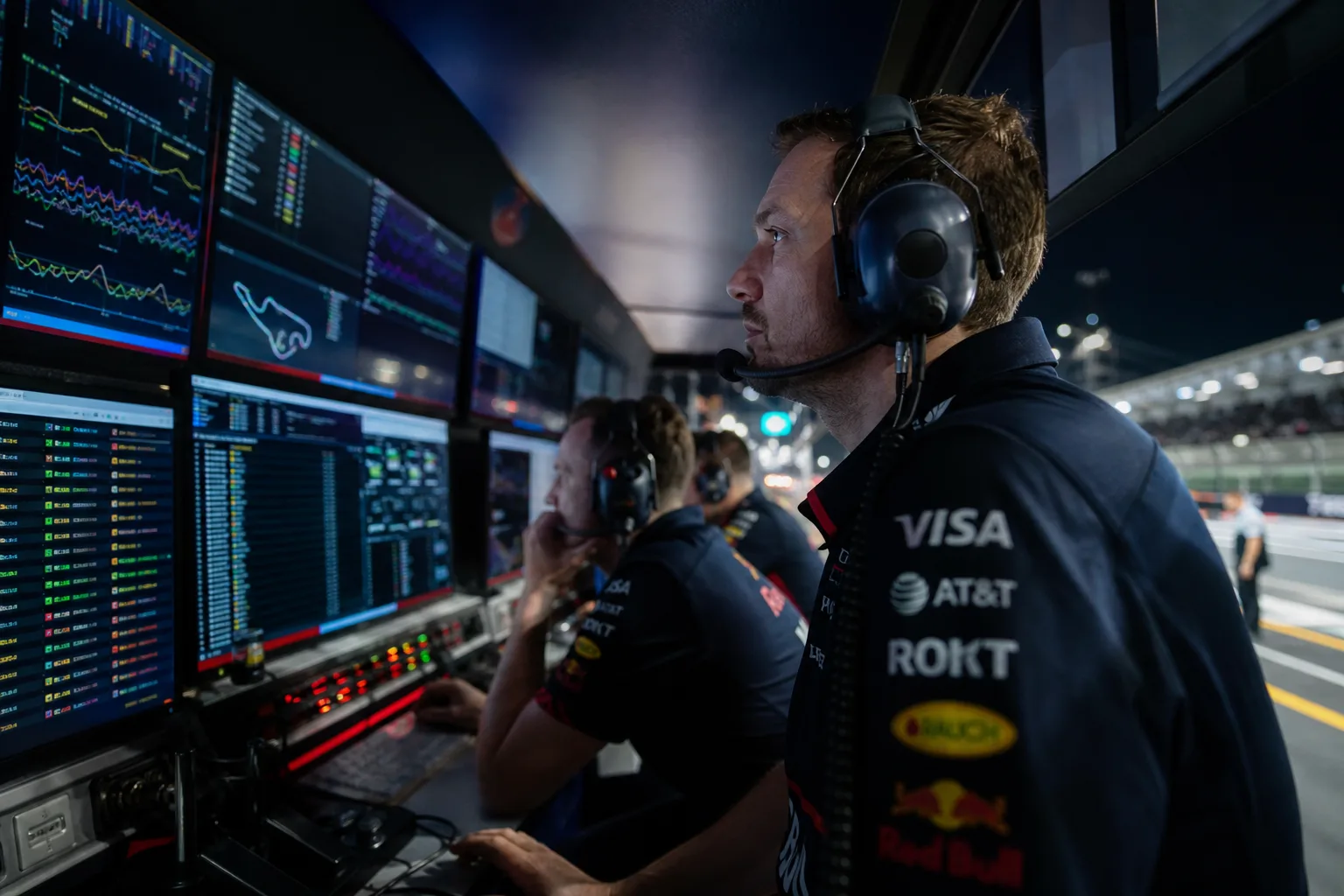
- AI in Formula One now drives race strategy decisions that human engineers once spent hours calculating manually.
- Teams using AI in Formula One can process millions of sensor data points per lap to optimise car performance in real time.
- Machine learning models are reshaping pit stop timing, tyre management, and aerodynamic setup across the grid.
- The AI arms race in F1 is widening the performance gap between well-funded teams and smaller outfits.
Table of Contents
AI in Formula One Has Moved Way Beyond the Simulator
AI in Formula One is no longer a background tool running batch analysis after the chequered flag. It’s embedded in every phase of a race weekend — from the initial car setup on Friday practice to the split-second pit stop calls that can flip a podium finish into a race win. The fastest decision-making in the sport isn’t coming from engineers with headsets anymore. Increasingly, it’s coming from models trained on billions of data points, running inference faster than any human can formulate a question.
Formula One was always a data sport. A modern F1 car carries a vast array of sensors, generating enormous volumes of data points per lap. That’s always been far too much for any team to manually process in a useful timeframe. What’s changed is that machine learning has made that firehose of information actually actionable — in real time, during the race, when it matters most. The role of AI in Formula One has shifted from post-race analysis tool to live competitive infrastructure.
What the Top Teams Are Actually Doing
Red Bull Racing’s partnership with Oracle is probably the most publicly visible example of enterprise AI infrastructure being applied to motorsport. Oracle’s cloud and analytics platform underpins Red Bull’s data pipeline, giving the team the ability to run predictive models on everything from brake wear to the probability of a safety car appearing at a specific point in the race. When you’re trying to decide whether to pit on lap 28 or lap 31, and the answer is worth three seconds of track position, that kind of probabilistic modelling isn’t a nice-to-have — it’s a competitive weapon.
Mercedes-AMG Petronas has been similarly aggressive. The team’s in-house simulation capabilities are among the most sophisticated in the paddock, and they’ve been open about using AI-driven tools to model thousands of race scenarios before lights out on Sunday. Their tools can factor in tyre degradation curves, rival strategies, and probabilistic weather changes simultaneously — work that used to take a room full of engineers days to complete now runs in minutes.
Ferrari and McLaren are both investing heavily too. McLaren has reportedly pursued partnerships and tooling around machine learning for aerodynamic development and race strategy optimisation. The team has been among the front-runners in recent seasons — you’d be unwise to call that a coincidence. Across the paddock, AI in Formula One is now a standard line item in a competitive team’s budget.
The Real Competitive Edge: Real-Time Strategy Calls
Pit stop timing is where AI’s impact is most viscerally felt. The difference between an undercut that works and one that hands a position to a rival often comes down to a one or two lap window. Human strategists are good, but they’re balancing multiple mental models simultaneously under extreme pressure. AI systems don’t get tunnel vision. They don’t freeze when a safety car changes everything in turn three of lap 44.
What modern F1 strategy tools do is run continuous Monte Carlo simulations — probabilistic models that test thousands of possible futures based on current conditions. Feed in updated tyre data, a change in track temperature, or a competitor’s unexpected pit stop, and the model recalculates optimal strategy in seconds. The human strategist’s job shifts from doing the calculation to interpreting the recommendation and knowing when to override it.
That last part matters. AI in Formula One doesn’t operate in isolation. There have been sharp reminders across the sport that no model is smarter than the conditions it hasn’t been trained on. When unusual variables appear, experienced engineers still provide essential context that a model built on historical race data can’t fully capture. The human-AI relationship in the pitwall is genuinely collaborative — not one-sided.
Aerodynamics, Car Setup, and the Tunnel You Can’t Build Fast Enough
Race day strategy is only part of the story. AI is arguably having an even deeper impact in the design and development cycle. Wind tunnel time in F1 is regulated by the FIA’s aerodynamic testing restrictions — teams are allocated a limited number of runs, scaled inversely to their championship position. That constraint has made computational fluid dynamics (CFD) simulation more valuable than ever, and machine learning is dramatically accelerating what CFD can do.
Neural networks trained on previous simulation data can now predict aerodynamic performance across a range of design variables faster than traditional CFD solvers. What might have taken a week of compute time a few years ago can be iterated in hours. That’s a meaningful advantage when a team is trying to optimise a floor design for three different circuit types across a tight development window. AI in Formula One development pipelines has effectively multiplied the number of design iterations a team can evaluate in a given season.
Tyre modelling is another area where AI in Formula One has made quiet but significant inroads. Pirelli provides the same rubber to every team, but how teams model degradation — accounting for driver style, set-up choices, and circuit-specific load patterns — varies enormously. Teams with better predictive tyre models make fewer mistakes on strategy, and that compounds over a season.
The Problem With the AI Arms Race
There’s an uncomfortable truth sitting underneath all of this. The teams winning the AI race in Formula One are, largely, the same teams winning the actual race. Red Bull, Mercedes, and Ferrari have data science departments with dozens of engineers. A team like Haas or Williams is competing with a fraction of those resources. AI doesn’t flatten competitive hierarchies — if anything, it can steepen them, because the teams best placed to invest in machine learning infrastructure are the ones that already have the most money and the most historical data to train on.
The FIA regulates almost everything in Formula One — car dimensions, engine specifications, fuel flow rates, even social media conduct during race weekends. It has so far stopped short of regulating AI tooling directly, perhaps because the technical complexity of doing so is genuinely daunting. How do you cap the sophistication of a machine learning model? It’s not like counting wind tunnel hours.
That question is going to become harder to avoid as the performance advantages compound. If AI in Formula One strategy tools become so effective that races are essentially decided by software quality rather than driver skill or mechanical engineering, that’s a problem for a sport that sells itself on human excellence under pressure.
Where This Goes Next
The next frontier is probably real-time driver coaching — AI systems that can feed information to engineers about driving style adjustments that would recover lap time, mid-session. Some of that is happening already in limited forms. Fully autonomous race strategy, where the AI calls every pit stop and the human engineer simply monitors for anomalies, is a plausible endpoint within this decade.
Beyond that, the techniques being developed for AI in Formula One will migrate. Logistics optimisation, real-time decision support in high-stakes environments, predictive maintenance on complex mechanical systems — these are all areas where what gets proved out in the F1 paddock on a Sunday afternoon has genuine industrial applications. The sport has always been a proving ground for technology that ends up in road cars. Increasingly, it’s a proving ground for technology that ends up everywhere.
Frequently Asked Questions
How is AI in Formula One actually used during a race weekend?
AI in Formula One is used across simulation, qualifying setup, and live race strategy. Systems analyse telemetry, weather data, and rival behaviour to recommend pit stop windows and tyre choices in real time, giving engineers faster and more accurate decision support than manual analysis alone.
Which F1 teams are the most advanced in using artificial intelligence?
Mercedes, Red Bull Racing, and Ferrari have the largest data science and machine learning teams in the paddock. Mercedes in particular has been open about using AI-driven simulation tools to model race outcomes, and Red Bull’s partnership with Oracle is central to its data infrastructure.
Does AI in Formula One replace human engineers or support them?
AI supports rather than replaces engineers. The systems surface insights and probabilities faster than any human could, but the final call on strategy still rests with the race team. Think of it as giving engineers a much faster, more data-rich co-pilot.
Could AI create an unfair advantage in F1?
It’s a genuine concern. Smaller teams with fewer resources can’t match the AI investment of outfits like Red Bull or Mercedes, which risks consolidating performance advantages at the top. The FIA has so far not moved to regulate AI tooling directly, though the conversation is growing.