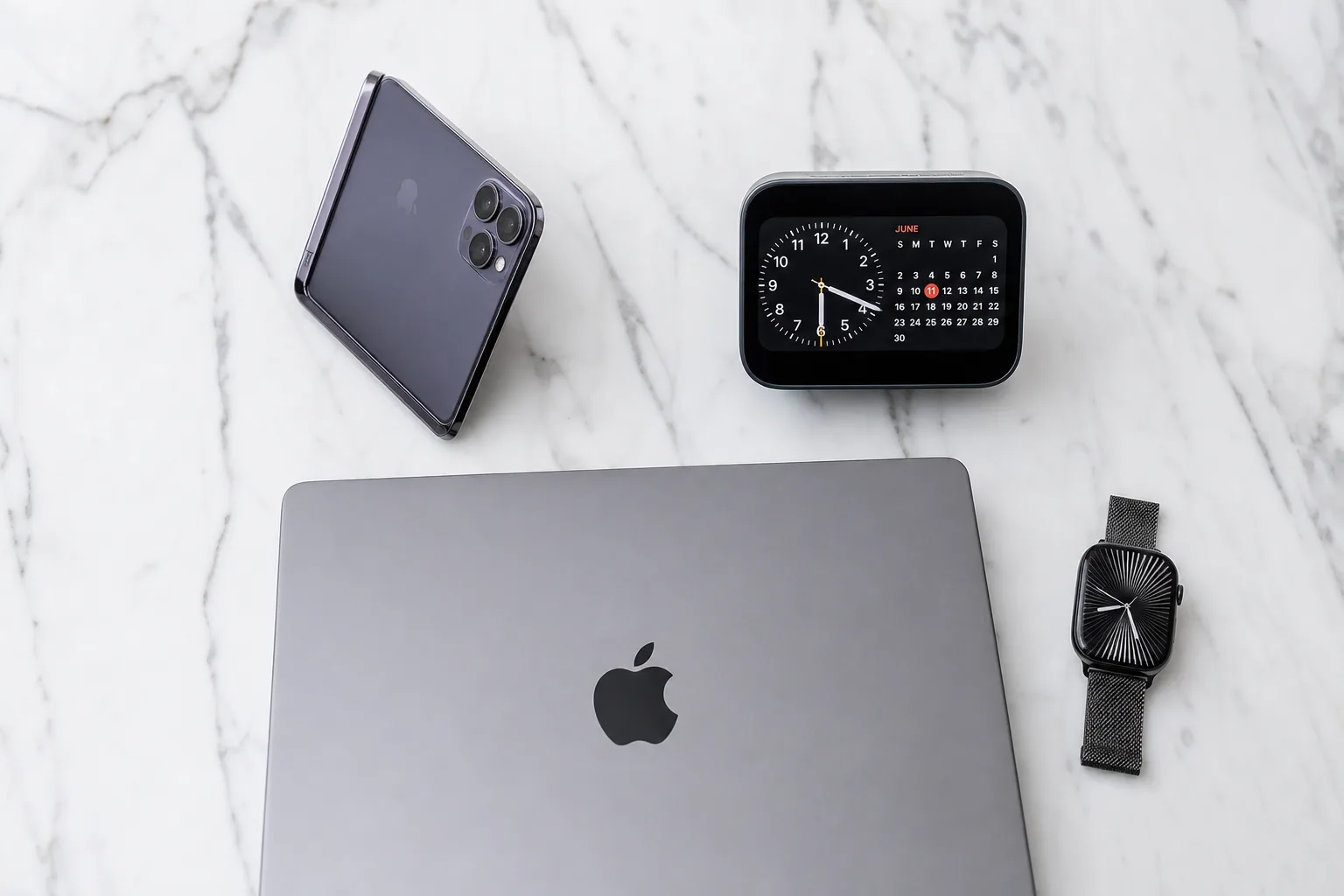
- Apple new products expected in 2026 include a foldable iPhone Ultra with a 7.7-inch inner display and Touch ID power button.
- The Apple new products lineup features a long-awaited smart home hub with a 6–7 inch display, A18 chip, and FaceTime support.
- iPhone 18 Pro arrives with Apple’s C2 modem, satellite 5G browsing, variable aperture cameras, and a smaller Dynamic Island.
- Mac Studio, Mac mini, and iMac all move to M5 chips, though supply constraints could push some launches into 2027.
Table of Contents
Apple New Products in 2026: A Second Half Worth Watching
WWDC 2026 may be wrapping up, but the real product fireworks are still ahead. Apple new products expected in the second half of this year stretch across almost every category the company touches — iPhones, Macs, home devices, and a brand-new product class in the form of a smart home hub. By most accounts, we’re looking at at least 15 Apple new products before the year is out, and that number could climb if Apple decides to move quickly on a few items still in the rumour pipeline.
The through line connecting a lot of what’s coming is Siri. The upgraded, more personal version of Apple’s assistant — first shown off at WWDC 2024 — has only just landed in beta, a full two years after that initial preview. Apple apparently didn’t want to ship new hardware without it, which explains why several Apple new products that looked ready on paper took longer than expected to appear. Now that the software foundation is in place, the hardware can follow.

iPhone 18 Pro, Pro Max, and the Foldable That Changes Everything
The iPhone 18 lineup will be the centrepiece of Apple’s September event, as usual. The iPhone 18 Pro is shaping up to be a meaningful upgrade rather than a spec-sheet reshuffle. Apple’s A20 Pro chip will handle the heavy lifting, while a smaller Dynamic Island addresses one of the few consistent complaints about the current notch-replacement design. The Camera Control button — introduced on the iPhone 16 series — is being simplified, which suggests Apple got feedback that the current implementation feels overly complicated for casual users.
On the camera side, variable aperture on at least one rear lens is a notable step. This is something Samsung and other Android flagships have explored, and if Apple executes it well, it could genuinely change how iPhone photos handle low light and bokeh control. The C2 modem, Apple’s second-generation in-house cellular chip, brings satellite-based 5G web browsing — not just emergency SOS, but actual data connectivity where towers don’t reach. That’s a more aggressive use of satellite than anything Apple has shipped so far. A ‘Dark Cherry’ colour is also in the mix, continuing the trend of bold Pro finishes that started with Titanium Black.
The iPhone 18 Pro Max is expected to carry identical specs, with one asterisk: it may end up slightly thicker than its Pro sibling, which would be an unusual reversal of the usual hierarchy. Whether that’s a battery play or a camera optics decision isn’t clear yet.
Then there’s the device that will draw most of the attention among Apple new products this cycle: the iPhone Ultra. Apple’s first foldable is expected to arrive with a 7.7-inch inner display and a 5.3-inch cover screen — dimensions that put it in competition with Samsung’s Galaxy Z Fold series and Google’s Pixel Fold. Unlike those devices, Apple is reportedly dropping Face ID in favour of a Touch ID power button, presumably because fitting the face-unlock sensor array into a foldable form factor without compromising the display or the hinge proved too difficult at this stage. Two rear cameras and one front camera round out the hardware.
iOS 27 is reportedly being built with this device in mind, offering split-screen and iPad-style multitasking in a way the current iPhone interface doesn’t support. That’s the right call — a foldable running a standard iPhone UI would feel like a missed opportunity.
Apple Watch, iPad, and the Incremental-but-Important Updates
The Apple Watch Series 12 and Apple Watch Ultra 4 are expected alongside the iPhones. Both will get at least an S11 chip, with design changes that reportedly include Touch ID integration and potentially new health sensors — though the specifics remain disputed among the various rumour sources. What’s more interesting is the reported satellite expansion: Apple Watch Ultra 3 and newer models may gain Apple Maps via satellite and the ability to send and receive photos through Messages over satellite. That’s a meaningfully different proposition for backcountry hikers and offshore sailors than the current emergency SOS feature.
On the iPad front, the standard iPad 12 is finally getting an Apple Intelligence-capable chip — a jump from the A16 to either the A18 or A19. These Apple new products in the iPad line represent a meaningful step forward for users who felt left behind by the previous generation. The bigger news is the iPad mini, which is reportedly getting an OLED display, a vibration-based speaker system, a water-resistant design, and a chip upgrade to A19 Pro or A20 Pro. If accurate, the iPad mini becomes a much more serious device than its budget-adjacent current positioning suggests. An OLED screen alone would make it the sharpest small tablet on the market.
Macs Move to M5 — and One Gets a Name Change
Apple’s Mac lineup is due for its next chip cycle. The Mac Studio steps up to M5 Max and M5 Ultra configurations, the Mac mini moves to M5 and M5 Pro, and the iMac gets an M5 chip plus new colour options. These Apple new products on the desktop side are not dramatic reinventions — Apple’s desktop hardware has settled into a reliable cadence — but the M5 generation should bring another meaningful performance-per-watt improvement, especially for creative professionals who use the Mac Studio for video or 3D work.
The most ambitious Mac announcement among Apple new products, though, isn’t a spec bump. Apple is reportedly planning a major redesign of its pro laptop line under the new name MacBook Ultra, expected in late 2026 or early 2027. The spec sheet reads like a wish list that’s been circulating in Apple circles for years: OLED display, touchscreen, Dynamic Island, M6 Pro and M6 Max chips, and a thinner chassis. MacOS 27 will reportedly include a touch-friendly interface layer to make the touchscreen feel like a first-class feature rather than a gimmick bolted on after the fact. This would represent the most significant MacBook redesign since Apple switched to its own silicon in 2020.
One caveat: a RAM chip shortage is reportedly threatening to push the Mac Studio, Mac mini, and MacBook Ultra into 2027. Apple isn’t the only company dealing with memory supply issues right now, and if the shortage lingers, it could reshape the entire second half of the product calendar.
Apple’s Home Push: Hub, HomePod, and Apple TV Finally Get Serious
The home category is where Apple new products take their most interesting turn. Three existing devices are getting long-overdue updates, and one brand-new device is entering the picture entirely.
The Apple TV will finally receive an A17 Pro chip, bringing it up to speed with Apple Intelligence and the new Siri. An N1 chip for Wi-Fi 7 and a possible built-in FaceTime camera are also in the rumour mix, though the camera may not make it into this specific generation. The HomePod mini gets a similar treatment — S9 chip or newer, Wi-Fi 7 via the N1 chip, a second-gen Ultra Wideband chip for precise device handoff, improved sound quality, and potentially new colours including red. The full-sized HomePod is also due for a refresh centred on the upgraded Siri experience.
But the most talked-about of all the Apple new products in the home category is the Apple Home Hub. This is a genuinely new category for Apple: a 6-to-7-inch square touchscreen display running on an A18 chip with Apple Intelligence baked in, supporting FaceTime, and designed to sit on a table or mount on a wall. Think of it as Apple’s answer to the Amazon Echo Show and Google Nest Hub, except with the company’s full privacy-first architecture and, now, a Siri that can actually hold a coherent conversation and act on context across apps.
Apple is also reportedly developing companion accessories for the hub, including a Face ID-enabled smart doorbell and a security camera or sensor. That kind of ecosystem thinking — a hub at the centre with purpose-built accessories radiating outward — is exactly what Apple’s home strategy has been missing. The company has the hardware and software chops to make this compelling, but it needs the accessory ecosystem to stick.
AirPods Ultra and What Comes After
Rounding out the rumour list is a pair of AirPods Ultra with cameras for Visual Intelligence. These Apple new products represent the kind of ambient computing feature that sounds like science fiction until Apple ships it and everyone realises it was always inevitable. The timeline is fuzzy; these may not arrive until 2027. But their existence in the pipeline signals that Apple sees spatial awareness as a core feature of future wearables, not a niche add-on.
Taken together, this is one of the more ambitious Apple new products cycles in recent memory. The foldable iPhone alone would be a watershed moment. Add a smart home hub, a touchscreen MacBook redesign, OLED across more of the lineup, and a genuinely upgraded Siri as the connective tissue, and it starts to look like Apple is executing on a multi-year vision that was quietly delayed while the AI infrastructure caught up. Whether all 15 Apple new products actually make it to market before the new year — or whether chip shortages and engineering delays push several into 2027 — will say a lot about how much of this roadmap was aspirational and how much was ready to ship.
Frequently Asked Questions
When will Apple new products like the iPhone 18 Pro be released?
The iPhone 18 Pro and Apple Watch Series 12 are expected to follow Apple’s usual September launch window. Other Apple new products, including the smart home hub and updated HomePods, are anticipated later in the year, with the MacBook Ultra potentially slipping into early 2027.
What makes the foldable iPhone Ultra different from current iPhones?
The iPhone Ultra is expected to feature a 7.7-inch inner display and 5.3-inch outer display, two rear cameras, and a Touch ID power button in place of Face ID. iOS 27 is being tailored to support side-by-side apps and iPad-style multitasking on the device.
Does the Apple smart home hub support Apple Intelligence?
Yes. The smart home hub is expected to carry an A18 chip for Apple Intelligence support. It will also support the upgraded, more personal version of Siri and include FaceTime capability.
Why were some Apple products reportedly delayed until Siri was ready?
Apple reportedly held back several devices until the more personal version of Siri was ready. That Siri upgrade was first previewed at WWDC 2024 but only arrived in beta form a full two years later, triggering the next wave of releases.
What is the MacBook Ultra and how is it different from the MacBook Pro?
The MacBook Ultra is a major redesign of the MacBook Pro line, expected in late 2026 or early 2027. It will reportedly feature an OLED touchscreen, a Dynamic Island, M6 Pro and M6 Max chips, and a thinner chassis — with macOS 27 offering a touch-friendly interface layer.