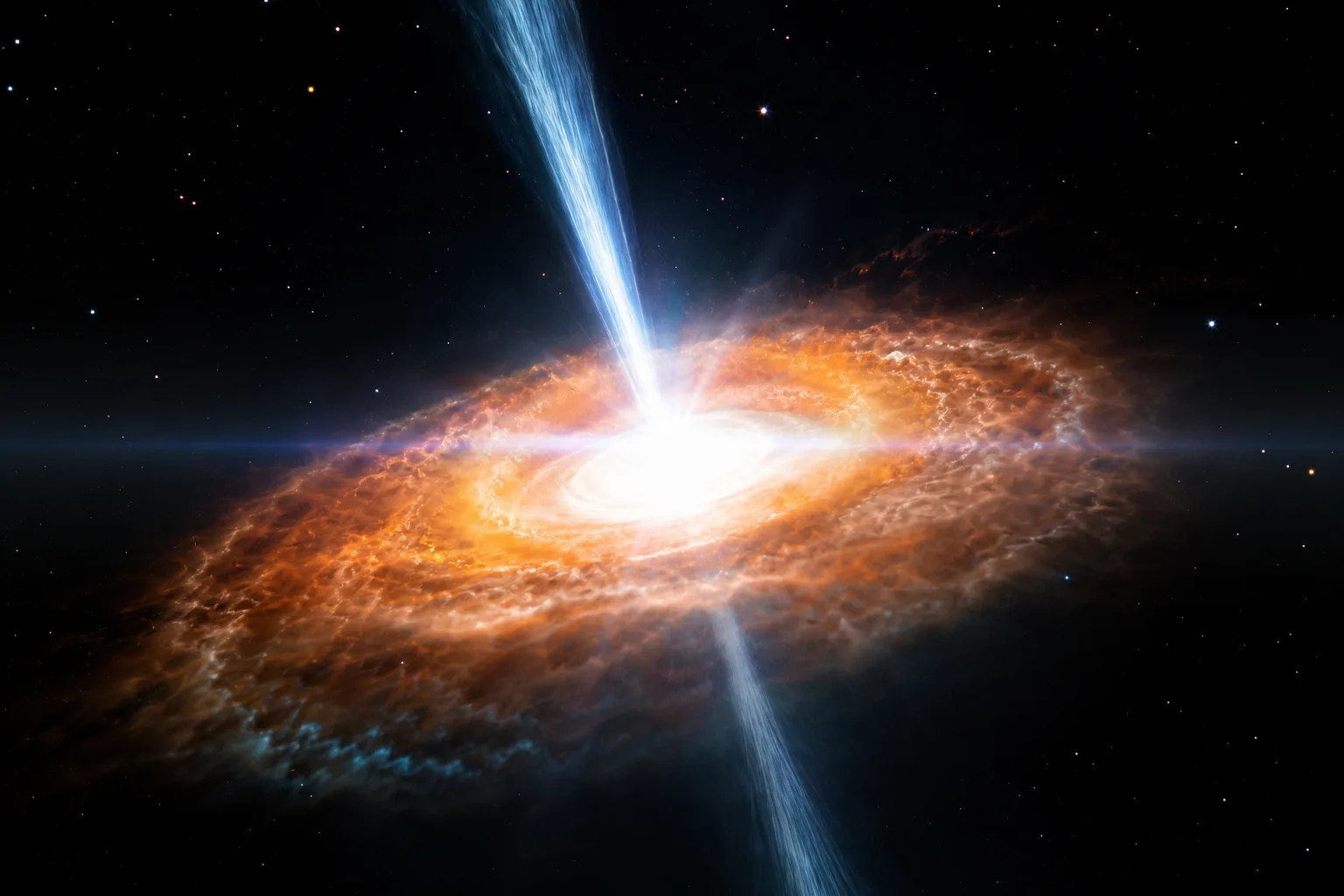
- Astronomers have detected the fastest quasar wind ever recorded at ultraviolet wavelengths, hitting 30% of the speed of light.
- The record-breaking quasar wind was discovered by a York University-led research team studying a supermassive black hole.
- Winds this powerful could reshape entire galaxies by stripping away gas needed to form new stars.
- The find pushes the boundaries of what physicists thought accretion disk dynamics could produce near black holes.
Table of Contents
A Quasar Wind Like Nothing Seen Before
A quasar wind blasting outward at nearly one-third the speed of light — roughly 90,000 kilometres per second — has been confirmed as the fastest ever measured at ultraviolet wavelengths near a supermassive black hole. The discovery, led by researchers at York University in Toronto, isn’t just a record for the record books. It’s a signal that the extreme physics playing out around black holes may be more violent, and more consequential, than current models suggest.
Quasars are among the most luminous objects in the observable universe. At their hearts sit supermassive black holes — monsters millions or even billions of times the mass of our Sun — actively feeding on enormous disks of superheated gas and dust. As matter spirals inward through this accretion disk, enormous amounts of energy are released, and some of that energy drives powerful outflows: the quasar winds. Think of it as the black hole’s exhaust. But nobody expected the exhaust to be moving quite this fast.
What Makes This Quasar Wind a Record-Breaker
Previous detections of fast outflows near black holes have been made primarily in X-ray wavelengths, where so-called ultra-fast outflows — or UFOs — have been clocked at similar fractions of light speed. But detecting a quasar wind at this velocity in the ultraviolet part of the spectrum is a different achievement altogether. UV observations trace a different layer of the outflow, probing gas that’s further from the black hole’s immediate vicinity and at lower temperatures than X-ray-detected winds. Finding UV-wavelength outflows at 30% of light speed suggests the wind maintains its extraordinary velocity over a much larger physical scale than previously observed.
That distinction matters enormously. A fast wind that fizzles out close to the black hole has limited impact on the broader galaxy. A fast quasar wind that sustains its speed as it travels outward carries enough momentum and energy to interact with — and potentially transform — the galaxy it inhabits.
The York University team made the detection using spectroscopic analysis, identifying the characteristic absorption signatures that a high-speed outflow imprints on the quasar’s light as gas races away from the central engine. The degree of blueshift in those absorption lines is what reveals the velocity. At 30% of light speed, the blueshift is dramatic and unmistakable.
Why the Speed of This Outflow Matters for Galaxy Evolution
Here’s where this stops being purely an astrophysics curiosity and starts touching on some of the biggest open questions in cosmology. Astronomers have long suspected that supermassive black holes don’t just sit passively at the centres of galaxies — they actively regulate how galaxies grow. The mechanism proposed for this is called AGN feedback, where the energy output from an active galactic nucleus (the quasar phase being an extreme example) heats or expels gas from the galaxy, cutting off the raw material needed to form new stars.
A quasar wind moving at 30% of light speed carries kinetic energy on a scale that could, in principle, do exactly that. Models of galaxy formation have actually required some form of energetic feedback from black holes to explain why large galaxies in the universe aren’t far more massive and star-rich than they actually are. Without something to quench star formation, simulations produce galaxies that are too big and too blue. Black hole winds are the leading candidate for that quenching mechanism, and findings like this one give those models some very concrete observational teeth.
The NASA overview on active galaxies and quasars provides useful background on how these outflows fit into the broader story of galaxy co-evolution with their central black holes.
Ultraviolet Observations Open a New Window
The choice of wavelength here is worth dwelling on. Most record-breaking black hole wind detections have come from X-ray observatories like XMM-Newton or NuSTAR, which are exquisitely sensitive to the hottest, most energetic gas right at the inner edge of the accretion disk. UV telescopes — including instruments aboard the Hubble Space Telescope — probe cooler, more extended gas. The fact that this quasar wind is still moving at 0.3c at UV-emitting distances from the black hole tells astrophysicists something important: the wind isn’t just fast at launch, it’s sustaining that speed.
That sustained velocity changes the energy budget considerably. When researchers calculate how much kinetic power a quasar wind deposits into its host galaxy, velocity matters far more than mass — kinetic energy scales with the square of velocity. A wind moving twice as fast carries four times the kinetic punch. At 30% light speed, this outflow is depositing energy at a rate that can genuinely compete with the gravitational binding energy of an entire galaxy’s gas reservoir.
How This Fits Into the Bigger Picture of Black Hole Research
The timing of this discovery is interesting. Astronomy is currently in an era of unprecedented observational capability. The James Webb Space Telescope is routinely detecting quasars in the very early universe — some observed less than a billion years after the Big Bang — raising hard questions about how black holes grew so massive so quickly. Energetic quasar winds might actually be part of that story too, since they affect how efficiently black holes accrete mass over time.
Meanwhile, theoretical models of accretion disk physics have predicted that winds could, under certain conditions, reach relativistic speeds. This detection doesn’t just validate those models — it pushes them. Thirty percent of light speed is toward the upper end of what disk-driven wind models comfortably explain, which means either the models need refinement or the conditions around this particular supermassive black hole are doing something unusually efficient at transferring energy to the outflow.
There’s also the question of how common winds like this are. One record-breaking quasar wind is remarkable. A population of them would be transformative for how we model black hole feedback across cosmic time. Follow-up surveys using UV spectroscopy — potentially with future missions or existing archives from Hubble’s Cosmic Origins Spectrograph — could reveal whether this is a freak event or whether powerful UV-detected outflows have simply been under-appreciated until now.
The York University team’s result is a reminder that the most extreme environments in the universe still have surprises to offer, and that which wavelength you look through can change everything you think you know. As next-generation observatories come online and archival UV data gets revisited with sharper analysis tools, don’t be shocked if this record gets challenged sooner than expected.