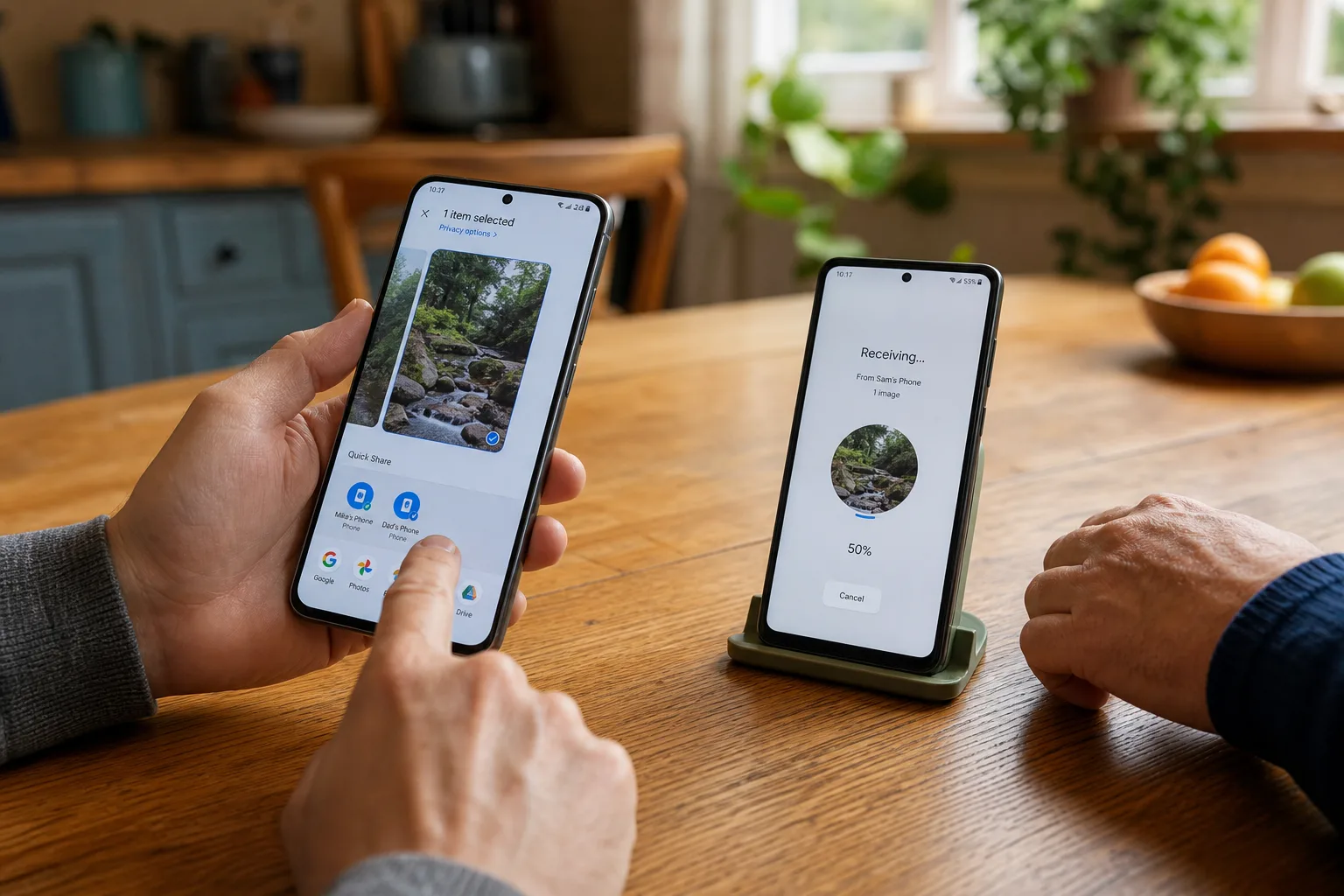
- A Quick Share family sharing option has been spotted in Google’s Nearby Share GitHub repository, though it hasn’t appeared in the app yet.
- Quick Share family sharing could replace the deprecated ‘Selected contacts only’ feature removed by Google back in February.
- Google hasn’t clarified how users would define ‘family’ — the most likely route is manual contact selection.
- The move strengthens Quick Share’s position as Google’s answer to Apple’s AirDrop on Android devices.
Table of Contents
Quick Share Family Sharing Is Being Quietly Built
Google appears to be working on a Quick Share family sharing option that would make it easier to receive files from people you trust — and it was hiding in plain sight inside the company’s own open-source code. A new “Family” attribute has been found in Google’s GitHub repository for Nearby Share, the underlying technology that powers Quick Share on Android. The feature hasn’t surfaced in the actual app yet, but its presence in the codebase strongly suggests it’s actively in development.
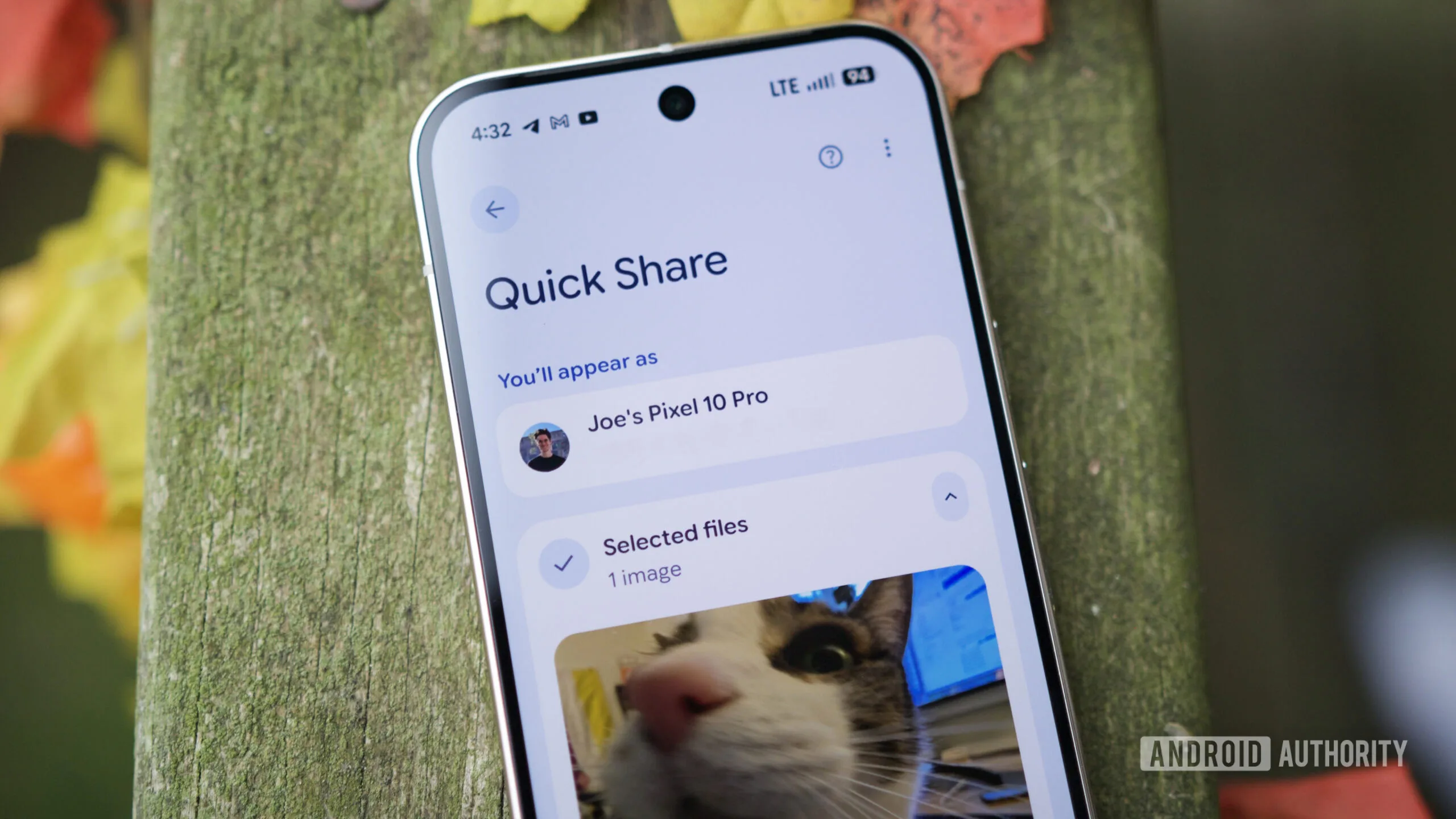
Right now, Quick Share offers three visibility modes: Your devices, Contacts, and Everyone for 10 minutes. The incoming Family option would sit alongside — or potentially replace — one of these tiers, giving users a more intimate, persistent sharing circle without flinging the door wide open to everyone nearby.
Why Google Pulled a Feature Before Adding This One
There’s some important backstory here. In February, Google quietly removed the “Selected contacts only” visibility option from Quick Share, citing security as the reason. At the time, it was a frustrating move for power users who wanted fine-grained control over who could reach their device. You were left choosing between your full contacts list or a timed open window — neither of which is ideal if you want to let, say, your parents send photos without also exposing yourself to every contact in your phone.
The incoming Quick Share family sharing feature looks very much like a more purposeful, better-branded replacement for that discontinued capability. Whether it’s functionally superior remains to be seen, but the intention seems clear: Google wants to fill the gap it created while making the experience feel more intuitive. “Family” as a label is consumer-friendly in a way that “Selected contacts only” never quite was.
How Might Google Define ‘Family’?
That’s the part nobody knows yet — including, it seems, anyone who’s looked at the code so far. The GitHub entry identifies the attribute but gives no description of how Google plans to let users populate that group.
The most straightforward route would be letting users hand-pick contacts to add to a Family list, effectively rebuilding the deprecated selected-contacts flow under a friendlier name. That would restore the lost functionality without introducing any new infrastructure. Simple, practical, and probably what most people actually need.
The other possibility is a tie-in with Google One family plans. Google One already lets subscribers share storage with up to five family members, so there’s existing plumbing Google could hook into. But that path has a significant catch: it would restrict Quick Share family sharing exclusively to Google One paying subscribers, which would price out a huge chunk of Android’s user base. Given that one of Quick Share’s core selling points is that it works for everyone regardless of whether they pay Google a monthly fee, tying a core sharing feature to a subscription tier would feel like a step backward. It’s the less likely scenario — but not an impossible one.
The Bigger Picture: Google’s AirDrop Ambitions
It’s hard to talk about Quick Share without acknowledging what Google is really trying to do with it. After years of fragmented, confusing file-sharing tools on Android — remember when Beam was a thing? — Google has been methodically building Quick Share into something that can credibly challenge Apple’s AirDrop.
The results so far have been genuinely impressive. AirDrop support was recently extended to a wider range of Android devices, meaning the cross-platform story between Android and Apple hardware is finally taking shape. RCS adoption, while a separate initiative, showed Google can actually move the needle on interoperability when it commits to the effort. Quick Share is following the same playbook.
Adding a Quick Share family sharing tier fits neatly into this strategy. AirDrop has long benefited from Apple’s tight ecosystem — sharing with family members who all have iPhones is frictionless because Apple already knows who your family is through iCloud family plans. Google is clearly building toward comparable ease on Android, where the default experience has historically been rougher around the edges.
The difference is that Android’s user base is wildly more diverse. You might be trying to share files with a family member on a three-year-old Samsung mid-ranger, a Pixel 9, or a budget device from a regional manufacturer. Making Quick Share family sharing feel seamless across that range of hardware is a harder engineering problem than Apple faces — which makes it more impressive if Google pulls it off well.
What to Watch For
Since the feature hasn’t appeared in any public builds of Quick Share yet, there’s no timeline to attach to it. Google has a habit of building things in the open — GitHub is a very public place to leave code — without committing to a ship date. Features like this can sit in repos for months before they land, or they can show up in a Play Store update with little warning.
What will matter most when this does arrive is the setup experience. The reason AirDrop feels effortless is that Apple handles the heavy lifting — you don’t configure a family list, it just works because of the family plan Apple already has on file. If Quick Share family sharing requires users to manually build and maintain a contact group, adoption will be limited to the people willing to spend five minutes in settings. If Google finds a smarter way to infer or suggest family connections — perhaps drawing on existing contact relationships or Google One membership — it could be genuinely frictionless.
Either way, this is another sign that Google is treating Quick Share as a serious, long-term platform rather than just a checkbox feature. The pace of updates over the past year — the rebrand from Nearby Share, the AirDrop compatibility work, and now this — points to a product team with real momentum. Whether that momentum translates into something Android users actually reach for every day is the question worth watching.