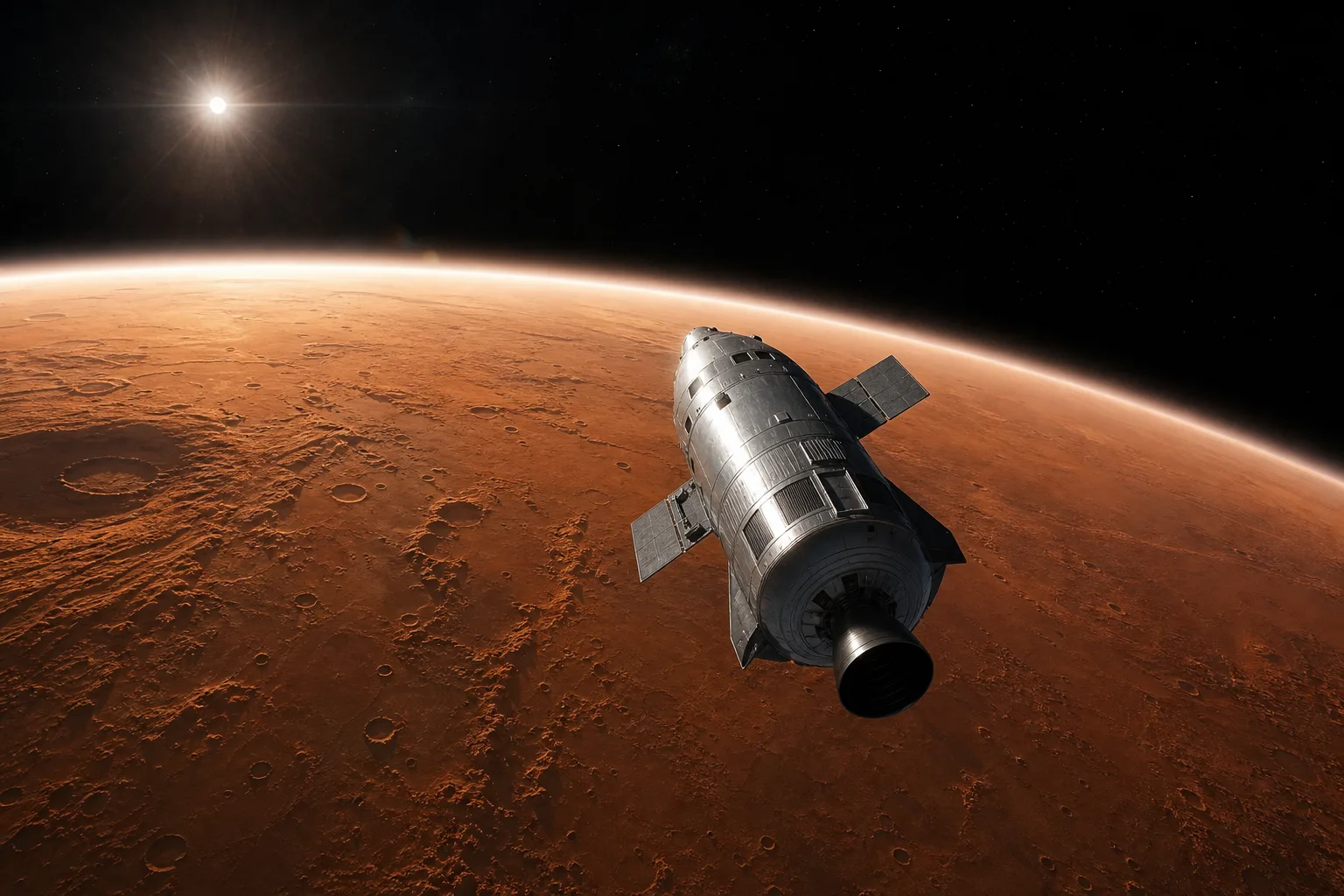
- NASA has officially declared the MAVEN Mars mission unrecoverable after six months of failed contact attempts.
- The MAVEN Mars mission spent 11 years studying how the Red Planet lost its ancient atmosphere and water.
- A mysterious safe-mode rotation in December 2024 likely drained the spacecraft’s batteries beyond recovery.
- MAVEN’s collected data will continue shaping NASA’s plans for crewed Mars missions for decades to come.
Table of Contents
MAVEN Mars Mission: NASA Pulls the Plug After Six Months of Silence
The MAVEN Mars mission is over. NASA made it official this week, formally declaring the Mars Atmosphere and Volatile Evolution spacecraft “not recoverable” and stating that it is “no longer capable of performing its science and data relay mission.” After six months of increasingly desperate attempts to reestablish contact, the agency has accepted what most planetary scientists had already feared since December: one of its most scientifically productive orbiters is gone.
It’s a genuinely deflating moment for the planetary science community — and not just sentimentally. MAVEN was still actively serving NASA’s Mars program right up until the day it went dark, relaying data from surface rovers back to Earth via the Deep Space Network. Losing it creates a real operational gap, not just an archival one.
What Actually Happened on December 6
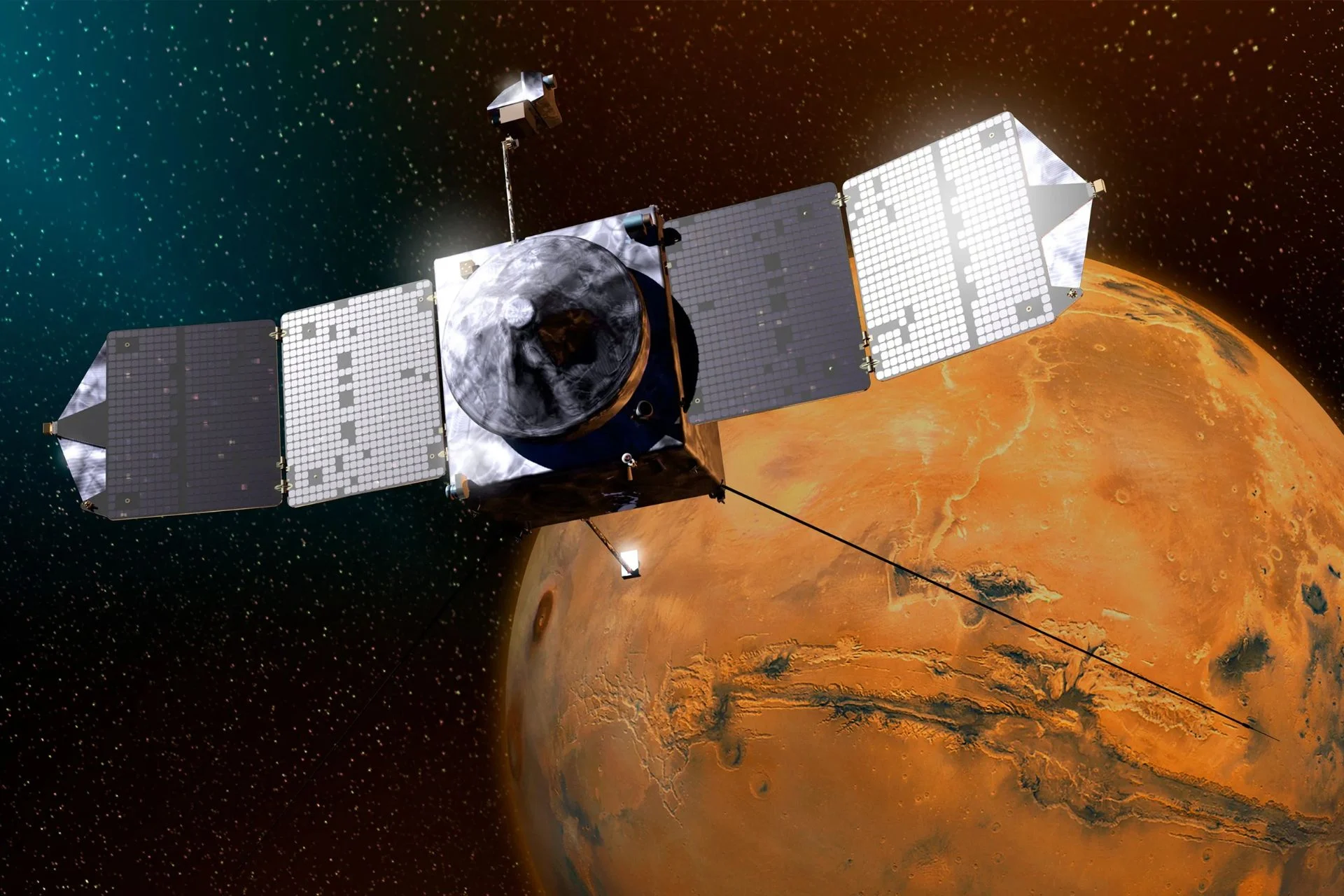
The spacecraft had been operating normally — all subsystems green — when it passed behind Mars on December 6, 2024. It never re-emerged from that communications blackout in any useful way. A brief fragment of tracking data painted a concerning picture: MAVEN had entered safe mode and was spinning at an abnormal rate. Engineers believe that uncontrolled rotation drained the spacecraft’s batteries, which in turn knocked out its ability to communicate. Once the batteries die on a spacecraft that far from Earth, recovery becomes nearly impossible without a way to recharge or reboot — and NASA had neither.
NASA says it’s still working to identify the root cause of the MAVEN Mars mission’s failure, but the review board has already made the practical call. Months of recovery attempts, including commands sent across hundreds of millions of miles of space, produced nothing actionable. At some point, continuing to try isn’t science — it’s just hoping.
Eleven Years of Science That Rewrote What We Know About Mars
Here’s what makes losing the MAVEN Mars mission sting particularly hard: the spacecraft was never supposed to last this long. Its original mandate was a single year in Mars orbit. It ended up delivering more than a decade of observations, far outrunning its design life and generating a body of research that has fundamentally changed how scientists think about the Red Planet’s past.
The central question the MAVEN Mars mission was built to answer was deceptively simple: where did Mars’ atmosphere go? Billions of years ago, Mars almost certainly had a thicker atmosphere and liquid water on its surface — possibly enough to support microbial life. Today, it’s a freezing, radiation-blasted desert with an atmospheric pressure less than 1% of Earth’s at sea level. Something stripped it bare. MAVEN spent over a decade figuring out what.
One of the mission’s most significant findings, announced just last year, was the first direct observation of a process called sputtering — an atmospheric escape mechanism where charged particles from the solar wind physically knock atoms out of the upper atmosphere. It sounds almost mechanical, and in a sense it is. Because Mars lost its global magnetic field early in its history, its atmosphere has no protective shield against the solar wind. Every day, solar particles slam into the Martian atmosphere and chip away at it. The MAVEN Mars mission confirmed that when Mars was young and the sun was far more active, sputtering was a primary driver of that atmospheric stripping.
That’s not just an interesting historical footnote. It’s a crucial piece of the puzzle for understanding planetary habitability — and by extension, what made Earth’s trajectory so different from Mars’.
Auroras, Solar Storms, and a Decade of Surprises
Sputtering was far from MAVEN’s only contribution. The spacecraft detected a previously unknown type of Martian aurora — a diffuse, planet-wide glow driven by solar energetic particles interacting with the atmosphere in ways that don’t match what we see on Earth. It also confirmed that atmospheric erosion accelerates sharply during solar storms, giving scientists quantitative data on how space weather shapes planetary environments over geological timescales.
Each of these findings has direct implications for human spaceflight planning. As Louise Prockter, director of NASA’s Planetary Science Division, put it:
“The science MAVEN has given us is key to informing what kind of radiation protection and safety measures we must take before sending humans to Mars.”
That’s a pointed reminder that the MAVEN Mars mission wasn’t purely about ancient history. Its measurements of present-day atmospheric escape rates, radiation exposure, and space weather effects feed directly into the engineering requirements for any crewed Mars mission — whether that comes from NASA, SpaceX, or anyone else with eyes on the Red Planet.
The Relay Role Nobody Talks About
Beyond its atmospheric science, MAVEN quietly played a critical supporting role for NASA’s entire Mars surface program. The spacecraft acted as a communications bridge between Mars rovers — including Curiosity and Perseverance — and Earth, relaying gigabytes of scientific data that couldn’t be transmitted directly at useful speeds. That function is now gone, and while NASA still has other relay assets at Mars (including the European Space Agency’s Mars Express and the Mars Reconnaissance Orbiter), the loss of MAVEN reduces redundancy at a time when surface operations are ramping up.
What NASA Loses — and What It Keeps
The data archive is safe. Over 11 years, the MAVEN Mars mission generated an enormous trove of observations that researchers will continue mining for years. Atmospheric models, solar wind interaction data, aurora measurements — none of that disappears because the hardware has gone silent. In that sense, the MAVEN Mars mission’s scientific life isn’t truly over, even if its operational life is.
But replacement is another matter. There’s no direct successor queued up to continue MAVEN’s specific atmospheric science work at Mars. NASA’s current Mars mission pipeline is focused on sample return (facing its own severe budget pressures) and surface geology. The kind of sustained, long-baseline atmospheric monitoring that MAVEN provided is difficult to replicate with a single dedicated instrument, and gaps in that monitoring record will affect the quality of atmospheric models going forward.
MAVEN launched in November 2013 when Mars missions felt like they were building toward something — a steady accumulation of knowledge that would eventually put humans on the surface. More than a decade later, that trajectory feels less certain. NASA’s budget constraints, the shifting politics of deep space exploration, and the rise of commercial players like SpaceX have complicated the picture considerably. The end of the MAVEN Mars mission is a reminder that the infrastructure supporting Mars science is finite, aging, and not guaranteed to be replaced on any particular timeline.
The spacecraft had enough fuel to operate until 2030. Whatever went wrong on December 6, it cut that runway by six years. That’s six years of atmospheric data that won’t exist — data that would have covered a full solar cycle, precisely the kind of long-duration record that makes space science so hard to rush or replicate. If and when humans do land on Mars, they’ll be working partly from an incomplete picture. That’s the real cost of losing MAVEN.