
- The House Armed Services Committee authorized $415 million to keep Space Force satellites in polar missile-warning orbits alive, defying Pentagon cancellation plans.
- Space Force satellites for secure military communications drew criticism after only two were procured — contradicting promises of a proliferated architecture.
- Lawmakers are demanding a single Pentagon official oversee the GPS and positioning enterprise, replacing what they call ineffective bureaucracy.
- Rep. Seth Moulton cited Chinese and Russian anti-satellite capabilities as reason the committee pushed back on the administration’s space priorities.
Table of Contents
Space Force Satellites Are at the Center of a Budget Battle
Space Force satellites are rarely headline news — until Congress decides the Pentagon got something badly wrong. That’s exactly what happened on June 4, when the House Armed Services Committee kicked off its markup of the fiscal year 2027 National Defense Authorization Act and promptly inserted itself into two separate satellite program disputes. The committee restored funding for a polar missile-warning program the Pentagon wants to kill, and fired a pointed broadside at a recently awarded communications contract it thinks misses the point entirely.
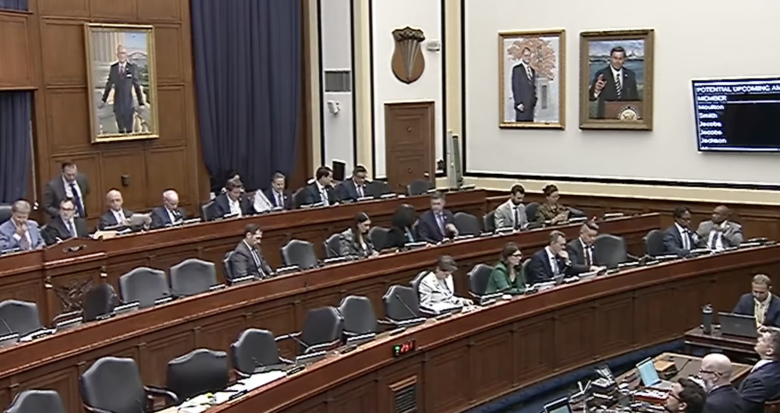
These aren’t minor procedural quibbles. Together, the two challenges signal genuine congressional skepticism about whether the Space Force’s current acquisition strategy is building the kind of resilient, threat-hardened infrastructure the U.S. military actually needs — especially as both China and Russia continue to develop and deploy capabilities specifically designed to neutralize American space assets. The fate of Space Force satellites in both polar and communications orbits now rests partly in lawmakers’ hands.
Saving a Northrop Grumman Program the Pentagon Wants Dead
The centerpiece of the committee’s space pushback is the Next-Generation Overhead Persistent Infrared Polar program — Next-Gen OPIR Polar for short — a Northrop Grumman missile-warning satellite system that has been in development since 2018. The Pentagon’s fiscal 2027 budget request proposes terminating it. The committee’s response was to authorize $415 million to keep it going.
The program’s purpose is specific and strategically important: these Space Force satellites operate in highly elliptical orbits, designed to monitor the polar regions and provide early warning of missile launches targeting the Northern Hemisphere. It’s not glamorous work, but from a military standpoint, the Arctic approaches are exactly where you’d expect a ballistic missile threat to originate. That’s been true since the Cold War, and it hasn’t changed.
So why does the Pentagon want to cancel it? The argument in the administration’s budget documents is that newer missile-warning architectures in low Earth orbit and medium Earth orbit have reduced the requirement for dedicated polar satellites. There’s some logic to that — the Space Force has been aggressively pursuing proliferated LEO constellations that can provide broader, more resilient coverage than traditional single-point satellites in higher orbits. But the committee clearly isn’t convinced the LEO/MEO constellation approach is mature enough to fill the gap left by retiring Space Force satellites in polar orbits.

What makes the cancellation particularly contentious is the sunk cost involved. The program’s total projected cost sits at approximately $3.4 billion, of which roughly $2.1 billion has already been spent. The Pentagon’s own budget includes $436 million in fiscal year 2026, largely to close out development activities. Walking away now means absorbing those costs without ever fielding the capability — a hard case to make when you’re looking at a potential adversary threat environment that U.S. Northern Command and U.S. Strategic Command have both flagged as serious.
Rep. Seth Moulton, the top Democrat on the Strategic Forces subcommittee, was direct about his reasoning. He argued that China and Russia have specifically demonstrated capabilities designed to degrade or destroy Space Force satellites, and that the committee’s position addresses areas the administration has underweighted. That framing matters — this isn’t just a procurement argument, it’s a threat assessment argument. Moulton and his colleagues are essentially saying: the Pentagon is too confident in a new architecture that isn’t fully operational yet, while cancelling a known capability that actually works.
The PTS-G Contract Doesn’t Look Like Proliferation
The second front in the committee’s challenge involves the Protected Tactical SATCOM-Global program, known as PTS-G. On May 22, the Space Force announced it had awarded a combined $437.6 million in contracts to Viasat and Intelsat — the latter now operating as part of SES — for secure X-band and Ka-band communications satellites. The program is structured as government-owned, contractor-operated, meaning the Space Force owns the spacecraft but commercial operators run them.
On the surface, that sounds fine. The problem is the number of Space Force satellites actually being bought: two. One from Viasat, one from SES/Intelsat.
This is where the committee’s frustration becomes pointed. PTS-G was sold as a proliferated architecture — a distributed network of satellites that would provide resilient, redundant tactical communications precisely because no single node would be critical. Pentagon budget documents described plans for what they called a “swarm” of four satellites. The committee’s own language confirms only two spacecraft are actually being procured under the current contracts. That’s a long way from a swarm.
The criticism cuts deeper than just satellite count. Lawmakers had supported PTS-G partly because its original design was meant to strengthen the defense industrial base — encouraging new entrants who could bring commercial manufacturing efficiencies and existing hardware into the military space supply chain. Buying just two Space Force satellites from two large, established players doesn’t really do that. It’s a more conventional procurement that happens to use the government-owned, contractor-operated wrapper.
The committee’s position, written into the NDAA markup, argues that procuring two satellites “runs counter to the goal of achieving resilience through larger numbers of lower-cost spacecraft.” That’s a pretty clean articulation of the core tension in modern military space acquisition: the Pentagon keeps talking about disaggregation and proliferation as strategic imperatives, but actual procurement decisions don’t always reflect those priorities.
The committee has directed the Space Force to produce a report explaining how it plans to implement a resilient tactical SATCOM architecture consistent with PTS-G’s original objectives. Lawmakers also want options for accelerating procurement of additional single-band Space Force satellites to get to a more distributed architecture faster. That’s congressional pressure with teeth — it’s not just a complaint, it’s a demand for a plan.
GPS Oversight Gets a Rethink
Beyond the two satellite program fights, the NDAA markup also takes aim at how the Pentagon manages its positioning, navigation, and timing enterprise — the broader ecosystem of systems and infrastructure built around GPS. It’s a quieter issue than missile-warning satellites, but arguably just as consequential. Nearly every aspect of modern military operations, from precision-guided munitions to logistics and communications, depends on reliable PNT infrastructure.
Moulton described the enterprise as “disjointed and underprioritized,