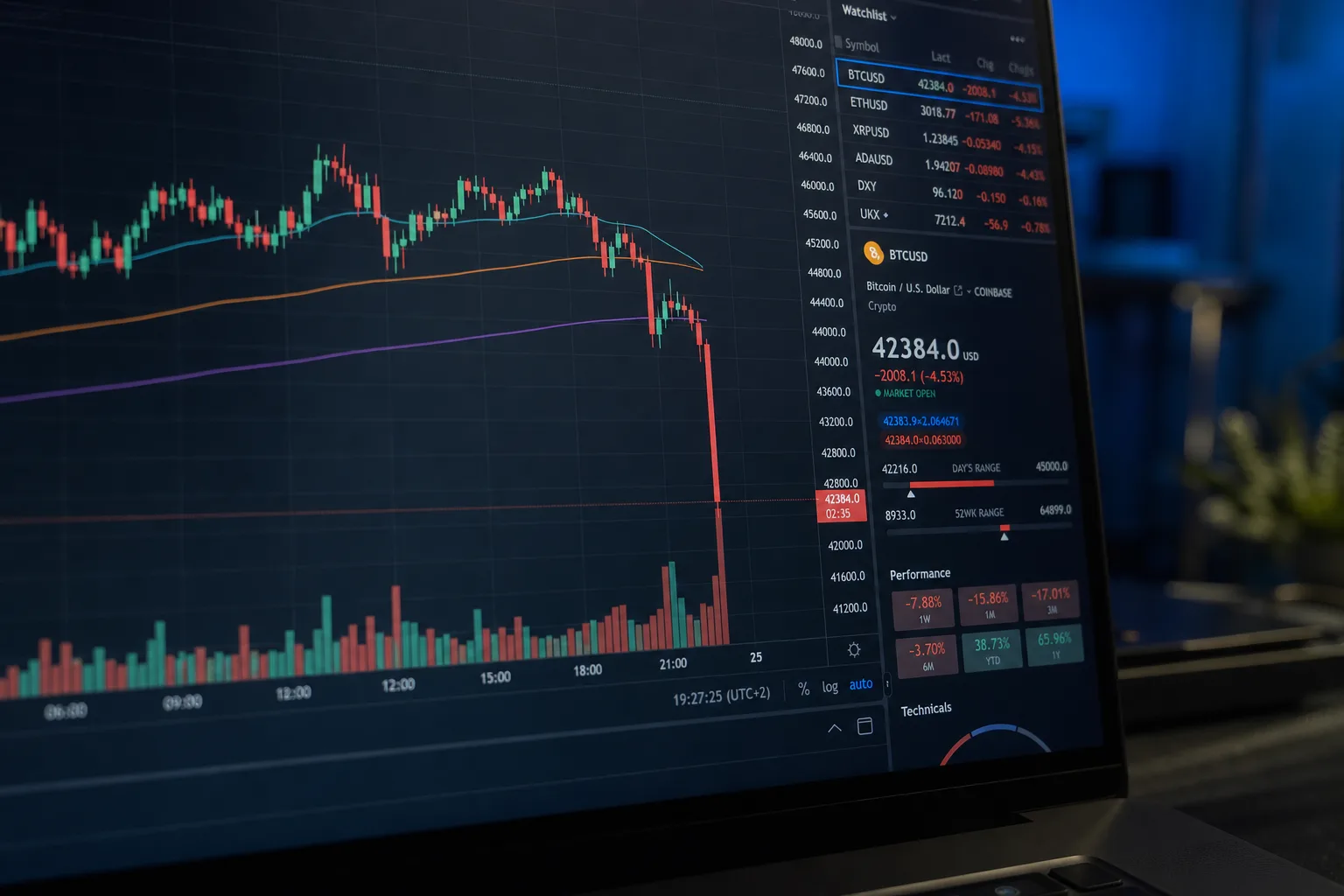
- The Bitcoin price drop pushed BTC below $60,000 for the first time since 2024, now down over 52% from its all-time high.
- Strong US jobs data — 172,000 new roles in May — has killed rate cut hopes and accelerated the Bitcoin price drop.
- A critical Zcash security flaw that may have allowed unlimited ZEC minting sent that coin down 40% in 24 hours.
- US spot Bitcoin ETFs snapped a 13-day outflow streak on Thursday, adding $3 million — a small but notable reversal.
Table of Contents
The Bitcoin Price Drop That’s Shaking the Market
The Bitcoin price drop that’s been building all week finally broke through a major psychological floor on Friday, with BTC falling to $59,909 — its lowest level since 2024. That’s a 6% slide in a single day and an 18.5% collapse over seven days. For a market that had been celebrating fresh all-time highs just months ago, the speed of the reversal is striking.

To put the scale of the damage in context: Bitcoin hit an all-time high of $126,080 last October. It’s now more than 52% below that peak. That’s not a correction — that’s a bear market by any conventional definition, regardless of how many Twitter accounts are still calling for $200K by year-end. The Bitcoin price drop of this magnitude hasn’t been seen since the last major cycle downturn.
The pain isn’t limited to Bitcoin. Ethereum is down 23% on the week, trading around $1,555. Solana has shed 22% over the same period, sitting at $63.75. When the largest assets in crypto fall this hard, the altcoin market tends to look even worse — and that’s exactly what’s playing out right now.
Why Jobs Data Is Bad News for Crypto
The proximate trigger for Friday’s leg down is a jobs report that, in most other contexts, would be considered good news. US employers added 172,000 jobs in May — roughly double what economists had forecast. Under normal circumstances, a strong labour market is cause for optimism. For crypto traders, it’s the opposite, and the resulting Bitcoin price drop has been swift and severe.
Here’s the logic: strong employment data signals a resilient economy, which gives the Federal Reserve less reason to cut interest rates. Lower rates are generally good for risk assets like Bitcoin because they make holding cash less attractive. Rate hikes, or even the threat of them, do the reverse. According to CME’s FedWatch tool, traders are now pricing in rate hikes before the end of the year — a scenario that was barely on anyone’s radar a few weeks ago.
Nicolai Søndergaard, a research analyst at crypto analytics firm Nansen, put it plainly:
“Strong jobs data kills the rate cut narrative. Bitcoin, already down 15% and sitting on uncleared leveraged longs, has no macro catalyst to recover into, and Middle East tensions are keeping risk appetite soft across markets.”
That phrase — “uncleared leveraged longs” — is worth unpacking. It means a significant portion of Bitcoin’s recent trading volume was built on borrowed money, betting on prices going higher. When the market turns, those positions get liquidated, accelerating the Bitcoin price drop in a self-reinforcing loop. It’s one of the structural reasons crypto moves faster and harder than most other asset classes.
Earlier Losses Had Different Causes
Friday’s macro-driven Bitcoin price drop didn’t happen in a vacuum. Earlier in the week, two separate developments had already put the market on edge. First, Bitcoin ETFs were bleeding cash — institutional money was walking out the door after a period of significant inflows that had helped push BTC to those record highs last autumn.
Second, and perhaps more surprising, Strategy — the firm formerly known as MicroStrategy and arguably Bitcoin’s most famous corporate evangelist — made its first BTC sale since 2022. For a company that has built its entire identity around accumulating and holding Bitcoin, selling any amount sent a signal the market didn’t want to receive. The combination of ETF outflows and a Strategy sell was enough to put cracks in the bullish narrative before the jobs data delivered the heavier blow.

On the ETF front, though, there’s a small but meaningful data point to hold onto: US spot Bitcoin ETFs broke a 13-day outflow streak on Thursday, pulling in just over $3 million in fresh investment. It’s a rounding error compared to the billions that have left those funds over recent weeks — and it hasn’t done anything to arrest the Bitcoin price drop — but a streak ending is a streak ending. Whether it marks a genuine floor in institutional sentiment or is simply noise in a volatile period remains to be seen.
The Zcash Vulnerability Is a Different Kind of Problem
While macro headwinds explain most of what’s happening to Bitcoin and Ethereum, Zcash’s collapse this week is a separate story — and potentially a more troubling one for the broader industry. ZEC, the native token of the privacy-focused Zcash network, has crashed more than 40% in 24 hours after developers disclosed a critical security vulnerability. The Bitcoin price drop has naturally dominated headlines, but the Zcash situation adds a layer of protocol-level fear to an already fragile market.
The flaw, which has since been patched, theoretically allowed for the minting of an unlimited number of ZEC tokens. What makes the disclosure particularly uncomfortable is what came alongside it: developers admitted they cannot currently determine whether the exploit was ever used. The reason? Zcash’s core privacy architecture — the very feature that makes it attractive to its users — also makes it impossible to audit whether fraudulent coins were created.
That’s a genuinely difficult position to be in. Zcash built its reputation on cryptographic privacy, using zero-knowledge proofs to shield transaction details from public view. That same opacity now prevents the team from giving the market any certainty about what happened. It’s the kind of disclosure that invites worst-case assumptions, and the price action reflects exactly that.
AI-Driven Exploit Discovery: The Fear Beneath the Fear
There’s a secondary anxiety running through the industry this week that isn’t fully showing up in price charts yet. The Zcash incident has renewed concerns about the security of blockchain protocols more broadly — and specifically, about whether increasingly capable AI models could be used to identify exploitable vulnerabilities in major networks before developers find and patch them.
It’s not a hypothetical. Security researchers have already demonstrated that large language models can assist in identifying smart contract weaknesses and protocol-level bugs. As those models get more powerful, the attack surface for every blockchain project — including the ones with market caps in the hundreds of billions — widens. The Zcash situation is a live example of what happens when a critical flaw surfaces in a network whose design makes the damage assessment nearly impossible. In a market already reeling from the Bitcoin price drop, fresh security fears are the last thing sentiment needs.
Whether that fear translates into sustained selling pressure across other privacy coins or smart contract platforms depends largely on how the Zcash situation resolves over the coming days. But it’s now a variable that serious crypto investors can’t ignore.
Stocks Are Hurting Too — This Isn’t Just a Crypto Story
It’s worth stepping back to note that Friday’s risk-off mood isn’t confined to digital assets. The Nasdaq is down 2.5% since open. Nvidia shares have dropped around 4.5% — notable given NVDA has been one of the market’s most closely watched bellwethers through the AI boom. When Nvidia sells off, it tends to signal broader nervousness about tech valuations.
Crypto-adjacent stocks are taking an even harder hit. Strategy (MSTR) is down nearly 10% on the day — an almost mechanical response to the Bitcoin price drop, given the company holds tens of thousands of BTC on its balance sheet. Coinbase (COIN) is off 8.4%, reflecting both the falling asset prices and the reduced trading volumes that typically accompany a market downturn. For Coinbase, fewer traders means less revenue, full stop.
The correlation between crypto and tech stocks has fluctuated over the years, but periods like this one tend to tighten it again. When risk appetite collapses broadly, everything speculative gets sold — and that category still includes most of the crypto market, regardless of how many institutional holders have come on board since 2020.
What Happens Next for Bitcoin
The immediate outlook for Bitcoin hinges on a few moving pieces. The macro picture won’t improve until there’s a clear signal from the Fed — and with jobs data this strong, that signal isn’t coming soon. The Zcash fallout needs to resolve cleanly, or the security concerns could metastasize into wider selling across privacy and smart contract tokens. And the ETF data needs to show sustained inflows, not just a one-day blip, before institutional confidence can be read as genuinely recovering.
The $60,000 level had been treated as a line in the sand by many traders. It’s now been broken. The next major support levels that technicians tend to cite sit in the $52,000–$55,000 range — still a meaningful distance below current prices, but no longer an abstract possibility given how quickly this week’s moves have materialized. Whether the Bitcoin price drop stabilises here or accelerates depends, more than anything else, on whether macro sentiment shifts — and right now, that’s not in crypto’s control.