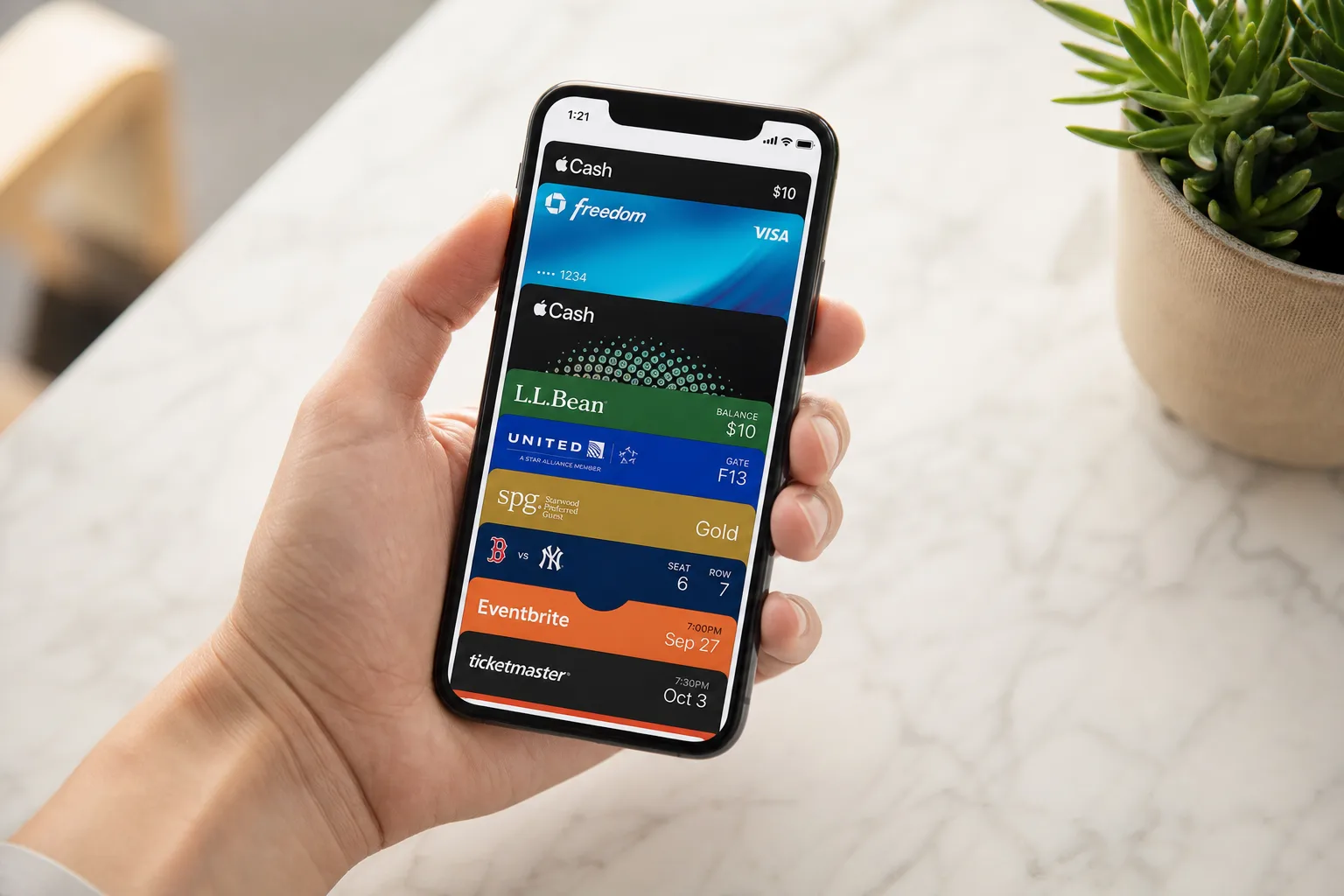
- Apple Wallet iOS 27 will let users convert physical loyalty and membership cards into digital passes directly in the app.
- Apple Wallet iOS 27 is also getting a bill-splitting feature that scans receipts and assigns items to different people.
- Three pass templates — Standard, Membership, and Events — will be available, each with distinct colour coding.
- The new bill-splitting tool ties into Apple Cash, Apple’s existing peer-to-peer payments platform.
Table of Contents
Apple Wallet iOS 27 Is About to Get a Lot More Useful
With WWDC just days away, the leaks are flowing — and one of the more practical ones concerns Apple Wallet iOS 27. According to reporting from Bloomberg, Apple is planning two significant additions to the Wallet app: a tool for creating your own digital passes from physical cards, and a receipt-scanning bill splitter powered by Apple Cash. Neither feature is flashy in the way a new chip announcement is. But for the hundreds of millions of people who use iPhone as their daily financial hub, both could genuinely change how they interact with their phone every day.
Create a Pass: Finally Killing the Physical Card
The first feature, reportedly called Create a Pass, is the one that’s been missing from Apple Wallet for years. The core idea is simple: if a business hasn’t bothered to integrate with Apple Wallet natively, you’ll now be able to build a digital version of their card yourself. Gym memberships, restaurant loyalty programmes, grocery store rewards cards, concert tickets — anything you’re still carrying around in physical form or tracking through a separate app could, in theory, get a proper home inside Wallet.
You’d access it through the existing + button in the Wallet app — the same one you tap to add a credit card. From there, Bloomberg says Apple will offer three distinct templates. Standard creates a general-purpose pass in orange. Membership goes blue and is clearly aimed at gyms, clubs, and subscription-based services. Events comes in green, built for concerts, sports fixtures, and anything with a date and a venue. Each template will support customisation — names, images, and visual styling — so you’re not stuck with a generic placeholder.
This is a smart move by Apple, and arguably an overdue one. The PassKit framework that powers Apple Wallet iOS 27 has existed since iOS 6, and for over a decade Apple’s approach has been to wait for businesses to adopt it. That strategy works well for airlines, major retailers, and banks — but it breaks down completely for the long tail of smaller operators who’ve never prioritised a Wallet integration. A local coffee shop, a regional gym chain, a community cinema — these are exactly the places where people still dig through their physical wallet.
The feature also has interesting implications for data privacy. Right now, if you want a digital loyalty card for a shop that doesn’t support Wallet, your options are usually a proprietary app (with all the tracking and notification permissions that comes with) or a third-party aggregator like Stocard. A user-created pass in Apple Wallet iOS 27 sidesteps both. The data lives locally on your device, not in some startup’s cloud infrastructure. For privacy-conscious users, that’s a meaningful difference.
Bill Splitting: The Feature Nobody Knew They Needed in Wallet
The second addition is arguably even more immediately useful for a specific type of user: anyone who regularly eats or drinks with other people. Apple Wallet iOS 27 will reportedly let you photograph a restaurant receipt, have the app parse the individual line items, and then assign each item to a specific person in your contacts. Once everything’s allocated — and the app factors in tax and tip automatically — it generates payment requests that everyone can settle through Apple Cash.
If that workflow sounds familiar, it’s because apps like Venmo, Splitwise, and Tab have been doing versions of this for years. What Apple is doing differently is pulling it into the payments infrastructure that iPhone users already have, without requiring everyone at the table to be on the same third-party platform. The catch, of course, is that Apple Cash is US-only — which means this feature, at least in its full form, won’t land globally at launch.
Still, for American users, the integration makes a lot of sense. Apple Cash already handles peer-to-peer transfers through Messages. Adding receipt scanning on top of that turns Apple Wallet iOS 27 into something approaching a proper shared-expenses tool — one that doesn’t require you to manually calculate who owes what after a weekend away with friends, or chase people down for their share of a group dinner bill. The fact that it handles tax and tip automatically is a small detail that will save a surprising amount of friction in practice.
What This Means for Apple’s Wallet Strategy
Zoom out and both features point to the same strategic direction: Apple wants Wallet to be the default financial layer of the iPhone experience, not just a place to store your contactless payment cards. The company has been building toward this for years — adding transit cards, ID support in select US states, Apple Card integration, and order tracking. But the Wallet app has always felt like it was missing the connective tissue that would make it truly indispensable.
Creating your own passes addresses the coverage gap. The bill splitter addresses the social payments gap. Together, they push Wallet meaningfully closer to being an all-in-one tool — the kind that makes you genuinely reluctant to switch platforms because so much of your daily financial life is wrapped up in it. That’s not an accident. It’s the same lock-in logic that drives every other Apple services decision, just applied to your wallet instead of your music library.
Whether the execution lives up to the concept is something we’ll find out at WWDC. Apple’s track record with financial features is mixed — Apple Cash remains US-only years after launch, and the Apple Card rollout was slower than expected internationally. But the underlying ideas here are sound, and if the implementation is solid, Apple Wallet iOS 27 could mark the point where Wallet stops being an afterthought and starts being a genuine reason people stay on iPhone.