

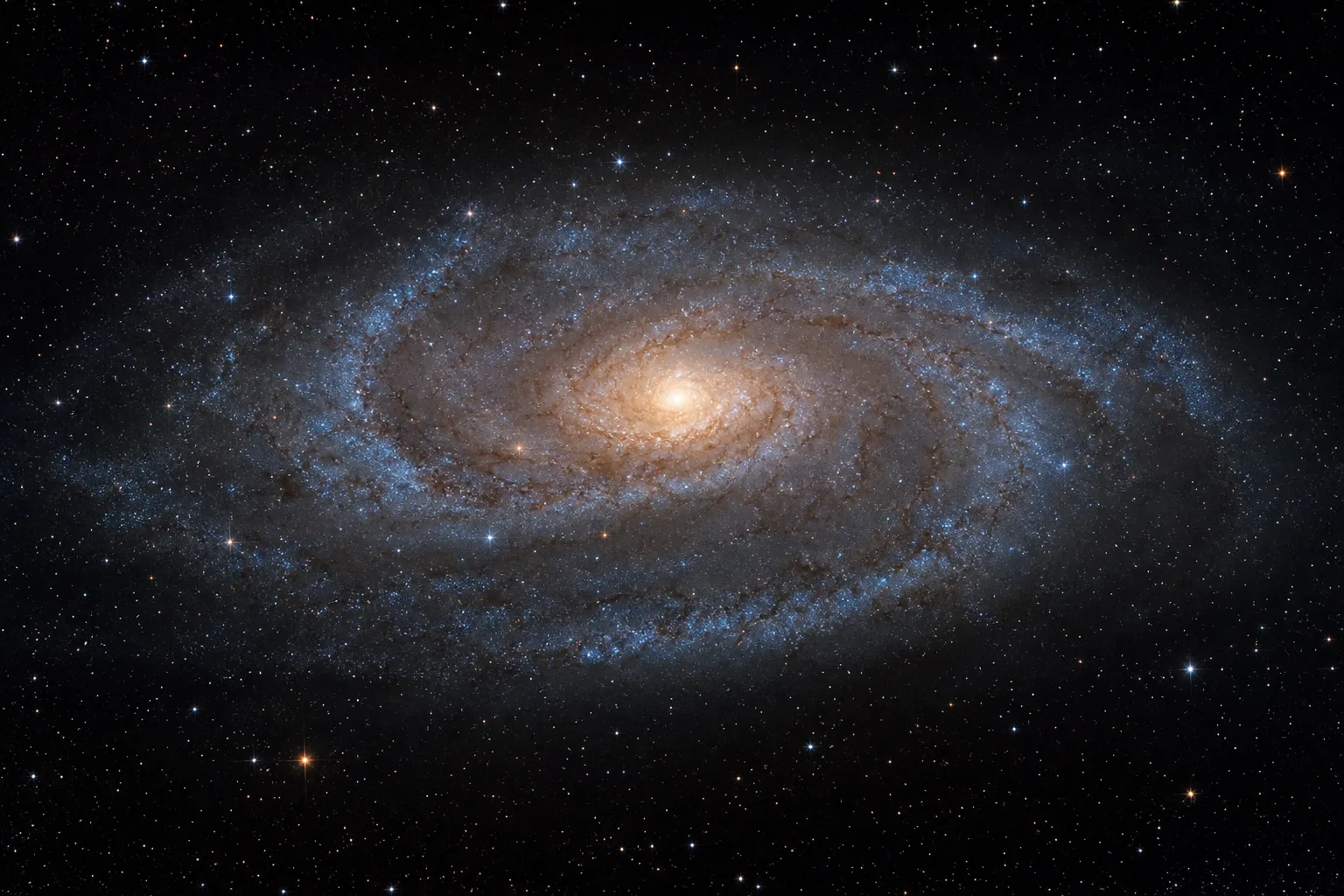
- Spiral galaxy W2246f has been mapped in detail for the first time using the MUSE instrument on the Very Large Telescope.
- The spiral galaxy W2246f contains both an old, quiescent core and an actively star-forming outer disk — an unusual combination.
- Deep spectroscopic observations published on arXiv in May 2025 are helping astronomers understand how this peculiar galaxy evolved.
- The findings add to a growing body of research showing that galaxies can sustain complex, mixed-age stellar populations simultaneously.
Table of Contents
Spiral Galaxy W2246f Gets Its Closest Look Yet
Astronomers have turned one of the world’s most capable spectrographs toward spiral galaxy W2246f — and what they’ve found is far more layered than anyone expected. Using the Multi-Unit Spectroscopic Explorer (MUSE) mounted on the European Southern Observatory’s Very Large Telescope (VLT) in Chile, a team of researchers conducted deep spectroscopic observations of this relatively obscure spiral galaxy, producing results detailed enough to reveal its internal structure in ways that broadband imaging simply can’t match. The findings, posted to arXiv on May 27, are already prompting a rethink of how this particular system came to look the way it does.
W2246f isn’t exactly a household name, even in astronomy circles. But that’s part of what makes this campaign interesting. It’s the kind of object that could easily be passed over — a spiral galaxy that, at first glance, doesn’t scream “look at me.” Look harder, though, and the story gets complicated fast.
What MUSE Actually Does — and Why It Matters Here
Before unpacking the results, it’s worth understanding why MUSE is the right tool for this job. Most telescopes take images. MUSE takes spectra — and it does it across thousands of points in the sky simultaneously. That means for every patch of a galaxy it observes, astronomers get a breakdown of the light by wavelength, which encodes information about what elements are present, how old the stars are, how fast they’re moving, and whether gas is collapsing to form new stars or sitting quietly in place.
For a galaxy like spiral galaxy W2246f, that granularity is everything. You can’t understand a galaxy’s evolutionary history from a pretty picture alone. You need the spectral fingerprints. MUSE provides exactly that, and the VLT’s sheer light-collecting power means it can do it even for relatively faint or distant objects where signals are weak.
This kind of instrument has transformed extragalactic astronomy over the past decade. Studies that once required multiple observing runs with different instruments can now be done in a single, coherent dataset. The efficiency gains are real — and they’re showing up in results like this one.
An Old Core, a Young Disk: The Dual Nature of W2246f
Here’s where the science gets genuinely interesting. The MUSE observations of spiral galaxy W2246f reveal what appears to be a galaxy with two distinct personalities living inside the same structure. The central region — the core — is dominated by older stellar populations. These are stars that formed long ago and have since settled into a kind of quiet middle age, burning steadily without the turbulent bursts of new star birth. In galactic terms, this core looks old and largely dormant.
The outer disk tells a completely different story. Across the disk of spiral galaxy W2246f, the spectroscopic data shows signatures of ongoing star formation — regions where gas is still condensing and new stars are being born. This isn’t a relic galaxy winding down. Parts of it are very much alive.
That combination — ancient core, active disk — is genuinely unusual, and it’s the kind of finding that forces astronomers to ask harder questions about the sequence of events that produced it. How did this galaxy’s center age out while the disk kept going? What drove star formation to persist in the outer regions while the core went quiet?
Inside-Out Quenching: A Pattern That’s Starting to Repeat
One leading interpretation is that W2246f is a textbook — or near-textbook — case of what astronomers call “inside-out quenching.” The idea is that star formation doesn’t switch off uniformly across a galaxy all at once. Instead, it shuts down first in the center, where stellar feedback, supermassive black hole activity, or simply the exhaustion of cold gas reserves can halt new star birth. The outer disk, further from these effects, keeps forming stars for much longer.
This model has been gaining traction across the broader field of galaxy evolution research. Observations of galaxies both nearby and at cosmological distances have pointed toward inside-out quenching as a common pathway — though the details vary considerably from system to system. What the MUSE data on spiral galaxy W2246f adds is another well-resolved, well-characterized data point that fits the pattern.
It also raises a follow-up question that astronomers will want to answer: what triggered the quenching in W2246f’s core in the first place? Active galactic nuclei — essentially supermassive black holes in feeding frenzies — are known to pump enormous amounts of energy into their surroundings, heating and dispersing the gas that would otherwise collapse into stars. Whether that mechanism is at work here is something future observations could help clarify.
Why Peculiar Galaxies Deserve More Attention
There’s a tendency in large-survey astronomy to focus analytical energy on the most common types of objects, because statistics are easier to build with bigger samples. Elliptical galaxies, run-of-the-mill spirals, well-behaved star-forming systems — these dominate galaxy catalogs and get the most attention from automated classification pipelines.
Peculiar galaxies like W2246f often slip through those nets. They don’t fit cleanly into standard categories, which makes them harder to process at scale but far more informative individually. They’re the edge cases that stress-test our models of how galaxies are supposed to work. When the data doesn’t fit the expectation, that’s where the actual discovery tends to live.
The decision to point MUSE — a resource-intensive instrument on a heavily oversubscribed telescope — at W2246f signals that the team behind this work saw something worth investigating. The arXiv results suggest that instinct was correct.
What Comes Next for Spiral Galaxy W2246f Research
The pre-print nature of this publication means the work is still moving through the peer-review process. That’s standard in astronomy — arXiv has been the field’s go-to venue for rapid dissemination since the early 1990s, and most serious observational results appear there well before formal journal publication. The underlying data and methodology will face scrutiny, but the broad strokes are unlikely to change dramatically.
More interesting is the question of what follow-up this work inspires. MUSE campaigns like this one often serve as pathfinders — they identify specific regions or phenomena that warrant targeted follow-up with higher-resolution instruments or at different wavelengths. Radio observations, for instance, could map the cold gas distribution in W2246f’s disk and give a clearer picture of the fuel supply driving ongoing star formation. Infrared data could help characterize dust and reveal star-forming activity that optical light can’t penetrate.
Spiral galaxy W2246f has gone from an overlooked system to an object with a research agenda attached to it. In a field where telescope time is among the most competitive resources on Earth, that’s a meaningful shift in status — and a sign that the peculiar, the complicated, and the hard-to-classify still have plenty to teach us about how the universe builds and rebuilds itself over cosmic time.
Frequently Asked Questions
What makes spiral galaxy W2246f unusual compared to other spiral galaxies?
Spiral galaxy W2246f is described as a peculiar spiral galaxy that has attracted astronomers’ attention for what it reveals about galactic evolution. The deep spectroscopic observations suggest it has an unusual nature, though the specific details of what sets it apart are still being studied.
What is the MUSE instrument and why is it used for this kind of research?
MUSE, the Multi-Unit Spectroscopic Explorer, sits on the Very Large Telescope and is used to perform deep spectroscopic observations of galaxies. Its capabilities make it well suited for studies like this one, helping astronomers gain new insights into how galaxies like W2246f evolved.
Where were the findings about W2246f published?
The results were published on May 27 on the arXiv pre-print server, meaning they had not yet undergone formal peer review at the time of release. Pre-print publication is standard practice in astronomy for sharing findings quickly with the broader scientific community.
What do the W2246f results tell us about how galaxies evolve?
The observations offer new insights into how W2246f evolved and shed more light on its nature, according to the researchers. The findings contribute to the broader scientific understanding of galactic evolution, though the specific conclusions about inside-out quenching are not detailed in the available source.

