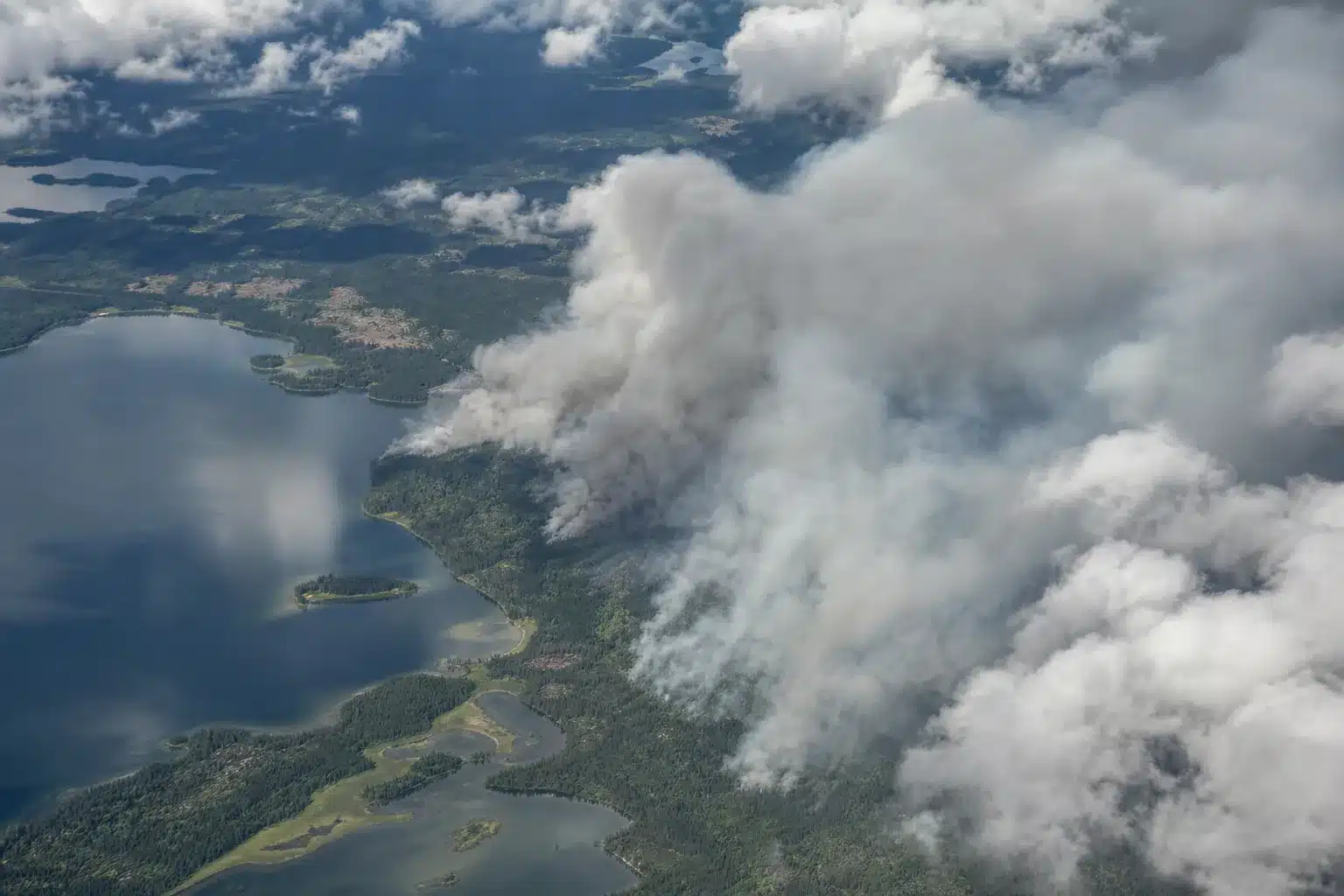
A satellite engineered to study ocean plankton has done something nobody explicitly asked it to do — and it turns out to be remarkably good at it. NASA’s PACE mission has captured wildfire smoke from space, delivering a striking image of smoke plumes curling across Canada’s Great Lakes region that raises serious questions about how we think about the boundaries of space technology.
- NASA’s PACE satellite captured wildfire smoke from space over Canada’s Great Lakes region using its Ocean Color Instrument.
- Detecting wildfire smoke from space wasn’t PACE’s primary mission — the satellite was designed to study Earth’s oceans and atmosphere.
- PACE’s hyperspectral imaging can identify dry vegetation and burn scars, making it a potential early-warning tool for fire risk.
- The mission captures data across hundreds of light wavelengths, revealing detailed plant stress and pigmentation data on Earth’s surface.
Table of Contents
The Image That Wasn’t Supposed to Exist
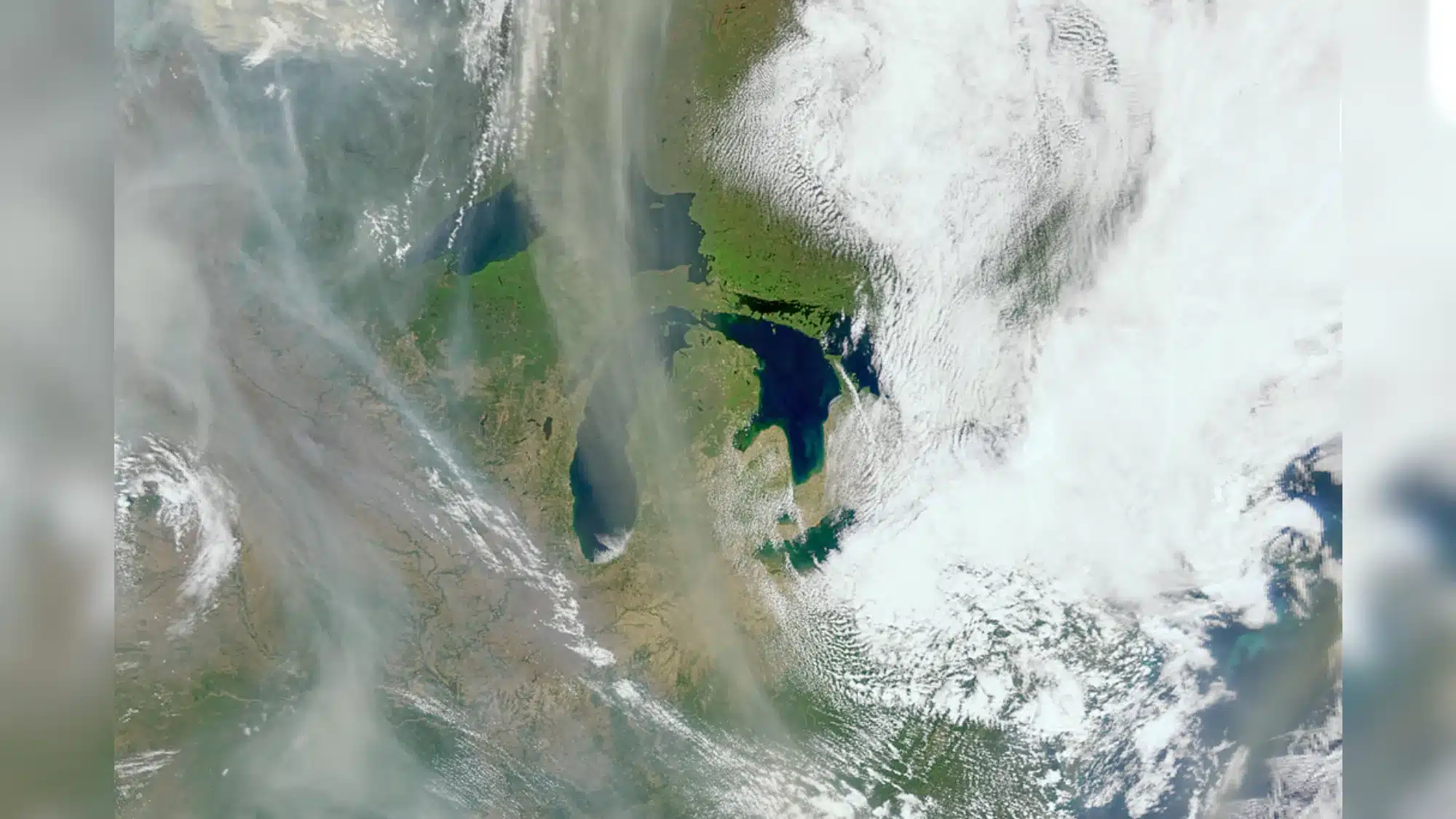
The photograph was taken in May of last year by the PACE satellite — short for Plankton, Aerosol, Cloud, and ocean Ecosystem — during what was, by any measure, a brutal wildfire season across North America. In the image, tendrils of gray smoke drift across the frame in stark contrast to the fluffy white cloud cover above the lakes and shorelines below. It’s an arresting visual, but the real story isn’t aesthetic. Seeing wildfire smoke from space with this level of clarity was not something mission planners had prioritized.
The instrument that took it, PACE’s Ocean Color Instrument, was built to peer into the sea. Its job is to detect subtle variations in ocean color that reveal the presence of phytoplankton, sediment, and other biological and chemical signatures beneath the surface. That it can also document a continent-scale wildfire event is, to put it plainly, a bonus nobody originally planned for.
What Hyperspectral Imaging Actually Means for Wildfire Smoke from Space
To understand why this matters, it helps to know what ‘hyperspectral’ actually means in practice. Most cameras — including the ones on many Earth-observation satellites — capture light in a handful of broad wavelength bands. Your smartphone camera sees red, green, and blue. Some satellites add near-infrared. PACE’s Ocean Color Instrument operates across hundreds of individual wavelengths, spanning visible light, near-infrared, and ultraviolet. That granularity is the difference between reading a headline and reading the full article.
When you’re looking at wildfire smoke from space across that many spectral channels, you’re not just seeing ‘gray stuff in the air.’ You’re potentially pulling apart the chemical composition of the aerosols, distinguishing smoke from dust or sea spray, and tracking how those particles interact with incoming sunlight. For climate scientists and atmospheric researchers, that’s not a side note — it’s the whole point.
But the implications extend further down to the ground. PACE’s instrument doesn’t just catch what’s airborne. It can detect burn scars — the charred footprints wildfires leave behind — and read the stress signatures of vegetation that hasn’t burned yet. Dry, moisture-depleted plants reflect light differently across specific wavelength bands. In theory, that means PACE could flag regions where vegetation is becoming dangerously parched long before anyone lights a match. Monitoring wildfire smoke from space is only one part of what makes this capability so valuable; the pre-ignition intelligence it offers may matter even more.
Scientists Are Already Paying Attention
Skye Caplan, the terrestrial lead for the PACE mission at NASA’s Goddard Space Flight Center in Maryland, has been direct about the opportunity here. ‘The PACE satellite observes land too, and does it really well,’ Caplan said in a statement. ‘There is so much to explore with a new hyperspectral data set.’
That phrase — ‘so much to explore’ — carries more weight than it might initially seem. NASA missions are expensive, tightly scoped, and justified to funders on the basis of specific scientific objectives. PACE was sold, essentially, as an ocean mission. The fact that its land-monitoring capabilities are turning out to be this capable means the scientific community is now sitting on a dataset it didn’t fully anticipate, and researchers are only beginning to figure out what questions to ask of it. The ability to observe wildfire smoke from space in such spectral detail is one of the more unexpected answers that has emerged so far.
This isn’t entirely without precedent. Landsat, the long-running USGS and NASA joint mission, was designed for broad land-surface monitoring but has become an indispensable tool for tracking deforestation, urban sprawl, glacier retreat, and yes, wildfire burn scars. The difference is that Landsat was at least designed to look at land. PACE’s terrestrial utility is genuinely incidental — and arguably more interesting for that reason.
Why Wildfire Monitoring Needs More Than One Tool
The timing of this discovery matters. Wildfire seasons globally are intensifying. The 2025 North American fire season — the one that produced the smoke in these images — forced mass evacuations across parts of Canada and generated air quality alerts that reached as far south as the US Midwest. The 2023 Canadian wildfire season was already the worst on record at that point; 2025 has pushed the discussion further. Each new season reinforces why the capacity to track wildfire smoke from space is becoming an essential part of the emergency-response toolkit.
Existing satellite tools for wildfire tracking include MODIS (aboard NASA’s Terra and Aqua satellites), the Visible Infrared Imaging Radiometer Suite on the NOAA-20 and Suomi NPP satellites, and the European Copernicus programme’s Sentinel fleet. Each has strengths and gaps. MODIS, for example, has been tracking active fire hotspots for over two decades, but its spectral resolution is coarser than what PACE offers. The Sentinel satellites offer good resolution but are tuned for different primary purposes.
PACE, with its hyperspectral depth, could slot into this ecosystem in a genuinely useful way — not replacing existing fire-monitoring infrastructure, but complementing it with a level of spectral detail that existing systems can’t match. Capturing wildfire smoke from space at this resolution adds a layer of atmospheric analysis that coarser instruments simply cannot replicate. The ability to assess vegetation stress at scale, before fires ignite, is particularly compelling. Pre-fire risk mapping has historically been a ground-up exercise: field surveys, local weather data, historical fire records. A satellite that can read plant stress from orbit across thousands of square kilometers simultaneously is a different kind of tool entirely.
The Broader Lesson About Satellite Versatility
There’s a broader point worth sitting with here. Space hardware is extraordinarily expensive to design, build, launch, and operate. The traditional model has been to build highly specialized instruments for tightly defined scientific purposes — and that specificity is part of what makes missions scientifically credible in the funding process. But PACE is quietly demonstrating that a well-designed sensor with genuinely broad spectral coverage can punch well outside its original weight class.
It raises an interesting design question for future Earth-observation missions: should agencies be building in more spectral flexibility from the start, precisely because the applications tend to exceed what anyone imagined at the proposal stage? The commercial satellite sector — players like Planet Labs, Maxar, and Satellogic — has been moving in this direction, offering clients hyperspectral data on demand. But government science missions have been slower to embrace that flexibility, partly because it complicates the scientific justification process. The prospect of routinely imaging wildfire smoke from space as a secondary mission output is exactly the kind of unanticipated dividend that makes the case for broader spectral design.
PACE’s wildfire smoke imagery might be the most visible argument yet for rethinking that approach. A satellite watching the ocean just handed wildfire researchers a dataset they didn’t know they needed. Observing wildfire smoke from space was never in the mission brief — and yet here we are. That’s not a flaw in the mission plan — it’s an advertisement for building sensors broad enough to surprise you.
Frequently Asked Questions
How does NASA’s PACE satellite detect wildfire smoke from space?
PACE uses its Ocean Color Instrument, which performs hyperspectral imaging across hundreds of wavelengths of visible, near-infrared, and ultraviolet light. This allows it to distinguish wildfire smoke plumes from ordinary cloud cover, and also identify burn scars and stressed vegetation on the ground.
What was the PACE satellite originally designed to do?
PACE — which stands for Plankton, Aerosol, Cloud, and ocean Ecosystem — was built to study Earth’s oceans and atmosphere, not wildfires. Its ability to monitor land is a secondary capability that scientists are only now beginning to explore in depth.
Can PACE help predict where wildfires might start?
Potentially, yes. PACE’s hyperspectral data can reveal how stressed, dry, or moisture-depleted vegetation is across Earth’s surface. That kind of fine-grained detail could help scientists and fire agencies flag high-risk areas before a fire actually ignites.
When did PACE capture the wildfire smoke image over Canada?
The image was taken in May of last year, showing swirling smoke plumes from major wildfires over the Great Lakes region of Canada. It was captured by PACE’s Ocean Color Instrument as part of the satellite’s ongoing Earth observation work.